Building a Modern Vending Machine Empire
Two years ago, an Altea member told me she was getting into the vending game. Today she runs 30+ smart machines across LA.
Welcome to the Alts Sunday Edition 👋
Japan is the spiritual home of the vending machine. So when I flew to Tokyo last month for our Altea investor trip, I expected to be dazzled.
And sure, the machines are everywhere. On every corner, in every train station, outside every temple.
But honestly, I was underwhelmed. To my surprise, lots of these machines still use coins. Most sell the same handful of drinks they sold twenty years ago. It all felt like the coolest thing about Japan...in 2005.
Turns out my gut was about right. Japan's vending machine count actually peaked at 5.6 million in 2000 and has been shrinking ever since. This year, beverage maker DyDo announced plans to pull 20,000 underperforming machines off the streets. (It turns out convenience stores have been eating their lunch for two decades.)
The funny part? The day before I flew to Tokyo, I saw what modern vending actually looks like. It was in a warehouse in Torrance, California, where an Altea member is building something quite special.
Today, we're going inside this modern vending business: how it was built, how the numbers actually work, and whether any of this is "passive income" like the internet promises.
A reader writes back
Two years ago, we ran a guest issue asking: Is America at peak vending machine? The verdict at the time was yes, probably. Too many machines, not enough good locations, limited locations with high foot traffic (unlike Japan).
One reader totally disagreed with us.
A few days after that issue was published, I got an email from Antares Vargas, a longtime reader (and now Altea member).
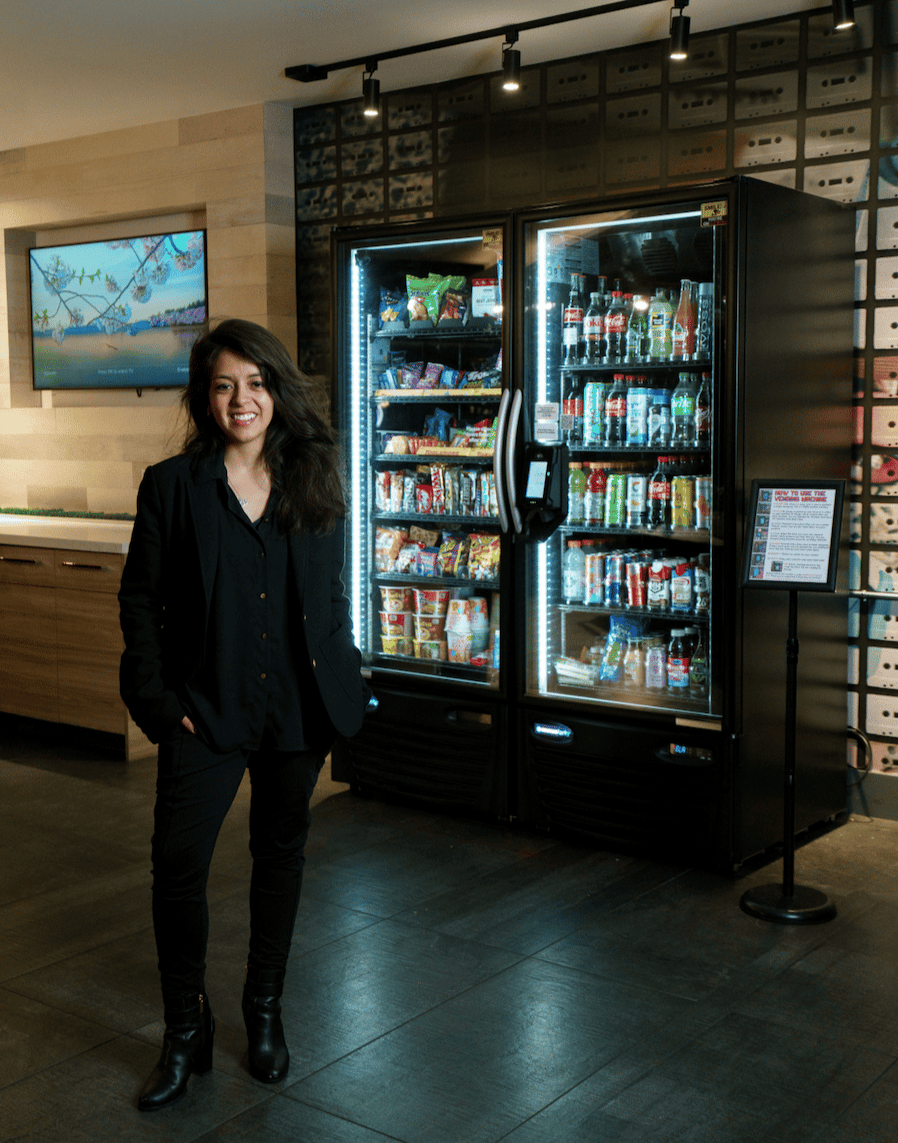
Antares had started her own vending business, Keep That Vending, three months earlier. She had exactly one machine, sitting outside the leasing office of a 140-unit apartment building in Marina del Rey.
And she had some corrections + notes on our math.
Her machines cost more than we'd estimated, she told us. But they also sold more units per day, and at higher prices too. Only one item in her machine was priced at $2. Everything else ran $3 to $6.
Also, the foot traffic analysis was kind of irrelevant, because her machines weren't on street corners, they were installed in apartment buildings. She never paid a building rent for a location. Instead, properties got a cut of revenue each quarter.
Oh, and her machines didn't have coils, either. They were a modern "grab & go" style. That last part really perked my ears up.
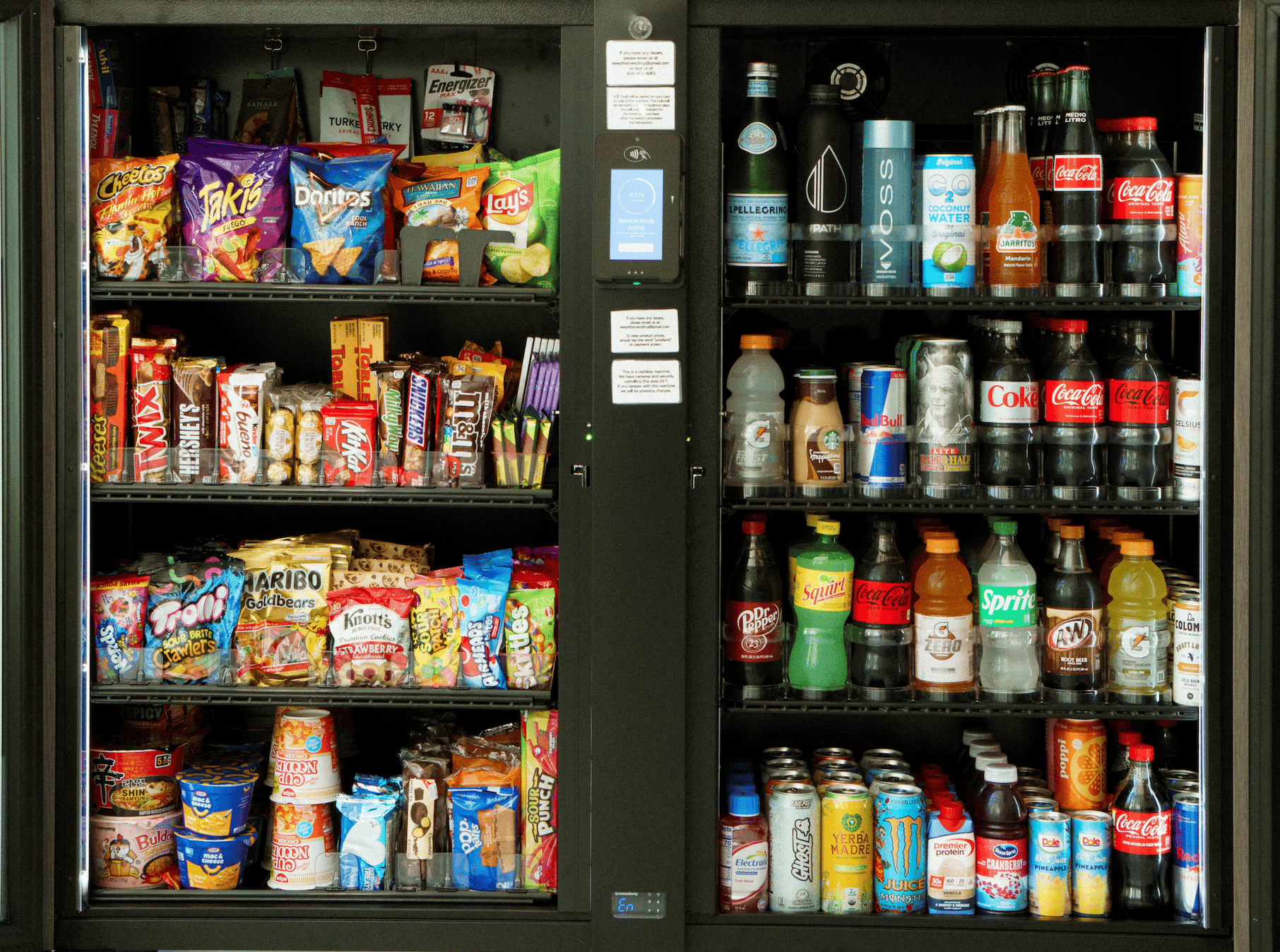
There's no keypad and no spiral. Just tap your card or phone, grab whatever you want, and close the door. Cameras scan what you took and charge your card automatically.
In other words, Antares was building something modern from day one.
I asked her to check back in later. Then life got busy, and two years went by.
Last month, I had the pleasure of running into her at our event in Los Angeles. She told me I really needed to come see the operation. They'd just moved into a new warehouse and grown quite a bit.
So I took a trip down to Torrance. We'll get to what I found in a moment.
But first, a little about how she got started.
How Antares got started
Antares didn't come from vending, she came from television.
In 2013, fresh out of USC, she called producer Narumi Inatsugu looking for work. An hour later, she had an unpaid internship. They've worked together ever since (he's now chief creative officer at JoySauce, an Asian-American streaming network).
Narumi had one rule for her fun "side quests": stick with entertainment until a side project started out-earning her day job. Then go for it.
When she started vending, she was an executive producer on a show for Discovery. By spring 2025, she was out-earning her entertainment salary, and went all-in.
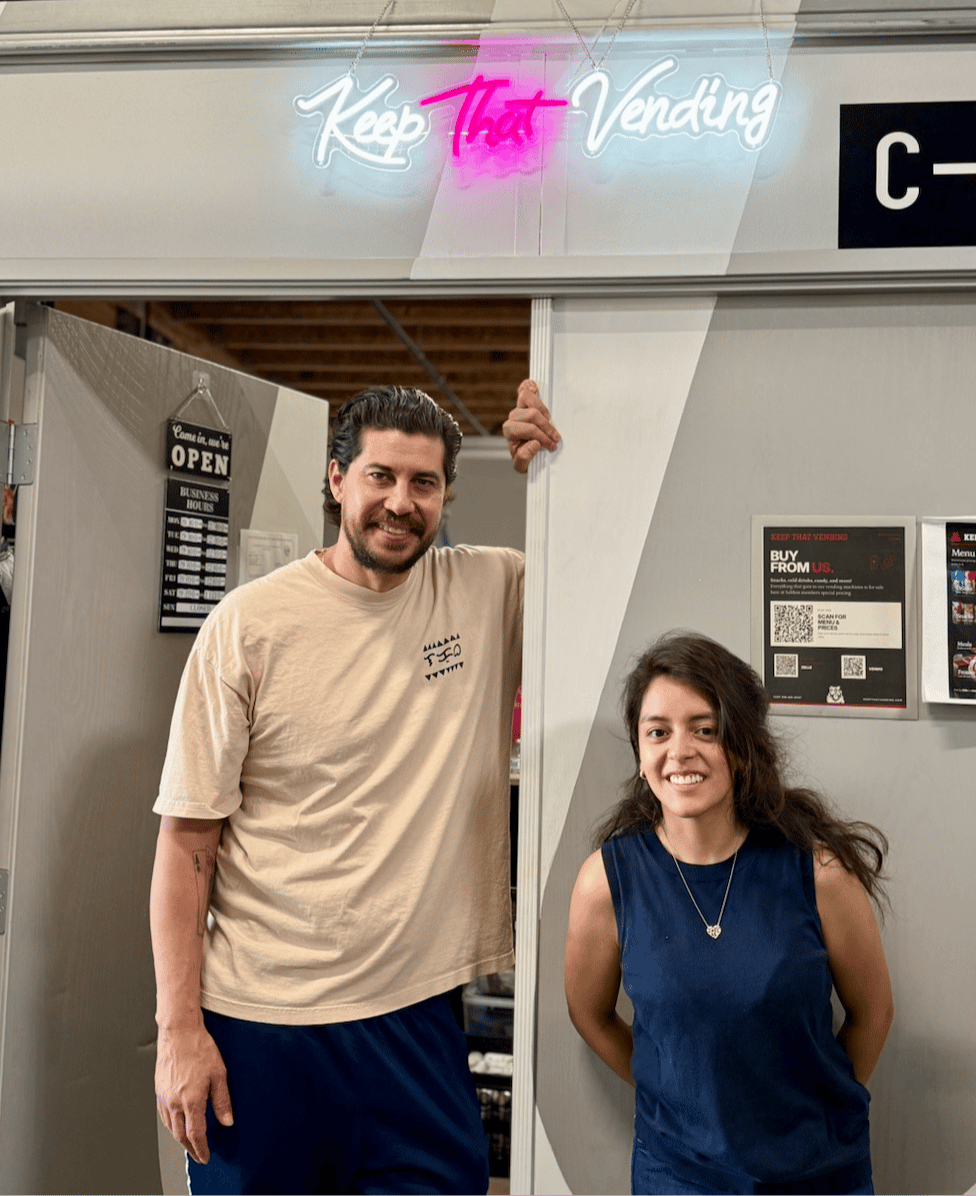
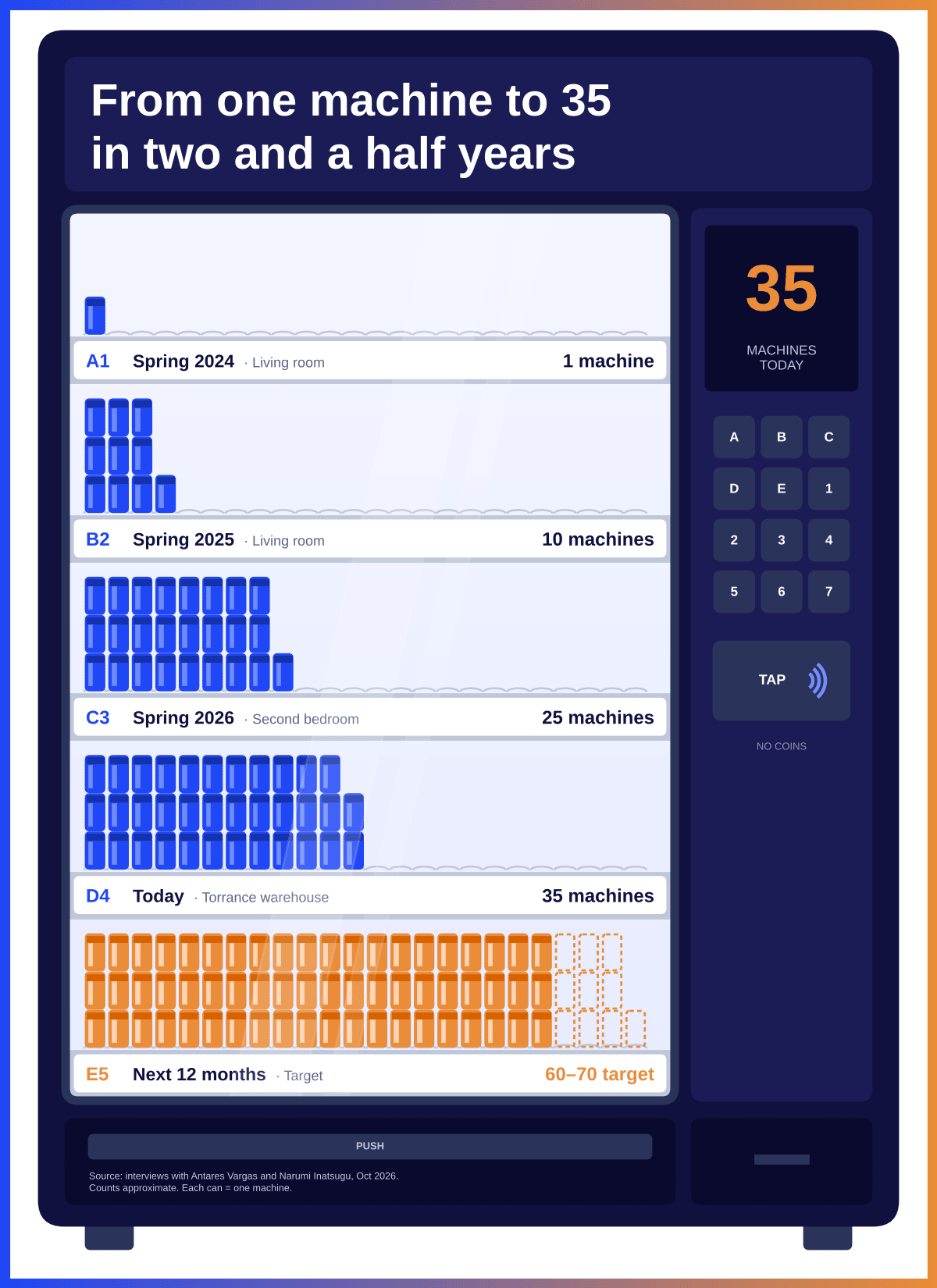
Fast forward to today, and Keep That Vending has 35 machines across Southern California, a warehouse, a team of operators and drivers, and is working to expand into the hospitality industry.
What a modern vending operation looks like
We all know the old machines. Punch in B4, watch the spiral turn, and pray your Snickers doesn't get stuck halfway.
Antares runs two very different formats.
The first is the smart machine we met earlier: a glass-door fridge that unlocks with a tap and charges you for whatever you take.
The second is the micro market. This is where a building gives her an entire room to design, usually near the leasing office or the gym, and she turns it into a tiny self-checkout store: fridges, a freezer, shelving, lighting, even a rug.
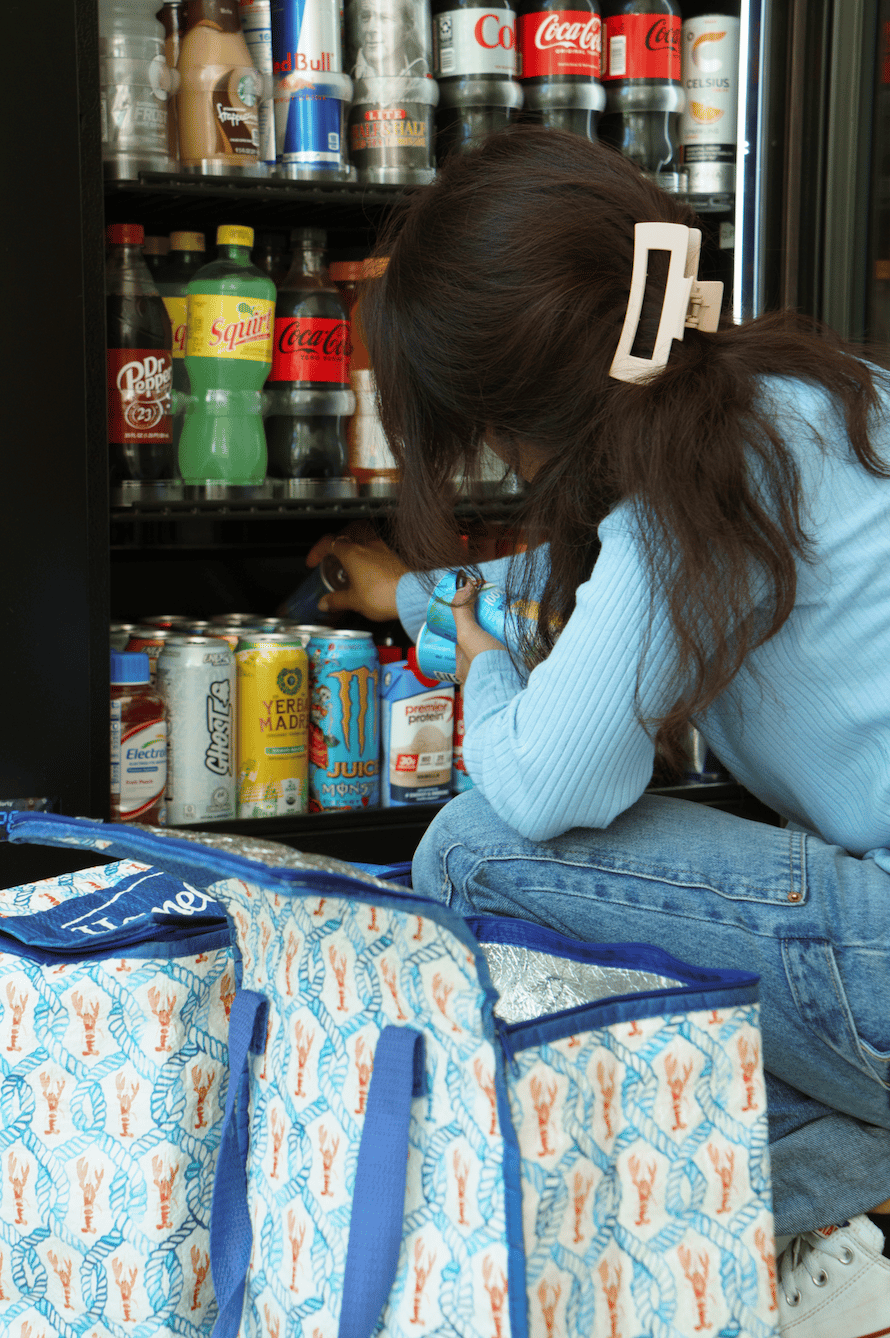
More room means more variety, including slow movers like toothbrushes and floss. But her top sellers are still the classics: energy drinks, Coke and Coke Zero, Hot Cheetos, and Takis.
Interestingly, micro markets run on the honor system. She has cameras in every one, but in California, theft under $950 is generally a misdemeanor, and filing a police report over a stolen bag of chips isn't worth her afternoon.
So in apartments she sticks mostly to smart machines, and saves micro markets for high-end buildings and hotels.
None of this hardware is cheap. A smart machine runs about $5,000 at the low end and up to $14,000 for the big ones. Even the spring-loaded "pushers" that slide products to the front cost around $500.
Delivery of the machines is curbside only. White-glove installation costs about $1,000 extra, so Antares skips it. All she needs is a dolly, a couple of hired guys, and a technique for walking a machine off its pallet that she now teaches to men much bigger than her.
Designing the space
This is where Antares' film background shows.
She and Narumi treat each location like a set. They swap out cheap fixtures, add good lighting and mirrors, and think about how the space feels.
She compares it to the mirror in a budget hotel versus one at the Four Seasons. One makes you wince, the other makes you look great, so you want to stick around.
In LA, that matters more than you'd think. You can be solidly middle class and still pay $4,000 a month for an apartment. She's ultimately competing against convenience stores & Uber Eats. Her customers hit up the lobby vending machine instead of ordering takeout.

The machines are the easy part, though. The hard part is everything behind them.
From living room to loading dock
Every vending empire starts in a chaotic but poetically over-packed apartment.
Antares placed her first machine in spring 2024. She hit 10 machines in year one, about 25 in year two, and 35 today, with eight more on order.
The living room was her warehouse. (Living with every snack you've ever wanted within arm's reach is exactly as dangerous as it sounds.) In March 2026, a second bedroom became the stockroom. Neither lasted long.
The problem was pallets. Costco Business Center (about 70% of her product) and Vistar (the other 30%, mostly specialty items like ice cream and frozen specialty meals) won't deliver to a residential address. Once you go from boxes to pallets, the apartment is over.
So this past September, she leased warehouse space in Torrance with a loading dock. Pallets roll straight off the truck, and her drivers load up and hit the road before traffic.
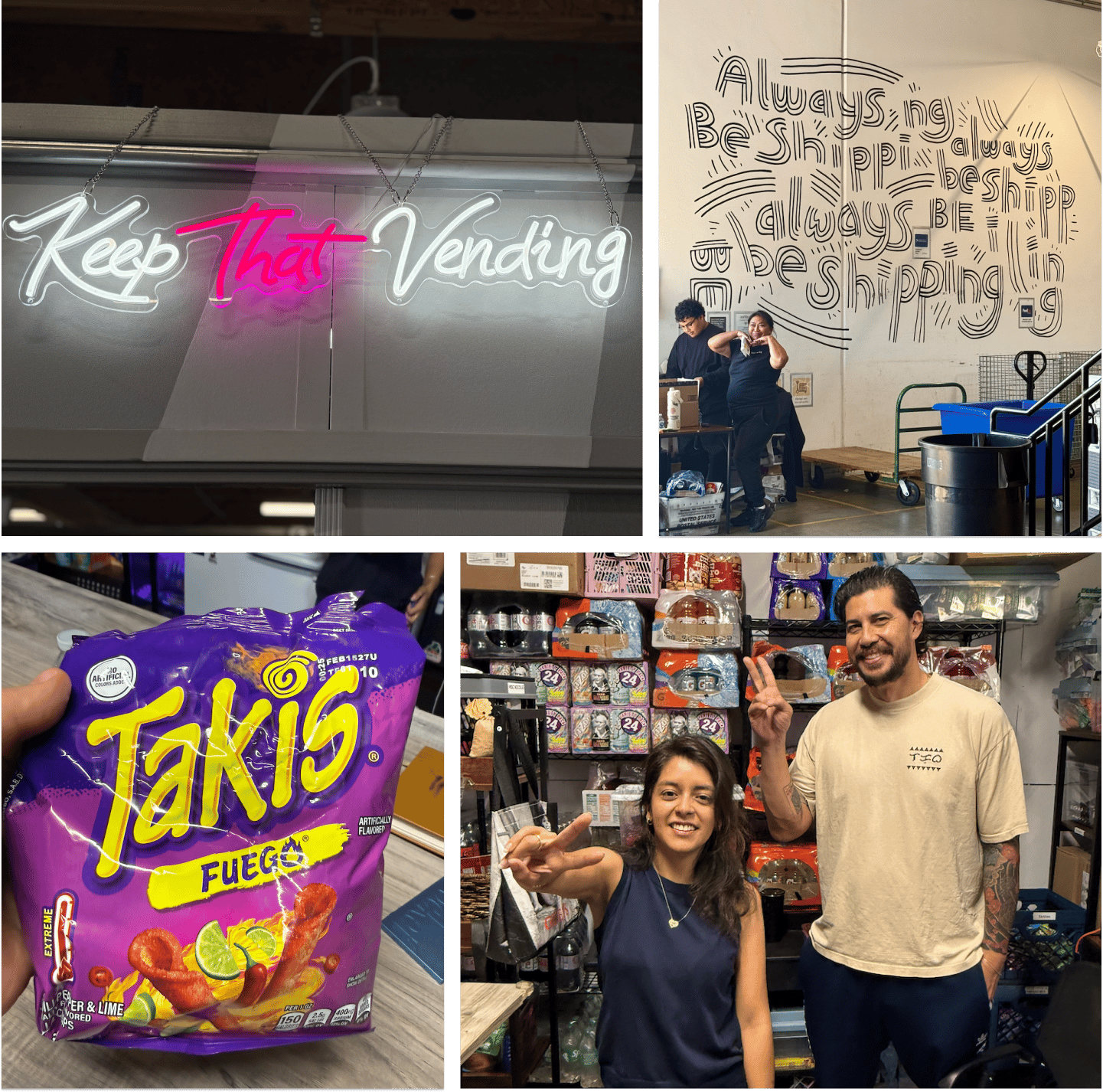
Clockwise from top left: 1) Keep That Vending, rebranded as KTV Industries. 2) They now operate out of Saltbox, a co-working/warehousing space for ecommerce/industrial firms. 3) Antares & Narumi in their warehouse. 4) I'd never had Takis before, apparently they sell like crazy (Southern California likes it spicy!)
She now stocks 300+ products, about 15x higher than a typical vending operation in the 1960s. But she buys only a few weeks' worth at a time, to save space and cash.
A warehouse meant she could finally buy by the pallet. It also gave her room to get creative about where her product came from.
A brilliant trade show trick
Each year, the vending industry gathers at the NAMA show, North America's premier annual trade event for the convenience services industry.
This past April, it came to Los Angeles. And here's where things get fun.
On the last day of the show, hundreds of exhibitors from across the country have to get their leftover stock and floor-model machines home. Shipping is expensive. Machines are heavy. Most would rather not bother.
Antares realized all this the year prior. So this year, she came prepared. She rented a U-Haul and parked it outside on the final day.
After four days of building relationships with product vendors, the vendors basically gave Antares and Narumi entire cases of their products for free! The goal was to get these new flavors and products in front of new customers.
But the machines were the real prize. Distributors had floor models they'd otherwise pay about $1,000 each to ship back to the factory. So Narumi made them an offer: "cash today, and we'll haul it ourselves."
They drove off with eight machines at a very good deal.

The free stock sold at pure profit. All eight machines are already out on location, earning nicely.
How the money flows
So who actually makes money when you buy a Red Bull out of a machine in your apartment lobby?
Let's start with who pays for what.
Decades ago, some vending operators charged buildings for the privilege of hosting machines. Later, beverage giants like Coke started placing machines for free in exchange for exclusivity.
Today the money flows the opposite way. The building pays nothing. Antares buys the machine, stocks it, services it and fixes it.
In return, properties take a commission on sales.
How big a cut? It varies building by building, and Antares would rather keep her own deals private. Per The Hustle, operators across the industry typically hand locations anywhere from 5% to 25% of gross sales, with busy, high-traffic spots landing at the top of that range.
Not every building is the right fit. From day one, her filter has been luxury apartment buildings with 150 or more units, or commercial buildings with at least 100 employees. Lately, she's aiming even higher: high-end condos and boutique hotels.
Getting in is mostly a sales job. She gets about 20 minutes with a property manager or hotel GM to make a first impression.
Put yourself in that manager's shoes for a moment. You want amenities residents love, because happy residents renew leases, and empty units cost you money. But you don't want another thing to manage, another headache.
Antares' job is to convince you she'll deliver the first without the second.
The numbers
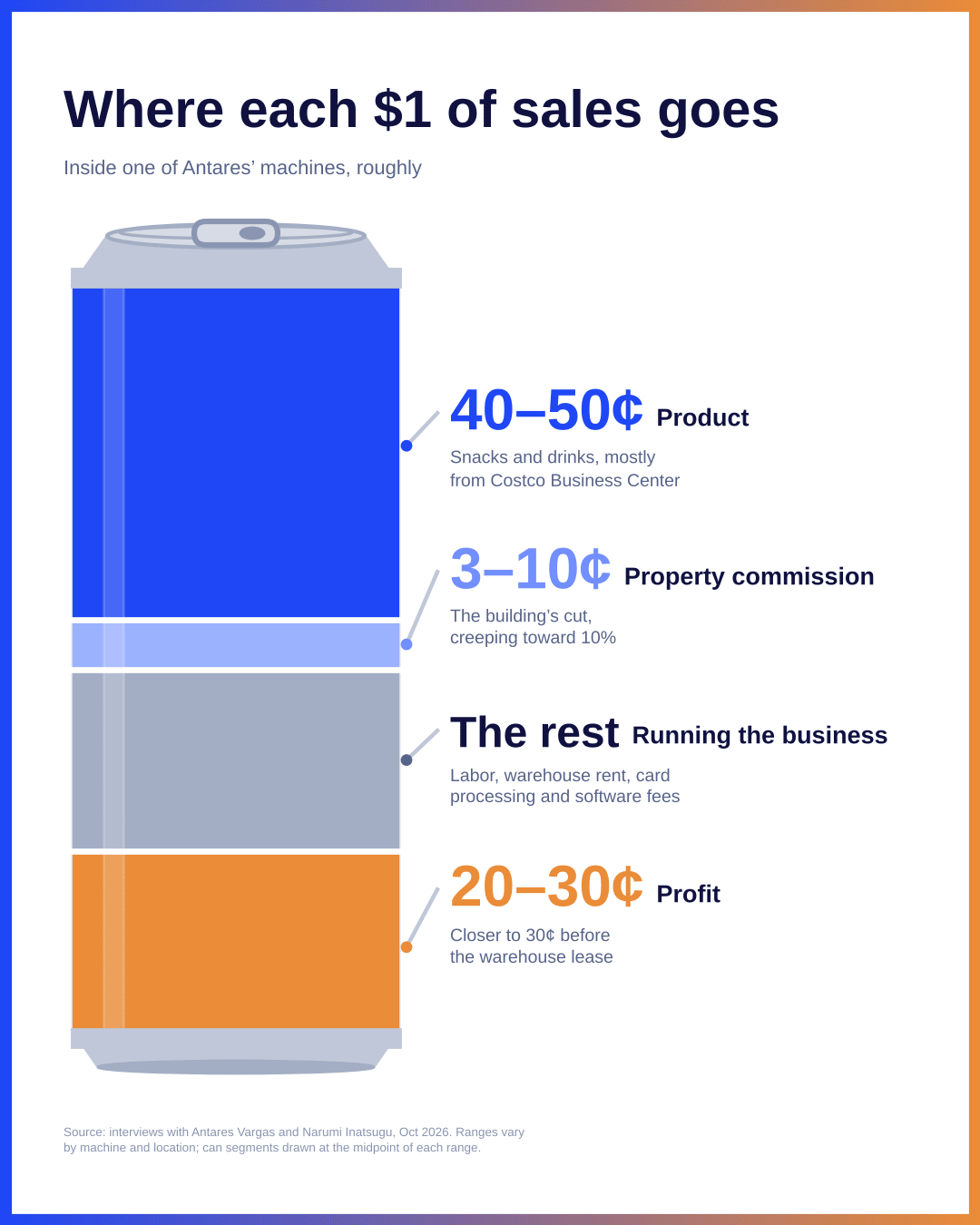
Here's roughly where each $1 of sales goes:
Product: 40 - 50 cents
Property commission: varies by building (5 - 25 cents industry-wide)
Everything else: labor, warehouse rent, and card processing and software fees on every machine
Profit: 20 - 30 cents
Product is the biggest slice, so that's another area where Antares gets clever.
One of her first accounts is a well-known entertainment production company. She loaded up their machine with ten rows of Coke Zero. (Hey, whatever sells!)
But she always saves 10% of her drink slots for brands nobody's heard of yet. Those slots double as a sneaky way to cut costs. Brands want their products in front of customers, so they send her free supply all the time.
But just because it's free doesn't mean it stays. New products get two weeks to prove themselves. If they don't move, they're out.
Margins used to sit right around 35%. Then came the warehouse, and rent. (Growing up has a price.) Today it’s closer to 30%.
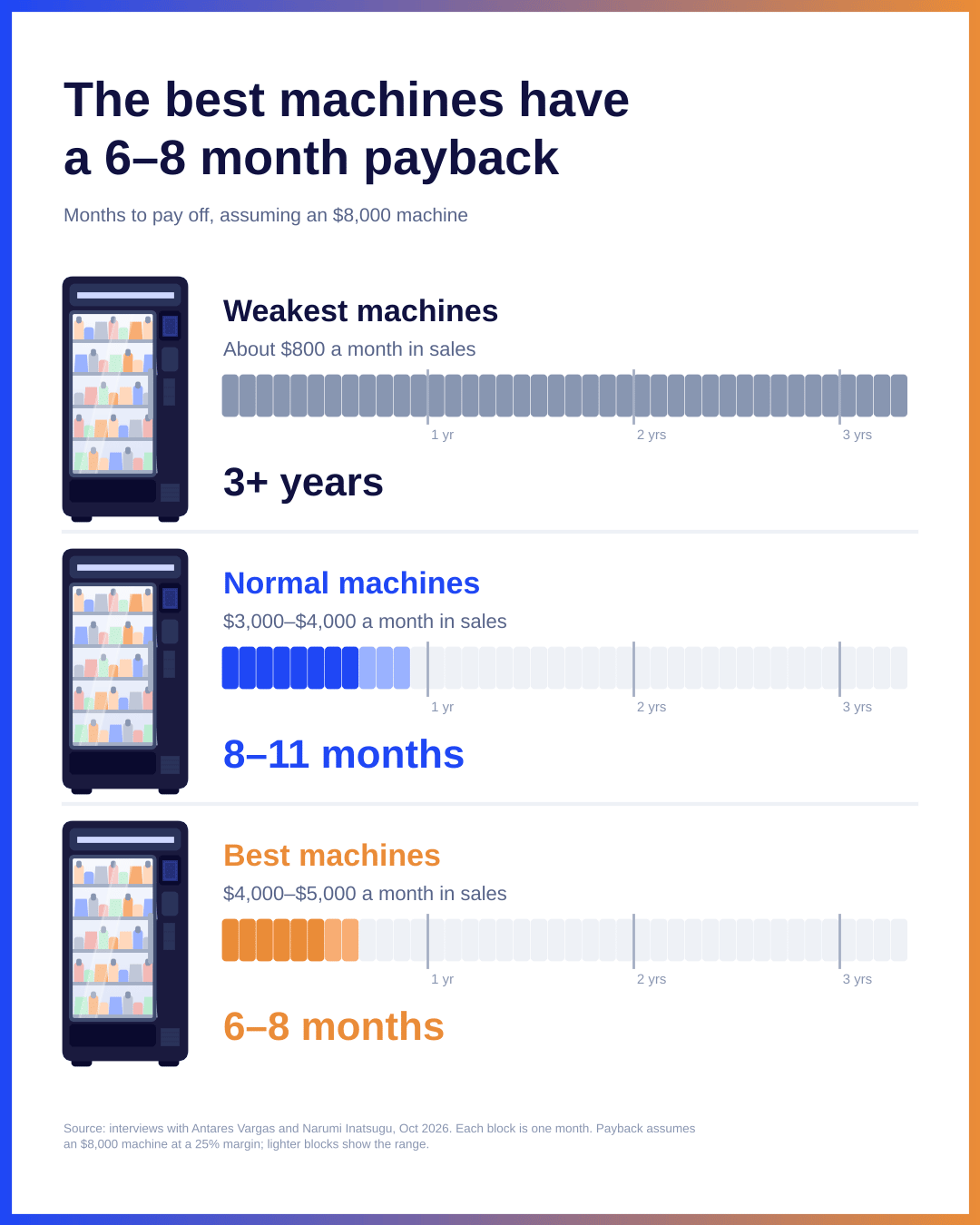
Her weakest machines do about $800 a month in sales. At a 25% margin, that's $200 a month of profit, so an $8,000 machine takes more than three years to pay for itself.
Her best machines do $4,000 to $5,000 a month. Same machine, same snacks, and it's paid off in six to eight months.
For context, the average vending machine in America brings in about $525 a month, per NAMA. (That's an industry-wide figure, separate from Antares' own numbers.) At a 25% margin, that same $8,000 machine would take more than five years to pay for itself.
What makes the difference? Location, and where exactly the machine sits.
In a building with lots of units, the best spot is next to the mailroom, the package lockers or the gym. Her very first machine (the 140-unit building in Marina del Rey) sits right next to all three. It produces between 10 to 14 transactions a day. The property manager shows it off on every tour.
Antares put her first machine on a credit card (for the points, naturally). Today she finances machines through the manufacturers.
Either way, she'd rather keep her cash and pay over time. The business has been profitable since the start. But the faster you grow, the more selective you have to become because not every location will be equally profitable.
Sales by referral
Antares doesn't do outbound sales anymore. And she doesn't really need to.
It started with the property manager at her first Marina del Rey building. His previous vendor had pulled their machine out without even telling him. He wanted someone he knew would show up, answer the phone and fix things fast.
He had connections and started sending her referrals. Nearly every account since has come the exact same way.
The real churn risk is management change. Managers also move between buildings constantly, and a new manager may want to bring in their own vendor, no matter how well Antares' machines are performing.
This is why Antares invests so much in relationships. The high-end property management industry in Southern California is surprisingly small. Antares estimates just 10-12 big players control the buildings she cares about, and most of them know her by name.
She also puts up all the capital for every machine, so she only takes locations that feel right for her business.
And once she's in, she delivers. She answers texts at midnight. She answers on weekends. In an industry where you could never reach anyone, that alone sets her apart.
The part nobody tells you
There's a popular myth that vending machines, laundromats and other "passive" businesses run themselves. Buy a few machines, sit back, collect the checks.
That's bogus.
The truth is, something is always broken. Antares starts most mornings checking which machines are offline. Usually at least one is. (A day without a problem text makes her suspicious.)
The biggest headache is connectivity. Smart machines need a cell signal to unlock, and LA's concrete buildings love to block it. No signal, no sale.
Then there's hardware. Compressors die. A door latch off by a centimeter won't lock, and machines have been emptied that way. One week, four machines' computers died at once.
Warranties cover parts, never lost sales. Spot a problem Thursday, fight for authorization through Friday, lose the weekend, and the part shows up Wednesday. Meanwhile, the machine wears a little sign: "I'm sick today."
Product fights back too. Chocolate melts (her European bars live in the warehouse freezer), and pastries get squished. Nobody wants a sad honey bun.
And every machine has a direct line for customer service. Charged for Hot Cheetos instead of Doritos? Refunded. Snack tasted off? Refunded.
Those people become fans for life.
What's next for KTV Industries
So far, we've mostly talked about vending machines. But there's another side to this industry: micro markets, the full self-checkout stores tucked inside a building.
That's where Antares is headed next, and the big opportunity is hotels.
Why the excitement? Volume. Hotel guests tend to buy a lot more than apartment residents. Narumi thinks a good hotel market could easily triple their monthly revenue.
Her goal for the next 12 months: double their machine count, and partner with a hotel chain.
She's also heading to Northern California. The challenges are exactly what you'd expect: Bay Area traffic, finding a central commercial address for deliveries, and above all, finding local people she can trust to keep her standards.
For now she's hiring through referrals, and plans to spend a couple of months up there getting it running.
A few more things on the list:
Soft liquor. Her smart coolers can sell alcohol, but California requires a liquor license for each location. She's exploring ways to leverage existing liquor licenses at the properties.
Trucks. The plan is Sprinter vans and eventually her own trucks, so moving a machine doesn't depend on someone else's schedule.
Social media. Few vending companies have an Instagram worth following. She wants hers to make you crave a bag of Ruffles. (She once ate a bag of pork rinds on top of a volcano in Iceland, for content.)
The business has also outgrown its name. It started as Keep That Vending. Narumi has since rebranded the umbrella as KTV Industries, with room for whatever comes next.
What about the long run? Antares is clear that she doesn't want a thousand machines.

The plan is solid accounts across Southern California, Northern California and Las Vegas. Bigger moves, like franchising, are a conversation for a couple of years from now. And they'd much rather borrow than give up equity.
(Who knows? Maybe the Altea community can help finance that growth someday!) 🤔
Closing thoughts
So, is any of this passive?
In my opinion, if vending were passive, anyone could do it, and there'd be no reason to pick one operator over another. The daily restocking, the carefully planned routes, the midnight texts, the manual refunds, the European chocolates in the freezer.
The list goes on. None of it is complicated. All of it is a pain.
People might read this story and feel inspired to start their own vending route. But understanding the fundamentals of business and knowing how to execute are everything here.
Passive? Not a chance. The snacks are the easy part. The hard work is the moat. 💪🏽
---
That's it for today.
A big thank you to Antares and Narumi for giving me a sneak peek into this world.
If you'd like to connect:
Keep That Vending website and Instagram
Antares Vargas in Altea and LinkedIn and IMDB
Narumi Inatsugu on LinkedIn and Instagram and IMDB
Until next time, Stefan
Disclosures
This issue was written and edited by Stefan von Imhof, with help from Antares. Antares was able to view it prior to publication.
Alt Assets, Inc has no holdings in any companies mentioned in this issue. It contains no affiliate links.
This issue is for informational purposes only and is not financial advice.