How venture investing split in half
Venture investing is bigger than ever. But the best opportunities are getting harder to spot.
Venture capital is having a record year. US startups raised $413 billion in the first half of 2026 alone, more than any full year on record.
But if you’re a startup CEO, you probably wouldn’t know it. Deal counts are down, fewer companies are making it to a Series A, and shutdowns have risen sharply.
How is it possible for venture to break records while many startups struggle? The answer is simple: right now, the label ‘venture’ is describing two very different markets.
At the top of the market, investors are chasing a handful of AI giants. Beneath them, the classic venture market is becoming more dispersed, with a widening gap between winners and losers.

At the top, venture looks like the transfer market, with everyone bidding for the same few stars. Below that, it looks more like a youth academy, where scouting matters more than spending.
Today, I’m looking at the forces pulling the venture market in two. I’ll also be discussing how Alumni Ventures is navigating this market with a curated approach to venture investing.
Along the way, we’ll see:
How the venture market is splitting between ‘mega VC’ and ‘classic VC,’
Why the venture market is seeing more failures alongside bigger winners,
How Alumni Ventures’ curated deal flow can help investors navigate a dispersed market,
And where the two halves of the venture market are heading next.
Click below to see AV’s latest investment opportunities – or read on to learn about the current state of the venture market.
Access Curated VC Deals →
Accredited investors are eligible to invest.
Let’s go 👇
Brian Flaherty is a financial writer based in Atlanta, Georgia. You can follow him on LinkedIn.
Classic VC vs mega VC: Venture’s two markets
Venture capital is no longer just one asset class. Instead, the market is splitting into two different categories, each operating with its own dynamics.
‘Classic VC’ is the model we all know and love. Investors write checks into young startups, trying to find the next big thing.
But today, much of the venture market works differently. Investors are putting huge sums into a small set of companies that are already phenomenally successful.
This type of ‘mega VC’ financing increasingly dominates venture, with much of the industry’s headline activity tied to a handful of deals:
In the first half of 2026, deals over $1 billion accounted for 73% of all venture dollars invested (up from 10% in 2021).
In the twelve months to July, venture’s ten largest deals accounted for 65% of the industry’s total deal value (up from 17% a decade ago).
The capital behind these deals is concentrating, too. Just three firms are responsible for raising nearly half of all VC capital this year.
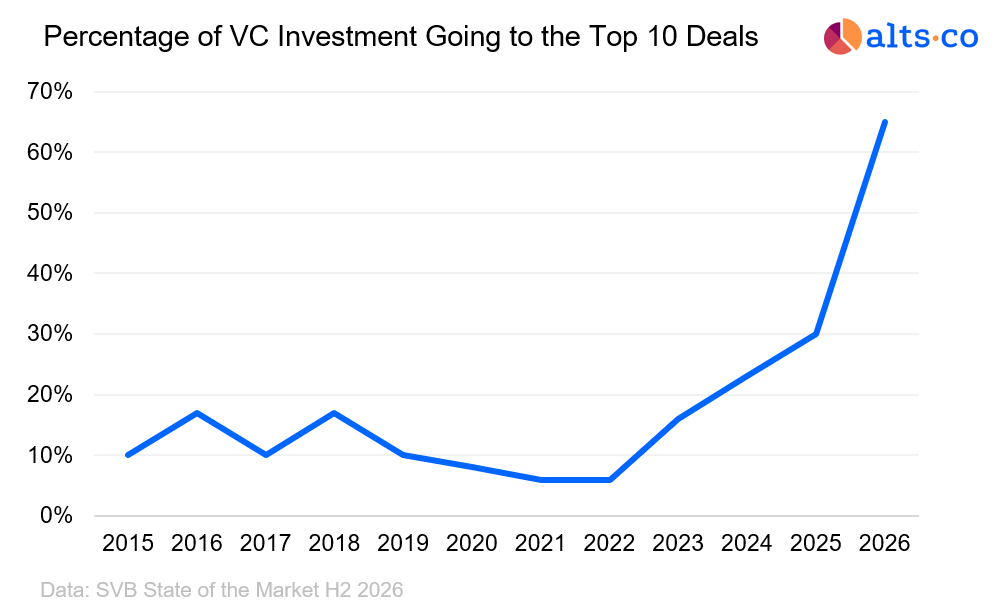
Venture’s growing concentration is a multi-year trend. Since 2022, megadeals have played an increasingly important role in the industry.
There are three reasons that mega VC financing is on the rise, each driving increased concentration at the highest levels of venture.
Reason #1: Frontier labs need lots of capital.
There’s one industry at the center of most VC megarounds: AI.
86% of all venture deal value in the first half of 2026 went to AI startups. OpenAI and Anthropic alone have raised over $200 billion in VC funding this year.
And it’s not just that investors are excited about AI. Training and deploying frontier models is enormously expensive – OpenAI is planning to spend $750 billion on compute through 2030.
Reason #2: The exit market has changed.
IPOs remain a key avenue for realizing value and generating liquidity. But today, companies are usually much older when they go public.
Before 2000, the median age of a company at IPO was about 8 years. That figure has drifted higher, climbing to 12 years in 2025.
For VCs under pressure to return liquidity to LPs, the incentive is clear: focus on later rounds and established companies where an IPO could be just around the corner.
Reason #3: Big funds need big deals.
The growth of megarounds partially reflects the growth of megafunds.
Today, there are about 20 VC firms with over $15 billion in assets under management. For a firm that size, a typical $10 million deal is just 0.07% of their capital.
Big funds need to make big deals. Smaller deals simply don’t move the needle on returns.

It’s no coincidence that OpenAI’s $122 billion round earlier this year saw participation from the world’s three biggest venture firms. For funds that size, deals need to be big enough to matter.
Put it all together, and you get a feedback loop: the biggest companies need the most capital, the biggest funds need somewhere to put it, and the IPO market increasingly rewards late-stage bets.
With so much capital flowing to the top, the math for everyone else has started to change. The early-stage market is becoming less crowded, but also less forgiving.
Classic VC: A changing market
The top of the venture market is concentrated in capital-intensive AI deals. But beneath that, classic VC is alive and well.
Thousands of startups raise early-stage rounds every year. Still, the path from seed to exit looks very different than it did a decade ago.
Graduation rates are slowing
Startups are taking longer to reach their next stage of funding, with many never raising a priced round at all.
In 2016, the average startup raising a $1 million seed round took 21 months to raise a Series A. By 2025, that average had climbed to 30 months.
And longer timelines are only part of the story. Historically, about half of startups that raised a $1 million seed round would raise a Series A. Today, fewer than 20% do.
This matters, because priced rounds are how investors learn what their companies are worth. Without another round, it becomes harder to tell which companies are working, and whether there’s a realistic path to an exit.
Failure rates are rising
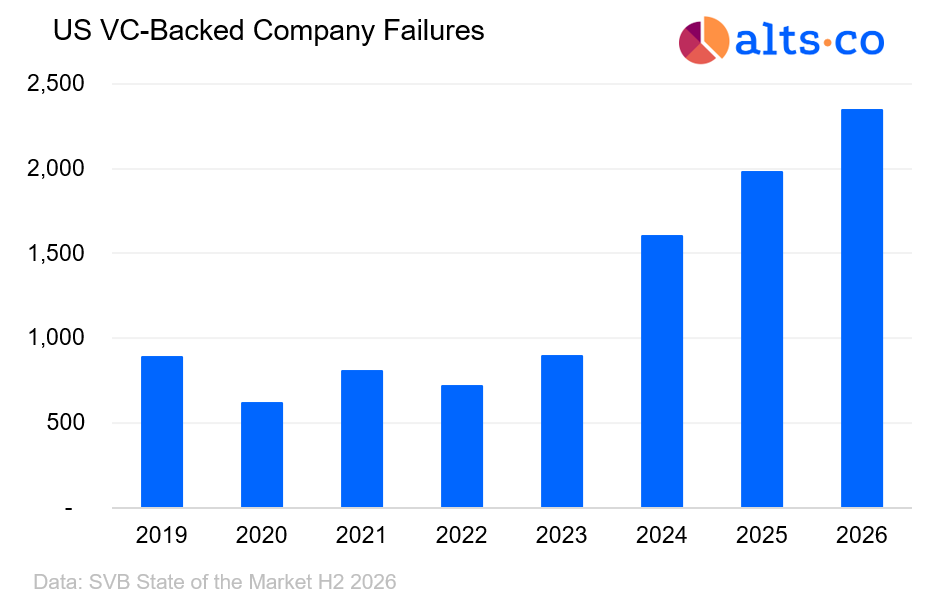
Not only are fewer startups graduating, but more of them are shutting down entirely. In 2026, 2,345 VC-backed startups have failed so far.
That’s a sharp jump from previous years. Before 2024, it was common to see total failures below 1,000 each year.
Winners are accelerating
With fewer startups graduating and more shutting down, you might think that classic VC is in decline.
But the situation is more complicated than that. Yes, success is getting harder. But for the startups that do succeed, the upside is bigger and arrives faster.
Valuations have accelerated for leading companies, with top-decile Series A startups valued at nearly 5x the median in Q1 2026. In fact, Lovable, Mercor, and Cursor have all beaten the previous record for fastest time to $100 million ARR.
Altogether, this data points to a market that can’t simply be labeled ‘good’ or ‘bad.’ Instead, classic VC is growing increasingly dispersed: the risk of backing a loser is higher, but the reward for identifying a winner has never been greater.
That makes deal selection an increasingly vital skill, and access to well-curated startups more valuable than ever.
Alumni Ventures: A gateway to classic VC
As megafunds chase the same few companies, Alumni Ventures continues to invest in the next generation of startups. AV seeks to back tomorrow’s leaders, not just today’s household names.

That doesn’t mean AV is limited to seed rounds. The firm invests across stages and sectors when the opportunity fits. What stays constant is the approach: disciplined selection based on rigorous analysis.
I discussed Alumni Ventures in depth earlier this year, and their model has only become more relevant since then. Here are the key points about how AV works:
Co-investment focus. AV doesn’t lead a startup’s investment round. Instead, the firm focuses on co-investing alongside established VCs, investing on the same valuation terms. This gives AV access to high-quality deals, leaning on the diligence of proven lead investors.
Expertise through volume. AV is consistently one of the most active venture investors in the US, ranked #3 by PitchBook for 2025 deal volume. This activity allows AV to spot patterns across sectors that a less-active firm might miss.
Deal-by-deal curation. AV’s syndicate model curates individual deals for investor consideration. This tailored approach puts investors in control, with each deal supported by AV’s own analysis. For investors who prefer a hands-off approach, AV also offers funds that invest across its deal flow.
The result is an approach that combines breadth with selectivity.
With so much of the market chasing the biggest deals, AV remains focused on quality. The firm curates which deals are brought to the platform, and investors get to pick which ones to back.
Explore Curated VC Deals →
Accredited investors are eligible to invest.
To see how this approach plays out across the market, let’s look at a few of the firm’s most interesting recent deals.
RegCell
RegCell is a biotech startup focused on cell therapy for autoimmune diseases. Founded in Japan, the company is seeking to commercialize immune therapy research that won the Nobel Prize in 2025.
Alumni Ventures participated in RegCell’s recent $44 million Series A round, which was complemented by a $22 million grant from Japan’s Agency for Medical Research and Development.
The deal was made possible by AV’s in-house biotech expertise, led by Senior Principal Luca Giani (a graduate of Harvard Medical School). In addition, AV has fostered relationships in Japan, recently opening an office in Tokyo.
This is what curation looks like in practice: specialized knowledge and local relationships allowing the firm to identify promising companies before they reach the wider market.
PicoGrid
PicoGrid is a defense startup building an integration layer for modern security systems. Its platform connects drones, sensors, and software from different vendors, acting as a hardware-agnostic operating system for defense.
Alumni Ventures first backed PicoGrid at the seed stage, then returned to participate in the company’s $45 million Series A this spring. PicoGrid recently received FedRAMP authorization, the gold standard for selling software to federal agencies.
With fewer startups making the jump from seed to Series A, the ability to identify (and double down on) the ones that do is increasingly valuable.
Thea Energy
Thea Energy is a nuclear fusion startup pursuing a leaner engineering approach than most competitors. The goal: clean, reliable power at a time when electricity demand is soaring.
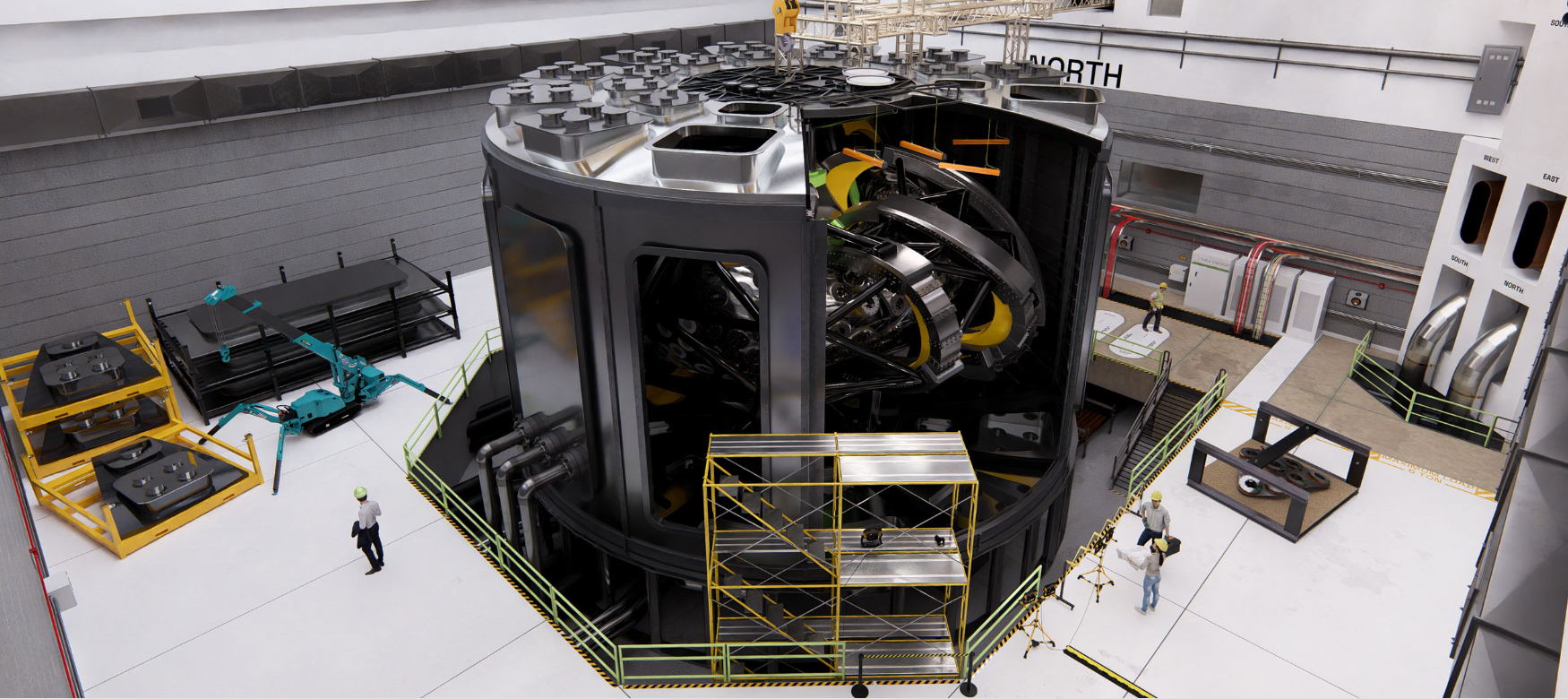
A rendering of Thea’s planned Eos facility. Thea’s approach depends on stellarators, machin that use twisted magnetic fields to hold plasma in place. Image: Thea Energy
Last year, Thea secured key awards from the US Department of Energy’s fusion energy program. Alumni Ventures has been an investor since Thea’s Series A, and recently joined the company’s $100 million Series B.
AV identified data center electricity demand as a key reason that Thea’s technology is so vital right now. Megarounds at the top of the market are accelerating opportunities further down – if you know where to look.
Where will the VC market head from here?
This split VC market isn’t going away. The drivers behind capital concentration at the top of the market are only getting stronger.
As a result, I expect to see increasing divergence between venture’s two segments. Mega VC will reward access to known winners, while classic VC will reward discovering new ones.
Mega VC: Betting on known winners
At the top of the market, everyone already knows who the winners are. Therefore, the goal is to access leading companies and invest at scale before an IPO.
SpaceX provides the clearest example of this dynamic:
In 2023, SpaceX’s Series J round raised $750 million at a $137 billion valuation. At this point, the company was already recognized as the leader in commercial spaceflight.
This summer, SpaceX went public at a $1.77 trillion valuation. Series J investors were rewarded for backing a proven company, not for finding a diamond in the rough.
And the pipeline of known winners with IPOs on the horizon is growing. Anthropic has already confidentially filed for an IPO, and OpenAI is expected to go public next year.
In fact, Wellington Management has argued that mega VC may increasingly deliver beta-like returns going forward. Winners tend to be priced like winners, so it’s hard to find an edge.
Classic VC: Searching for the unknown
Below the megarounds, the playbook looks different. Because outcomes are so dispersed, returns will depend less on scale and more on selection.
If mega VC is starting to look like beta, classic VC is where alpha still lives. In fact, small funds have posted the strongest median IRRs since 2010 (though also with the highest variance).
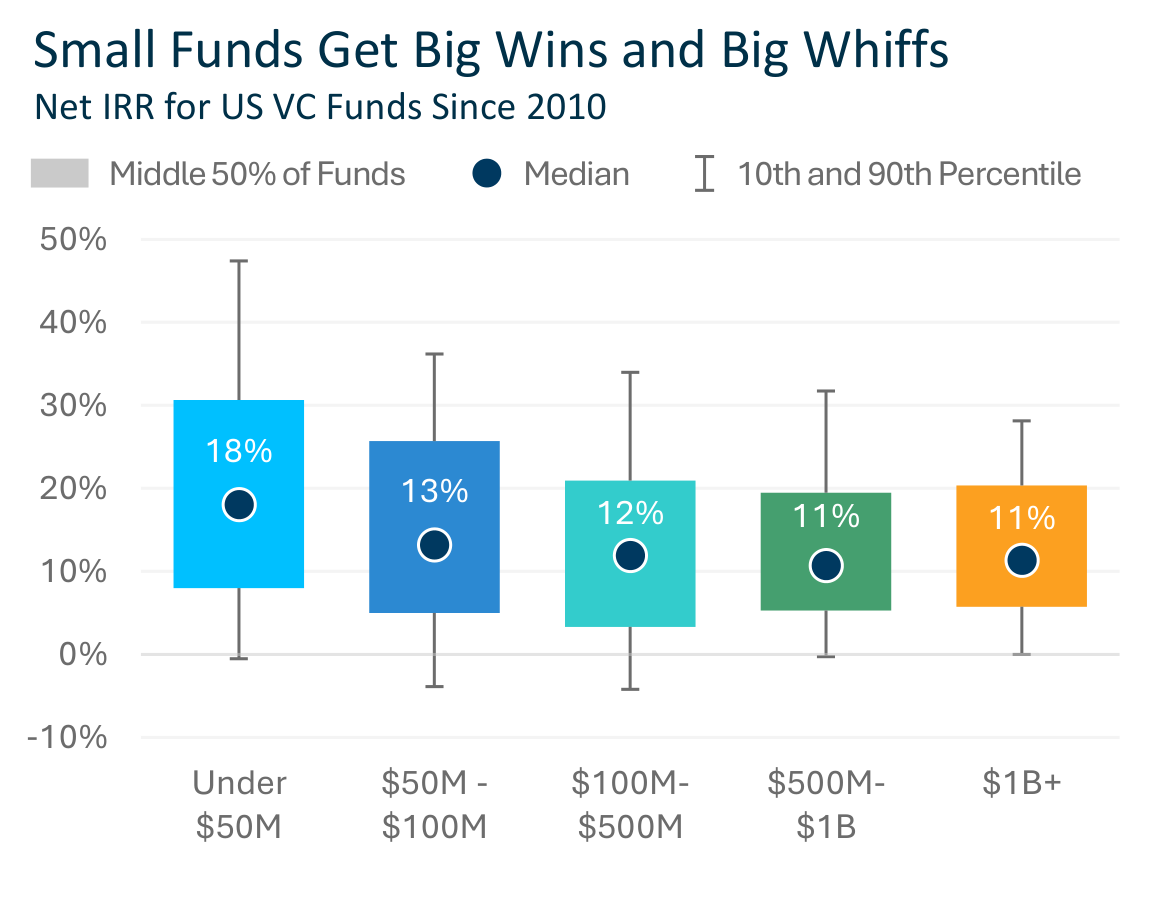
Chart: Silicon Valley Bank State of the Markets H2 2026
For investors, this dispersion means that classic VC rewards both volume and judgment.
Investors need to see enough deals to find companies worth backing. But they also need to have the expertise to identify the winners.
These two markets still share a name, but they increasingly reflect two different ways of investing.
Closing thoughts: Beyond the label
In my view, the biggest ‘venture’ deals today don’t really resemble venture. Instead, these deals look like a blend of:
Infrastructure finance. Billions of dollars are flowing into chips, power, and data centers, projects that have typically been financed by infrastructure funds.
Crossover investing. Backing companies in the final stretch before an IPO is a classic part of the crossover playbook.
Strategic investing. Alongside VC funds, megarounds often see participation from tech giants like Nvidia, Microsoft, and Amazon, whose investments are bundled with commercial contracts.
I landed on the label ‘mega VC’ for these deals. But I’m increasingly skeptical about whether this corner of the market deserves to be called VC at all – trillion-dollar companies aren’t governed by power-law dynamics.
An asset class label only tells you so much. If you truly want to understand your exposure, you have to evaluate the individual deals you’re investing in.
Explore Curated VC Deals →
Accredited investors are eligible to invest.
---
That's it for today.
As always you can find me in the Altea Community.
Until next time 👋
Brian
Disclosures
This issue was written by Brian Flaherty and edited by Stefan von Imhof
The AV team was able to review an early draft of this article. Brian and Stefan made final editorial decisions.
Alt Assets, Inc has no holdings in Alumni Ventures or any companies mentioned in this issue
Disclaimer from Alumni Ventures
This communication is not an offer to sell, or a solicitation of an offer to purchase, any security. Such offers are made only pursuant to formal offering documents, which describe the risks (which are significant), terms, and other important information that must be considered before an investment is made. Venture capital investing involves substantial risk, including risk of loss of all capital invested. Example investments and co-investors are provided for illustrative purposes only, are not necessarily indicative of all AV investments or co-investors, and do not guarantee future investments or co-investors will be comparable to the examples provided. Alumni Ventures paid cash compensation for the placement of this article.
Disclaimer from Alts
This issue is a sponsored deep dive, meaning Alts has been paid to write an independent analysis of AV. AV has agreed to offer a deep look at its business, offerings, and operations. AV is also a sponsor of Alts, but our research is neutral and unbiased. This should not be considered financial, legal, tax, or investment advice, but rather an independent analysis to help readers make their own investment decisions. All opinions expressed here are ours, and ours alone. We hope you find it informative and fair.