Music investors are worrying about the wrong thing
Everyone's worried about AI music cannibalizing streams. The real risks are one-time settlement checks and a shrinking sync business.
Hey everyone, my name is Chez Spigelman. 👋
I'm a long-time Alts reader, first-time Alts writer, and the GTM manager at Melodial, an AI-enabled background music platform for business.
A few days ago, Australia's ARIA (the Australian Recording Industry Association) banned AI-generated songs from the country's official charts.
The trigger was artist backlash, after Queensland DJ Josh Fawaz's AI cover of Madonna's "Like a Prayer" became the most-played song on Australian radio, reaching No. 4 on the ARIA Top 20 Australian Singles chart.
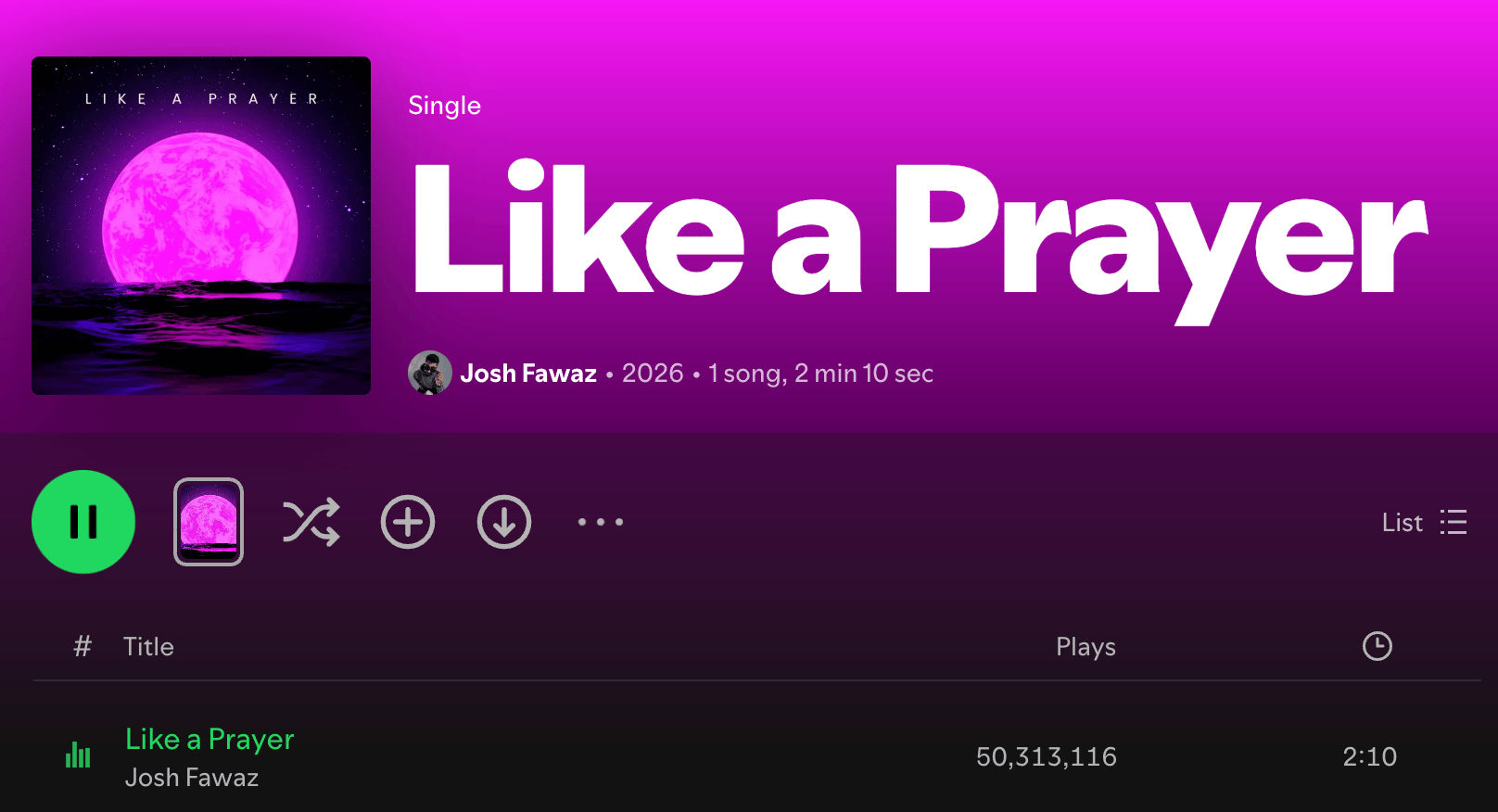
When Fawaz covered the Madonna classic tune, he used AI for both the vocals and drums. Australia's new rules bar songs wholly or mostly created by AI from entering the charts.
This is a case of the music industry fighting AI where it's most visible, yet least financially consequential.
Meanwhile, the real money is leaking out of sight, in the background of social media posts and commercial spaces, where businesses that once paid to license music now reach for royalty-free AI instead.
For Alts readers, this matters. The case for music royalties as an alternative asset is solid: 10-20x annual net royalties on sale, uncorrelated cash flow, copyright protection running life plus seventy years, and a streaming tailwind.
@Brian Flaherty’s piece on the great royalty roll-up walked through Music Royalties Inc. buying minority interests at 3-12x trailing cash flow and paying a 7.2% dividend, and it listed AI-generated music as a risk only in passing.
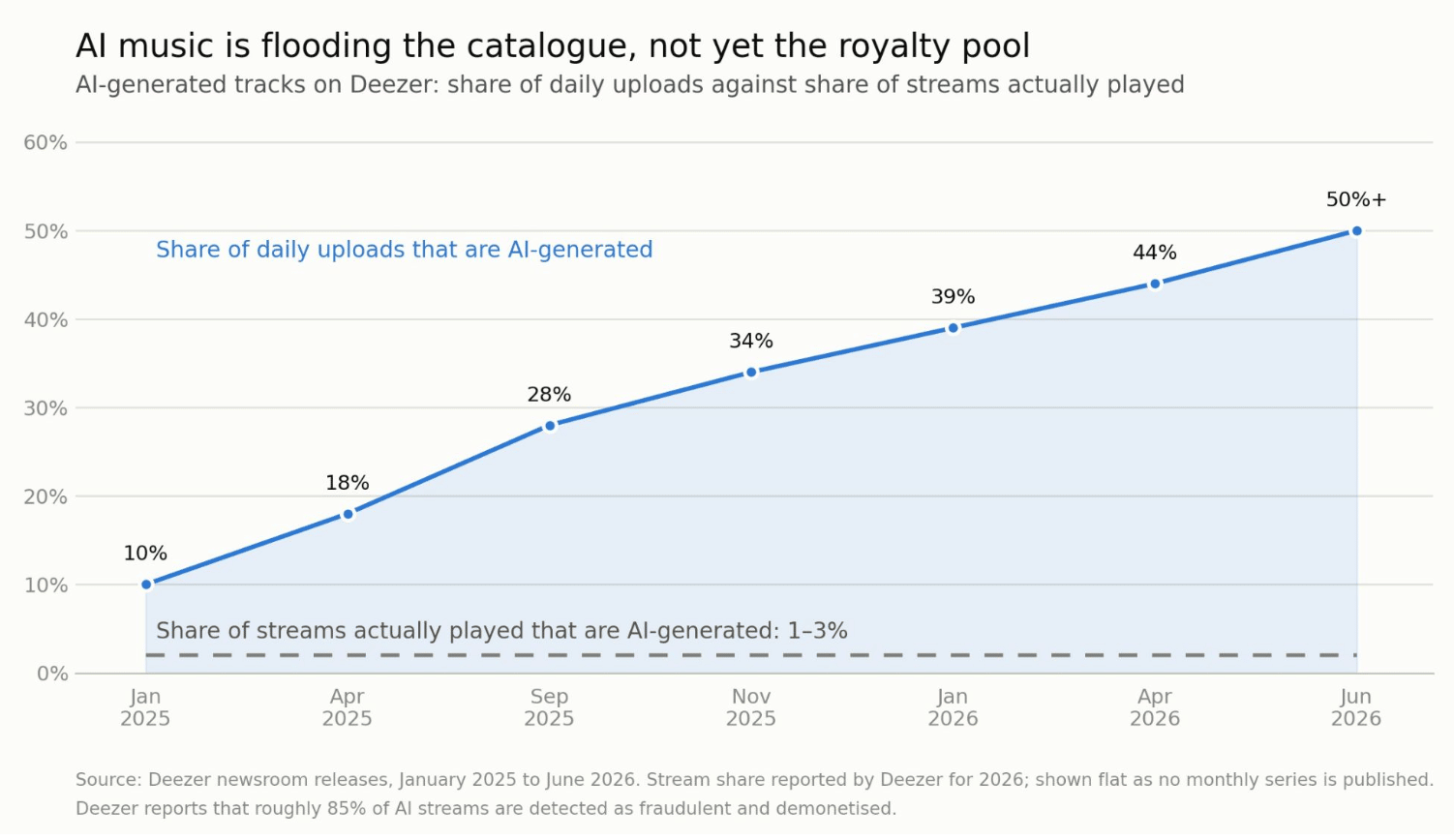
While AI music is flooding streaming platforms and now climbing up the charts, it remains slow. Streaming percentages are still tiny (though some forecast rapid growth, which we explore later) and the risks lie elsewhere.
Today, we'll explore why the ARIA headline is a distraction, and where the money is actually leaking out. I'll show you two things that matter more than the chart ban: what AI companies are being made to pay rights holders in court, and how fast royalty-free AI is replacing licensed background music in cafés, shops and social feeds.
Both hit the exact cash flows catalog investors are buying, and the implications are huge.
Let's go 👇
About the author: Chez Spigelman started his career in finance before pivoting to startups and tech sales. While working at SmartBear, he moonlit as a record producer under the stage name Singerlarity, which led him to his current role as GMT manager at music tech startup Melodial. This is his first guest issue with Alts.
Legality is still very much open
A few weeks ago, the Munich Regional Court ruled against AI music maker Suno, prohibiting four separate acts:
Reproduction for training. Copying protected works for the purpose of using them to train their models
Reproduction through memorization within the model. The technology here is new: a model reproducing a near-identical copy of a song works differently from copying a file. The Court considered that distinction immaterial and treated reproduction through memorization as infringement all the same.
Communication to the public by offering the model. Since the model can reproduce originals, it cannot be communicated or made available to the public
Reproduction via the outputs. The outputs that produce substantially identical copies are illegal to produce
In a nutshell: if you can make the model produce something essentially identical to an existing recording that was used to train the model, it is considered as if the model is storing a copy of that track.
But what was not settled was the status of other, new types of outputs elicited by this new technique.
If a Suno output carries 1% of the influence of each of a hundred famous songs, but reproduces none of them specifically, it may still be considered fair use of the training materials, and not breaching copyright.
The Munich reasoning does not address this open question, and for music royalty investors, that question is highly relevant.
Pete Dyson of Berklee (whose survey of this landscape in The AI Training Wars) is the most useful single document I have found on the subject, puts it plainly: where the model makers are in most trouble is provenance — showing that they got their training materials legally.
But as of today, no jurisdiction has produced a definitive framework governing AI training. So what is emerging instead is what he calls a "settlement economy" — which is bad news for rights holders in the medium to long term.
"...We can begin to see the emergence of a settlement economy with three connected components. First, litigation establishes bargaining power...
Second, settlements reveal prices. Once parties begin paying for training rights, those agreements provide evidence that a market for training licenses is commercially possible.
Third, licensing can become a competitive advantage for both AI developers and rightsholders: an AI company able to offer a model trained on documented, licensed material may reduce litigation risk and create a stronger proposition for investors...and a rightsholder licensing content for AI training can create new revenue streams."
— Pete Dyson
The lawsuits between music labels and associated stakeholders, and AI companies like Suno and Udio, have resulted in a rash of settlement deals:
Universal settled with Udio in Oct 2025 and announced a joint licensed service with opt-in artist compensation.
A month later, Warner settled with Suno, and licensed its catalog (with Suno acquiring Songkick as part of the package.)
BMG signed a global licensing deal with Suno in August 2026.
ElevenLabs launched Eleven Music with Merlin and Kobalt deals already signed.
It's becoming clear that lawsuits are ending in settlements, joint ventures, equity tranches and limited opt-in artist compensation.

AI music licensing is here. But the value created by these lawsuits is accruing to major rights holders as lump sums and equity stakes, not to the underlying income streams investors are buying.
So if you own a diversified basket of minority royalty interests, this is the problem. You are not at the table. There is no sign of a confirmed, durable, per-generation royalty flowing from AI output back to the owners of the training corpus.
The most likely medium-term outcome is that AI companies pay a large one-off price for how they acquired their training data, then continue generating music that owes nothing recurring to anybody.
No royalties is a problem for any asset priced on recurring royalty payments.
AI music is flourishing
Fans cannot tell the difference
The increasing popularity of AI music is also a long term threat to investors — not just by cannibalizing streams, but by blooming into a new competitive market.
AI music is crossing the uncanny valley threshold with both producers and consumers, and quickly becoming an independent entertainment product that effectively competes for music fans’ attention and dollars.
Since Jan 2025, streaming service Deezer counted ~10,000 fully AI-generated tracks arriving daily — about 10% of uploads. By Apr 2026 that had grown to 75,000/day, and by June it hit roughly 90,000/day — half of all uploads.
Deezer is a digital music streaming service founded in France. It's like Spotify, but with an artist-centric payout model that splits royalties by rewarding intentional fan engagement instead of total play volume.
SubmitHub's analysis of over a million July 2026 releases found 23.2% fully AI-generated and a further 15.3% AI audio modified by humans, close to 40% touched by AI in total.
But here's the thing: Almost nobody can tell!
Deezer commissioned market research firm Ipsos to run a blind test in Oct 2025. It gave 9,000 adults across eight markets three tracks; two were AI and one was human. Just 3% could tell the difference.
Creators are OK with AI too
Luminate's 2026 midyear data has 18% of US musicians using AI to edit or remix, with 54% of musicians positive about generative AI.
A Water & Music and Moises survey of 1,525 musicians in 2025 found 78% of professionals had used AI in the past year, and 21% were spending over fifty dollars a month on AI tools.
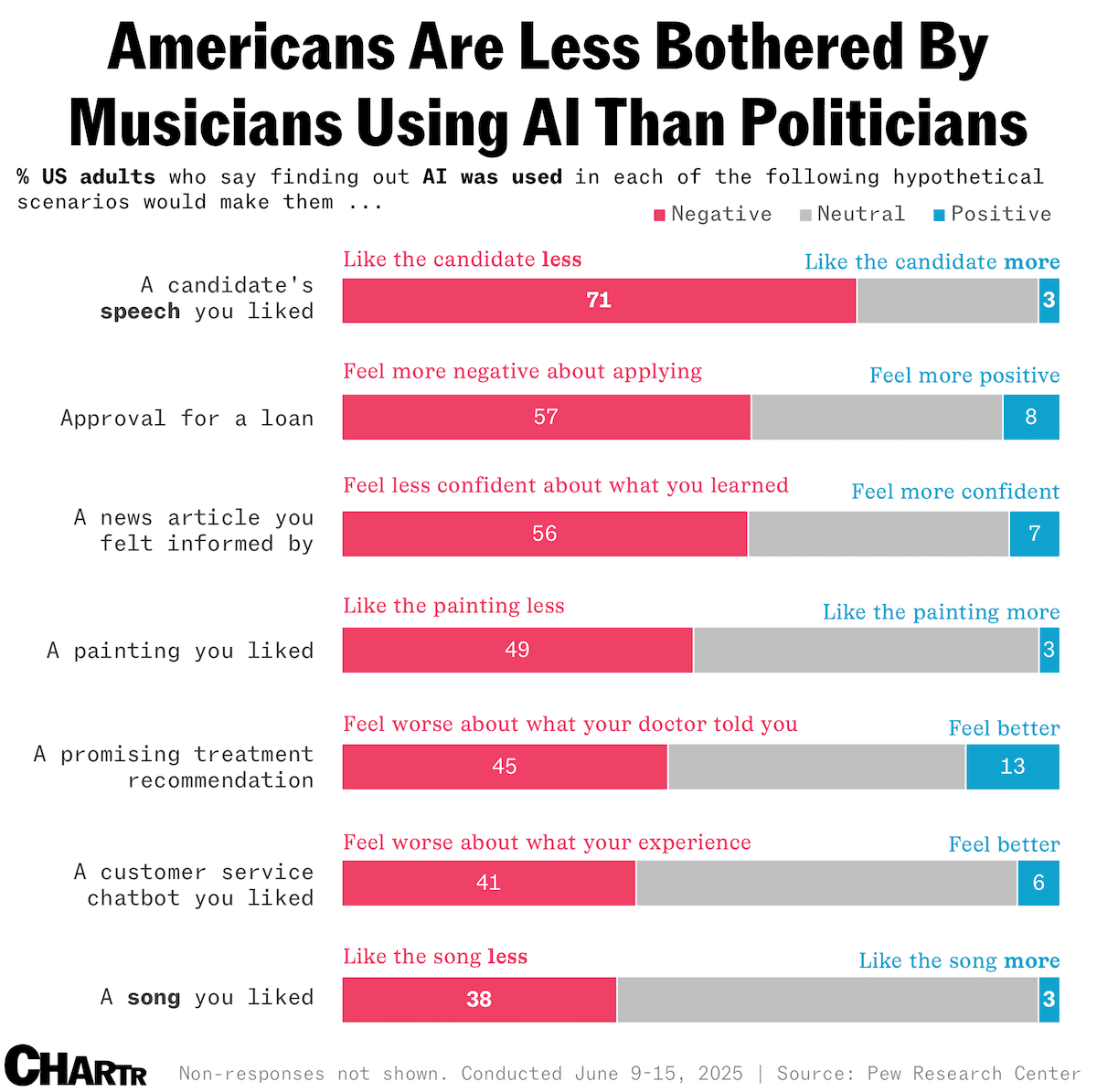
Dr. Dre told the New York Times in August that he uses AI in the studio and that only people who struggle to create see it as a threat. Jimmy Iovine has described a lot of "closet AI producers" working in the industry.
The budding AI music ecosystem
The rise of AI music is bringing about an alternative ecosystem — new media organizations, rights organizations and even new award organizations.
The AI Music Creators Association is described as a performing rights organization (PRO) built for AI music.
AI Music Embassy claims 40+ communities and 20,000 artists.
There are competitions: the AI Song Contest, an AI jazz competition staged at Casino Barrière Montreux.
There are Discord communities running tens of thousands of song submissions a year, a dedicated trade press, and of course, labels.
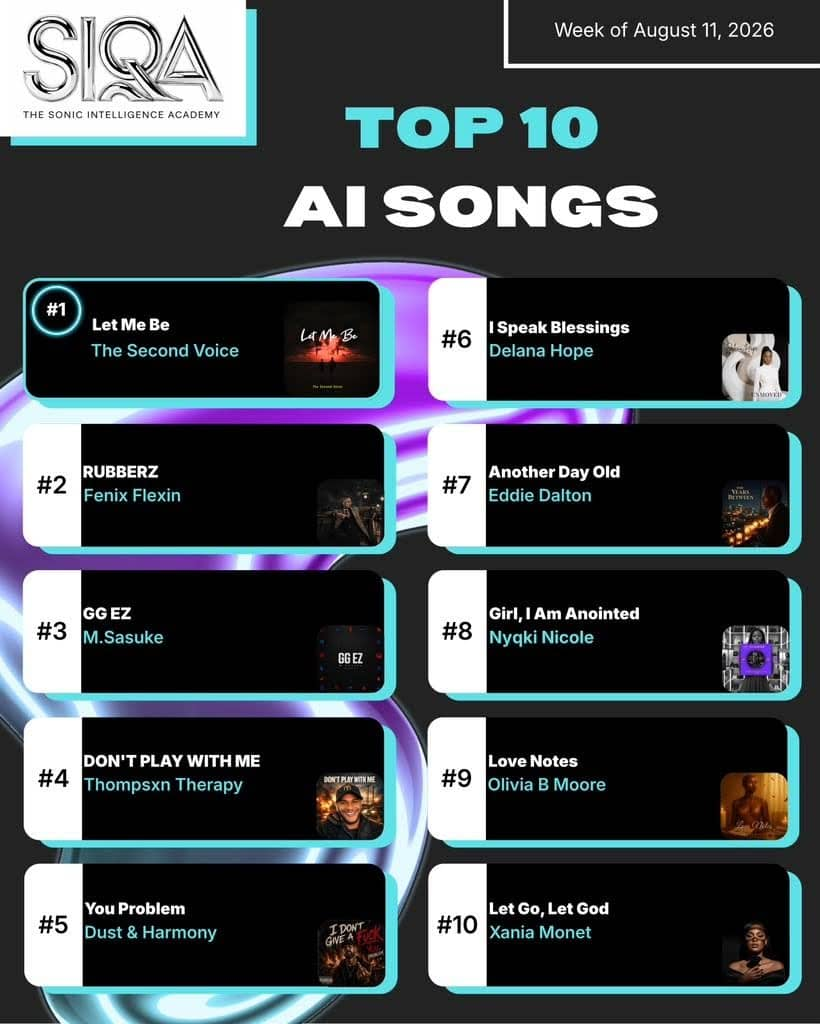
SIQA launched dedicated AI music charts in Jan 2026 and is planning an awards show.
And the acts are charting. Last year, Xania Monet, an AI-voiced persona created by a Mississippi poet using Suno, became the first AI artist to debut on a Billboard airplay chart, and Billboard reported the bidding for her reached three million dollars before Hallwood Media signed her. Breaking Rust, an AI country act, topped Country Digital Song Sales. The Velvet Sundown passed 900,000 monthly Spotify listeners before anyone worked out it was not a band.

Which brings us back to last Friday.
ARIA banned this from the charts. Spotify has removed 75 million spam tracks in a year and is backing a DDEX disclosure standard. Apple Music will apply "Made With AI" labels. Deezer tags. Tidal demonetizes. Bandcamp bans.
Every one of those responses is a gatekeeping measure — incumbent stakeholders trying to protect their cash cows. But AI music is showcasing the signs of independent liftoff, flourishing into a viable ecosystem on its own merits.
Changing fan listening habits lead to changing purchasing habits too. It’s hard to know what the future holds, but music investors should take note.
The largest threats to music royalties
Sync revenues are now leaking
IFPI's Global Music Report for 2026 put global recorded music revenue at $31.7 billion, up 6.4& yoy.
But synchronization revenue (the money artists and rightsholders earn when their music is paired with TV shows, films, commercials, and video games) came in at $641 million, down 2%, the first decline after four consecutive years of growth.
While not officially attributed, it’s very likely that this is due to generative AI music.
Companies like Canva and CapCut have generative audio built into their workflows, which means marketers no longer need to pay for licensing sync music.
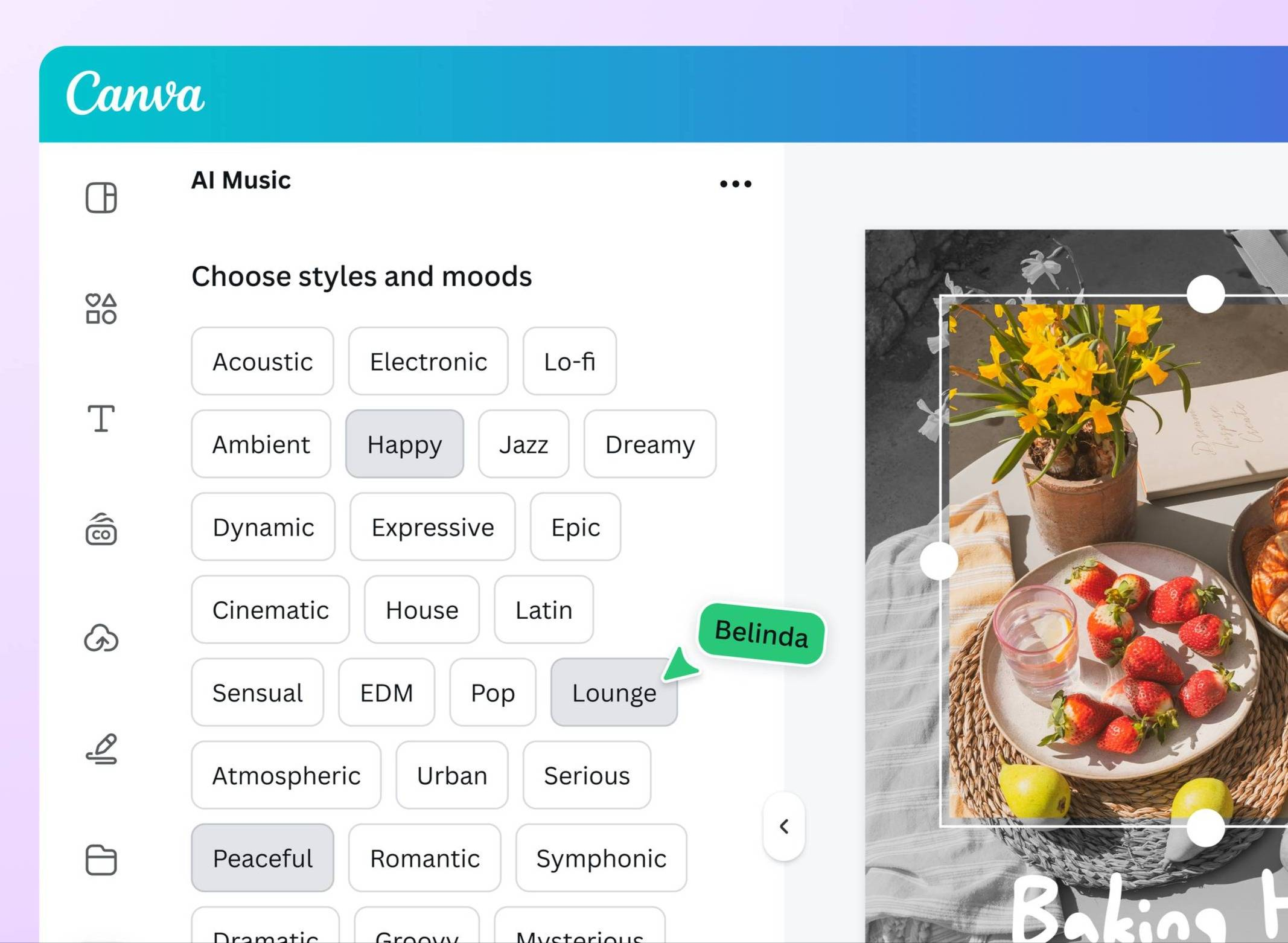
Last week Adobe moved its Firefly audio tools, including Generate Music, to general availability, proudly pitching it as the first model letting you generate instrumental soundtracks usable in film and TV because it is commercially safe.
On the high end of sync, the Nike-scale placement (that Alts has correctly identified as the most lucrative form of licensing) is probably safe for a while. But the long tail of sync, the volume business of creator content, corporate video, regional advertising and social campaigns, is being commoditized in real time.
Performance rights are even uglier
Any business playing music in a public space owes a performing rights license. A business cannot simply switch on Spotify or Apple Music, they must obtain a license from the rights holders of the tracks. It doesn't cost much ($500-$1,000/year), but if they don't do it, they can be sued.
Unsurprisingly, the majority of small businesses don't get a license. Most are unaware that it's required.
Lisa Farris, CMO of leading commercial music supplier Soundtrack, told the MUBUTV Music Business Insider Podcast that 79% of businesses are not using music legally, and put the cost to creators at $1.4 billion.
Now add AI. Here is where I have to declare my interest again, because this is my industry, and it is also where the numbers get uncomfortable.
In August,the New Zealand Herald reported that a growing number of cafés are switching to AI-generated music to avoid licensing costs.

At the other end of the scale, Belgian retailers including Brico and Carrefour are moving to AI-generated royalty-free in-store music across roughly 700 stores, with Carrefour planning a full switch between 2026 and 2028.
At Melodial, we employ experienced musicians who use AI to leverage their output to build playlists which we deliver to hundreds of venues, including popular quick-service restaurant brands and fashion chains.
Tonada, founded by an ex-Spotify engineering lead and an ex-Wolt sales head, raised a $3 million pre-seed led by Antler.
The logic is irresistible. Small businesses are more than happy to use AI music (even if it means they can’t play popular hits or classics). And for bigger businesses like Carrefour, the savings across 600+ locations are attractive.
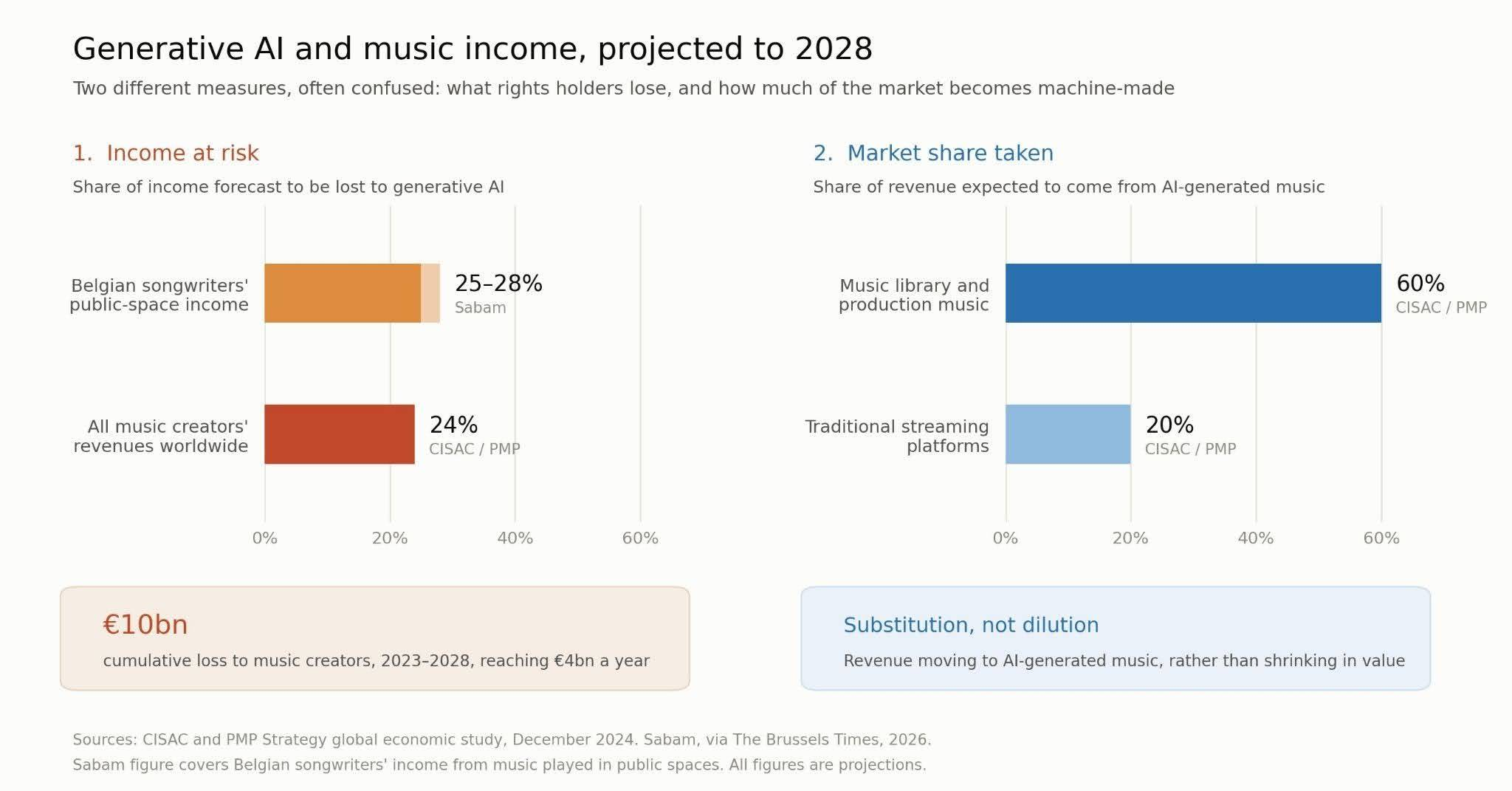
The risks to music royalty holders are stark. The Belgian collecting society Sabam warned that songwriters could lose 25% to 28% of their public-space income.
CISAC's own economic modeling, produced with PMP Strategy in Dec 2024, projects that generative AI puts 24% of music creators' revenues at risk by 2028.
The number in that study that should stop a catalog investor cold is more specific: by 2028, the modeling expects generative AI to account for ~20% of streaming platform revenues and ~60% of music library revenues.
Closing thoughts: The market doesn’t see the risk
Catalog multiples have softened from their peak.
Shot Tower Capital data showes publishing multiples (excluding iconic catalogs) fell from a 2021 high of about 19.4x net publisher share to 16.1x in 2024, with a forecast drift toward 15.1x by 2028.
But that softening has been attributed to interest rates and copyright termination risk, not to AI. Goldman calls AI a rounding error in the royalty pool. MIDiA says the disruption hasn't shown up.
Overall, the M&A market is still hot. Blackstone took Hipgnosis private for $1.6 billion in 2024, and sold it to Sony in a deal Bloomberg valued at $3.5 to $4 billion. Primary Wave with Brookfield moved on Kobalt, HarbourView took a majority of Slipknot's catalog and in general music-backed debt raised around $4.4 billion in 2025.
Still, my view remains that the market is not pricing in the AI risks detailed above.
The law hasn’t yet come close to ruling that rights holders will necessarily share in the ongoing profits from generations output by models trained on their IP.
AI music is increasing in popularity and will increasingly claim more market share of consumers’ attention and streams. And the billions of dollars in sync and performer royalties that rights holders earn are under serious threat from royalty-free AI music.
The ARIA ban that took effect on Friday protects the charts from AI, but not the royalties.
On the financial scoreboard, AI music is climbing inexorably up the rankings. 🎵
---
That's it for today. I hope you enjoyed my first issue with Alts.
You can find me in the Altea community.
See you next time, Chez
Disclosures
This issue was written by Chez Spigelman and edited by Stefan von Imhof
This issue was sponsored by Groundfloor. It contains no affiliate links.
Alt Assets, Inc has no current holdings in any companies mentioned in this issue.