Rare earths: A practical investing framework
To understand rare earths, discard the mining playbook and adopt a manufacturing one.
Welcome to the Alts Sunday Edition 👋
Hello, I publish Critical Minerals Journal. It’s an independent research publisher focused on the often overlooked (but increasingly strategic) world of critical minerals.
My research currently covers Rare Earths, Uranium, Copper, and Lithium. I’m also directly involved in developing a rare earth mining project in Brazil, which gives me a hands-on and unique perspective of the sector.
This is the first Critical Minerals Journal issue outside of CMJ, and it’s an absolute pleasure to partner with Alts (big shoutout to Stefan).
Before we get started, consider yourself already a member of our CMJ community, and please feel free to subscribe or DM me at: criticalmineralsjournal.substack.com
Here are the highlights of what I’ll cover today:
Why most Rare Earth Elements (REE) projects will fail, and how to spot the ones that won’t
Common myths and misinformation in the rare earths market
The current state of REE markets and pricing
A practical scorecard / framework for evaluating investments
If you’re new to this space, skim the issue to get oriented.
If you’re getting serious about precious metals investing, read the full piece.
Let’s go 👇
The backbone of rare earths
The familiar stories everyone gets wrong
Rare earth elements (REE) are among the most widely referenced (and least understood) materials in modern industrial policy and alternative investing.
Policymakers invoke them as symbols of strategic vulnerability, and capital flows toward projects labeled ‘non-Chinese supply’ (don’t worry, we won’t get into geopolitics here).
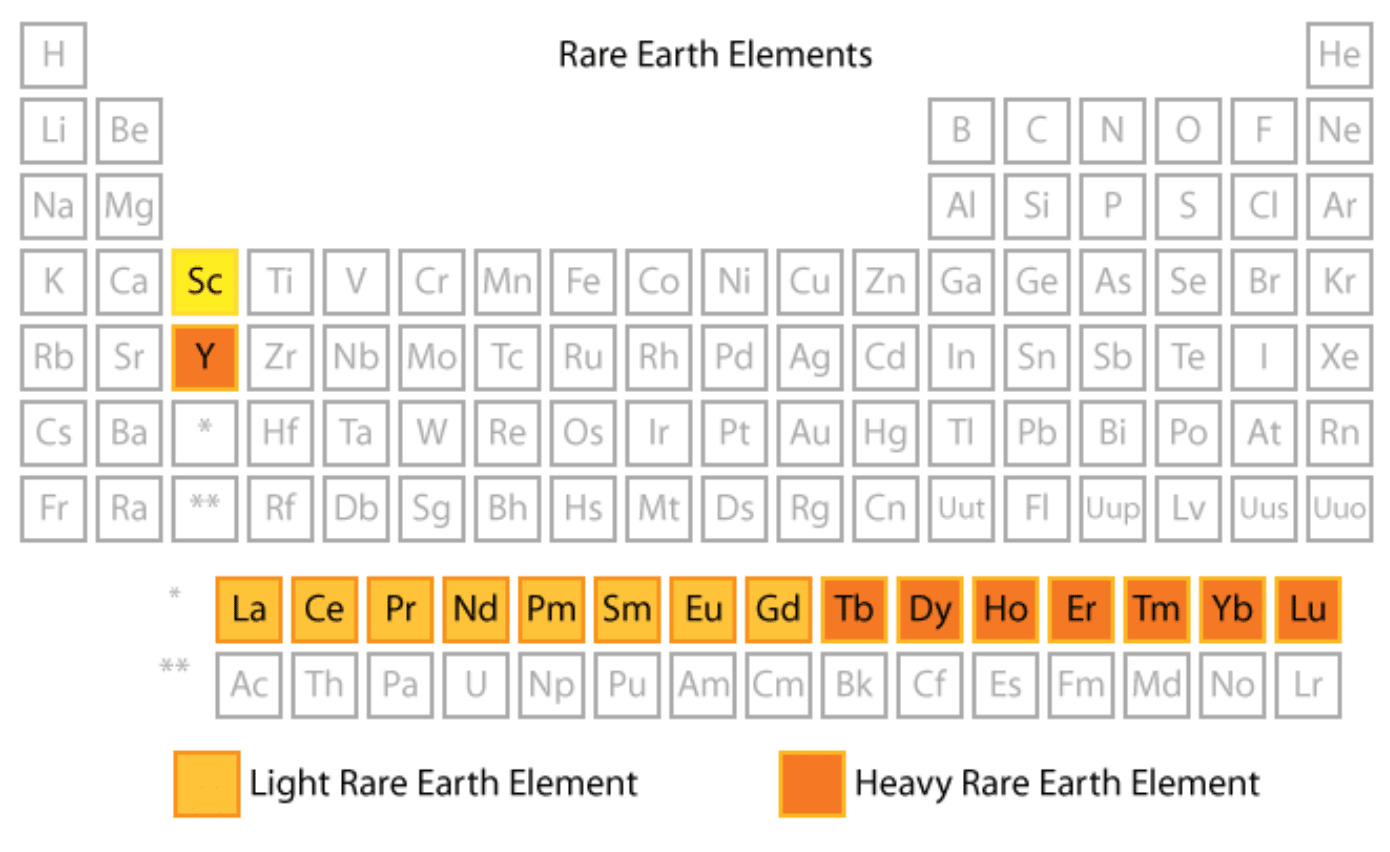
You probably recognize the REE names. They appear constantly in headlines about electric vehicles, wind turbines, national security, and China’s "dominance" of critical minerals.
And yet, after more than a decade of attention, the same pattern repeats: ambitious projects fail to reach steady-state production, downstream bottlenecks persist, and supply chains remain fragile despite billions deployed.
The mistake is not a lack of capital or interest. It's a faulty mental model (and I'll give a tool to fix it).
Rare earths are almost always analyzed like conventional mining assets: find the deposit, build the mine, produce the concentrate, and sell into a growing market.
This framing is intuitive, but deeply misleading.
Rare earth value is not created by finding rocks, but by reliably converting complex molecules into qualified products within constrained, specification-driven supply chains.
Mining is merely the opening move in a long industrial sequence where chemistry, process engineering, market access, and coordination matters far more than grade alone (often referred to as the Total Rare Earth Oxide grade, or TREO).
Until investors internalize this distinction, they will continue to misprice risk, overfund marginal projects, and underestimate why so many ‘strategic’ assets never become viable suppliers.
My goal is to explain how the system actually works and where value is really made or lost.
The dominant narrative (and why it fails)
Most rare earth discussions rest on a handful of shortcuts that feel directionally correct but break down under scrutiny.
"China controls everything"
China does dominate much of the rare earth value chain, but dominance is not monolithic, it varies by product form, specification, and processing stage:
Concentrate > Carbonate > Oxide > Magnet Grade Alloy > Permanent Magnet (standard) > Custom-made Permanent Magnet
Here is a very interesting video explaining the Permanent Magnets properties and their value chain: (in the end of the day, it’s important to keep in mind the end product from REEs)
In short, treating supply as a single fungible pool obscures where bottlenecks actually sit. Here are a few extra examples:
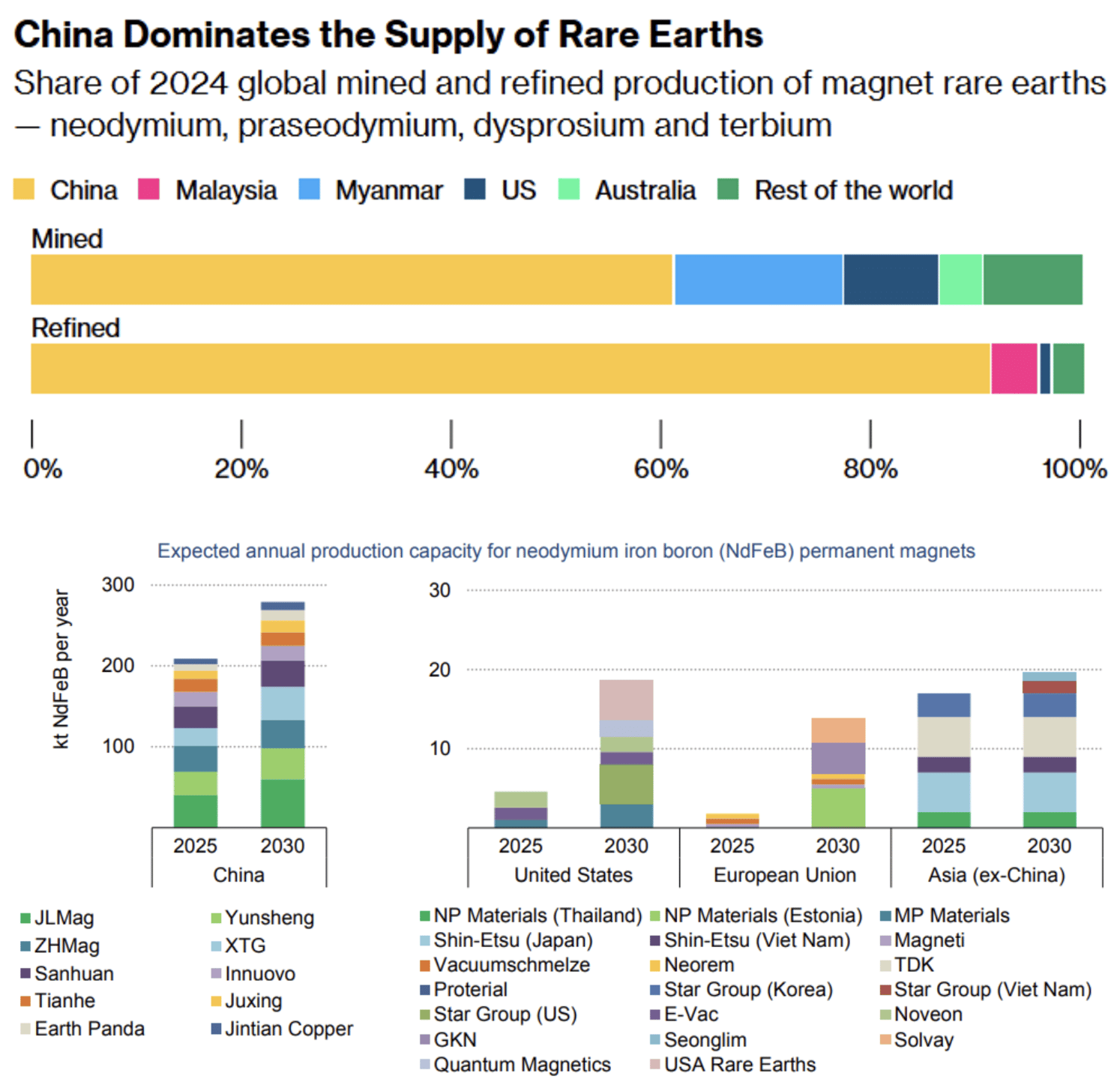
Source: International Energy Agency (IEA), Bloomberg
"EVs + wind turbines drive explosive demand"
Permanent magnets are critical to modern electrification. There’s no doubt about it.
But demand is not a simple function of unit volumes! You also need to consider magnet design, platform architecture, intensity assumptions, substitution, and qualification timelines.
The demand is real, but rarely as linear as forecasts imply.
"Scarcity means any project has value"
This is perhaps the most damaging assumption. Please, never say this.
Rare earth supply is not interchangeable.
A tonne of mixed rare earth carbonate (MREC) with unfavorable impurity profiles (or even a ‘cheaper’ distribution of elements) is not equivalent to an already separated oxide, let alone magnet-grade metal.
Many projects discover too late that they are producing something the market cannot, or will not, absorb.
The common failure across these narratives is the same: they treat rare earths as a mining scarcity problem, when in reality, they are a manufacturing and coordination/supply chain problem!
In short, supply is not constrained by geology, but rather by the capabilities to refine material through a tightly coupled chain of separation, purification, metallization, and qualification.
These are critical steps where errors compound and timelines stretch.
How to evaluate REE projects
The ‘low hanging fruit’ illusion: Ionic Clays vs Hard Rock
Few ideas have attracted more enthusiasm in rare earth investing than the concept of ‘low hanging fruit’ geology, particularly ionic adsorption clay deposits (IAC).
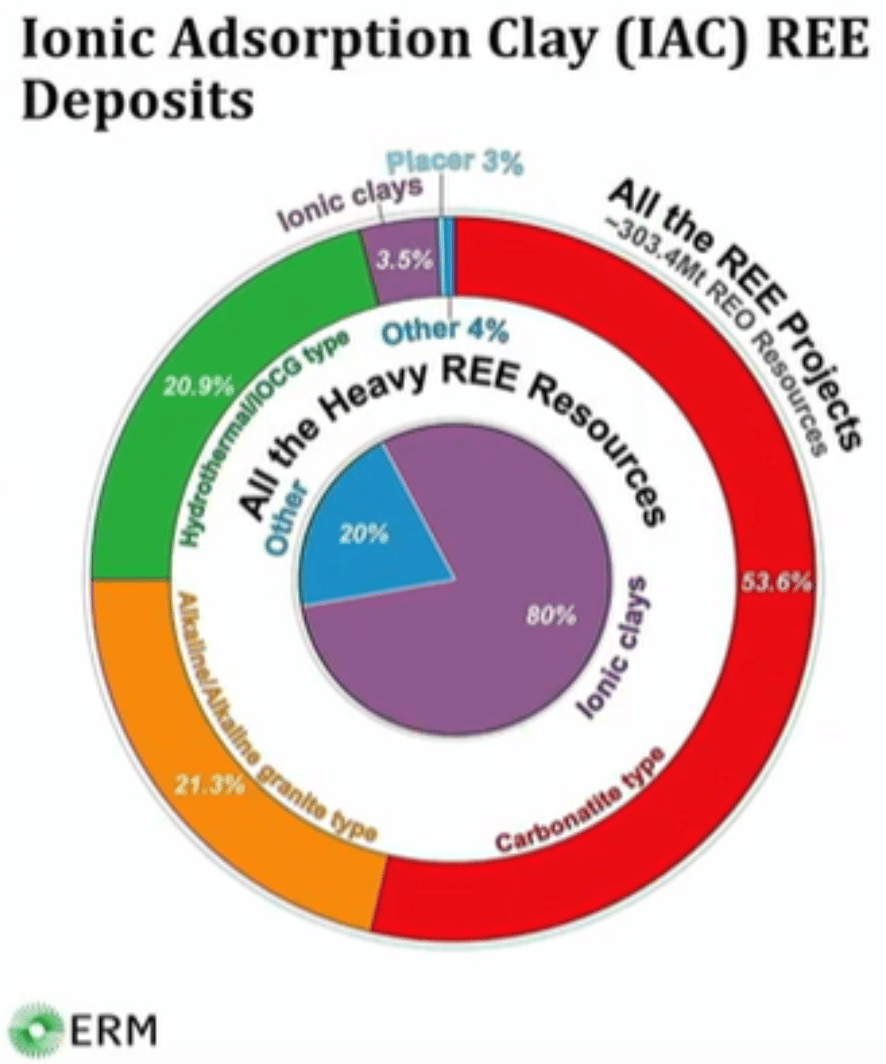
Although representing less than 5% of the known REE projects, the IAC represents 80% of the known HREE (heavy rare earth) resources. Source: ERM
At first glance, the appeal is obvious.
Over geological timescales, rare earth ions are naturally leached from primary minerals and become weakly adsorbed onto clay surfaces. They are not lattice bound, it’s a simple surface binding.=
Typical grades are lower compared to hard rock — often a few hundred to a few thousand ppm in TREO (total rare earth oxides).
The advantage is that, because REEs are weakly bound to clay surfaces, they are theoretically recoverable via relatively mild ion exchange leaching process.
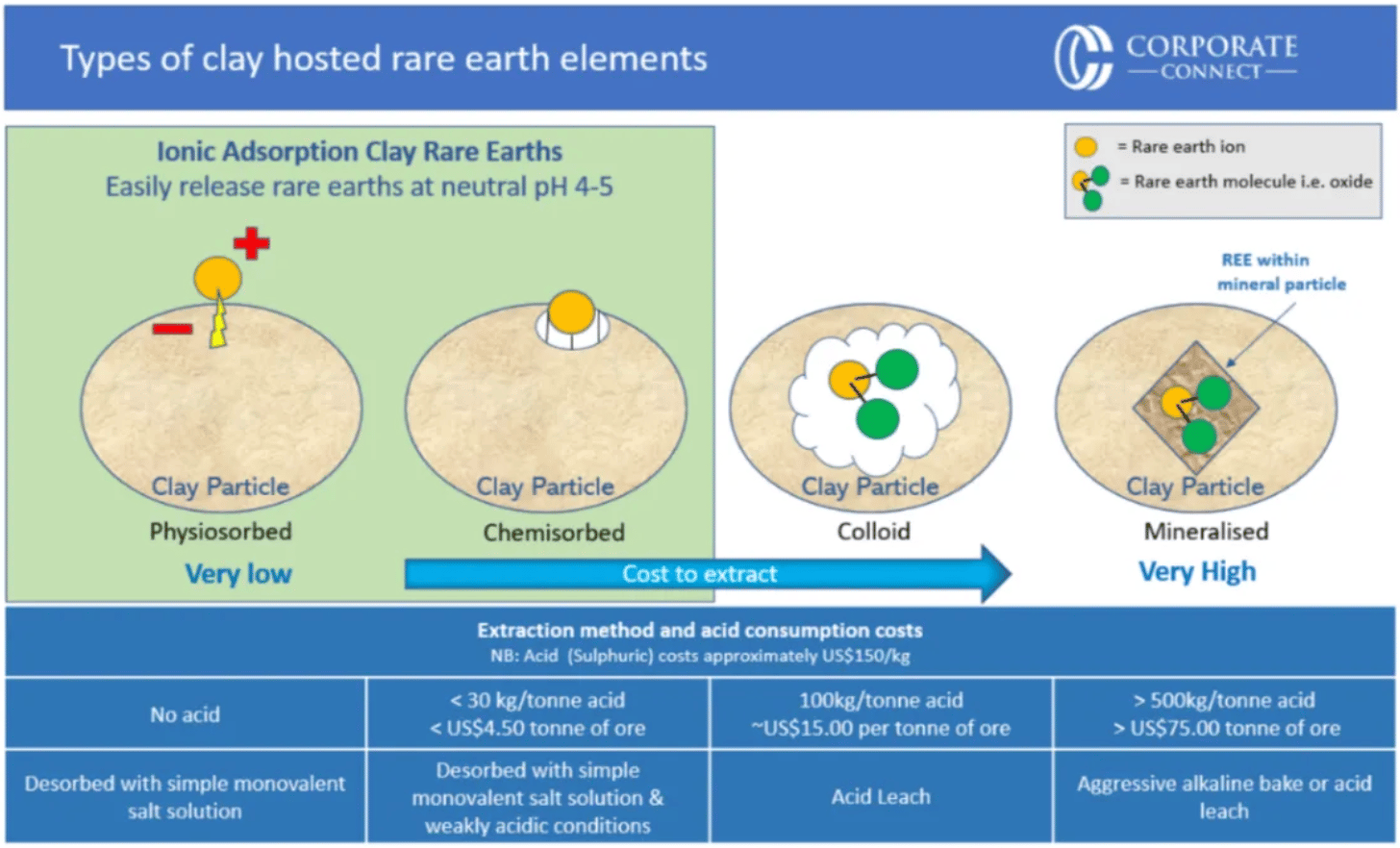
Most hard rock rare earth deposits (bastnasite, monazite, xenotime) contain REEs locked within crystal lattices. Ionic adsorption clays are different. They form through intense tropical weathering of granitic source rocks, and have a lower extraction cost.
This distinction matters. In principle, IACs allow:
Lower crushing and grinding requirements (conceptually even zero)
Ambient temperature leaching
Reduced reliance on aggressive acids
These characteristics have led many investors to assume that ionic clays are inherently simpler, cheaper, and faster to develop than hard rock projects, oversimplified as ‘low hanging fruit’.
But this assumption is incomplete!
Yes, IOC has a favorable chemistry and potentially even revenue. But its operations could be harder given the clay material you’re dealing with.
See, clays are fine grained, friable, plastic, water retentive, and operationally unforgiving (particularly for operators without prior experience!)
Grades are also low, which means:
High material throughput for modest REE output
Large solution volumes per unit of product
Tight sensitivity to recovery efficiency and reagent consumption
The weathering profiles that create IACs also introduce complexity:
Heterogeneous clay mineralogy (meaning the deposit grades and content varies throughout its body)
Variable permeability across horizons
Elevated aluminum, iron, and other competing ions (a.k.a. impurities)
Strong sensitivity to pH control
Bottom line: what appears to be a geological ‘low hanging fruit’, often becomes a high complexity operation at scale.
And this is precisely where differentiation emerges. Ionic clays aren't bad, but they shift the risk equation from mineral liberation and cracking, to material handling, filtration and process control.
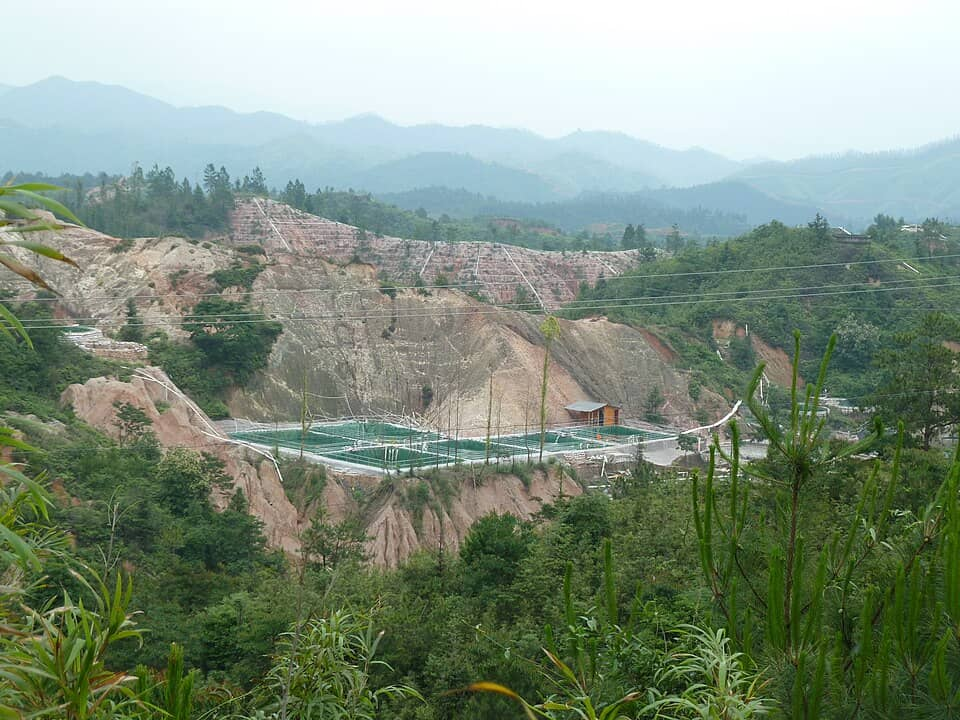
Ion-adsorption deposits are formed by intense weathering of REE-rich parental rocks like granite. Extraction of these REEs is actually cheaper! But the process risk is higher. This is partially why no one is really producing outside of China, Myanmar, and Laos. Image courtesy of Wikipedia
The correct mental model: Rare Earths as an industrial system
To understand rare earths, it helps to discard the mining playbook and adopt a manufacturing one.
The REE value chain looks roughly like this:
Ore (material handling) > leaching <> purification > precipitation > separation > product specification > customer qualification > offtake
(Note the loop between leaching and purification.)
Each arrow represents a potential failure point. Mining sits at the front and after precipitation, we’ll talk about it in a second.
Here's a visual representation:
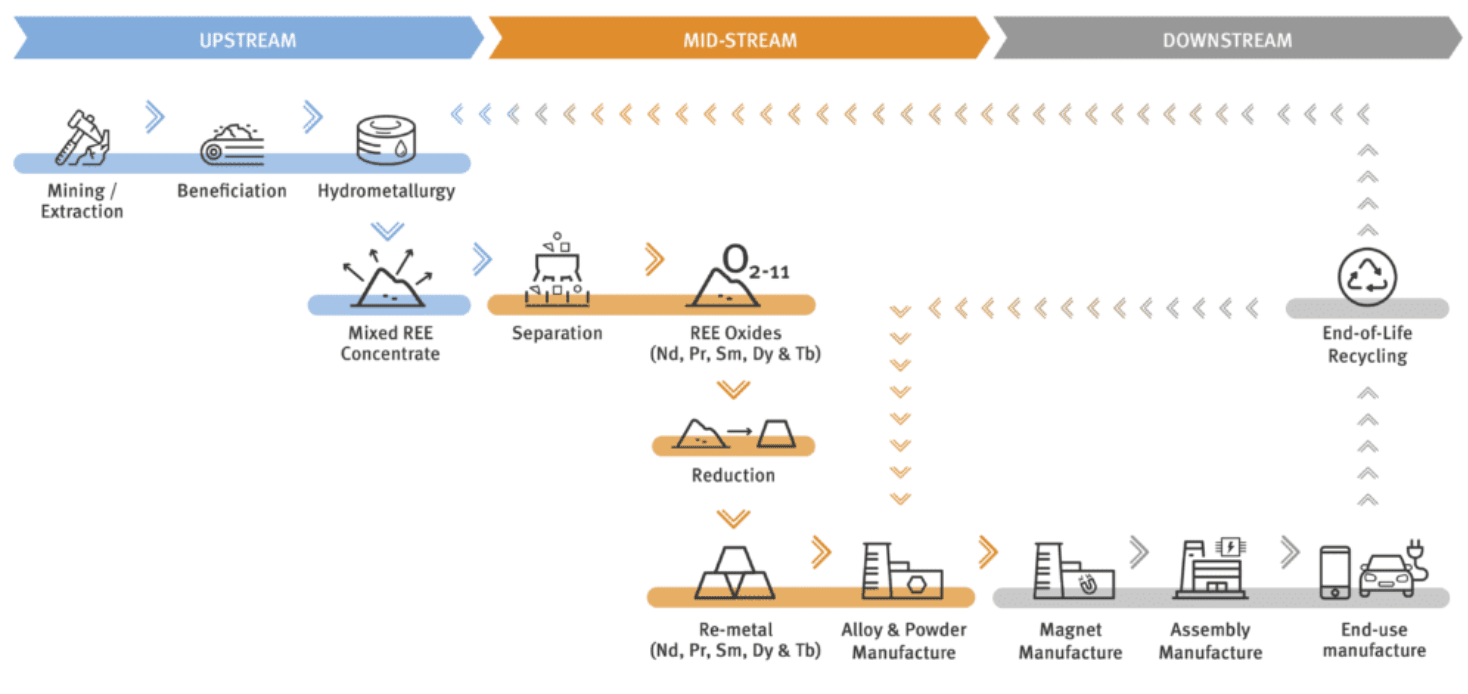
Source: Rare Earth Industry Association (REIA)
Mining is the easy part
In most cases, the physical act of moving the ore (rock or clay) from the ground is well understood. Contractors exist, equipment is standardized, and costs are estimable.
What is not standardized is what comes next.
Separation flowsheets are deposit-specific
Impurity removal depends on subtle chemistry. Product specifications vary by customer and end use. Qualification cycles can take years, not months.
To illustrate the level of chemical complexity involved: a separation plant can easily take from 2 to 4 months just to stabilize its system/solution — without producing anything!
And if anything goes wrong, there goes another few months (you get the picture).
This is why two deposits with similar grades can have radically different economic outcomes.
This is where the opportunity lies
Let’s break it down:
If you are a REE miner, producing a concentrate or carbonate, you could: (a) sell your production to China (which already has all capabilities installed for separation), or (b) sell to an intermediary as a ‘tolling’ service. Either path works, but each with its own price.
The REE separation is a chemical-based process, with strong needs for customization to the feed. So depending on the chosen path, projects might not be economically viable.
If you're a REE miner, you could develop your own separation capabilities. Of course, it’s not easy and it comes with several risks, but if properly done, it can unlock great value
Attention point: (and I apologize for this level of detail, but I must bring this to your attention), Ionic adsorption clays deserve special emphasis, because they illustrate the ‘industry, not mining’ thesis particularly well:
Flow and filtration: Fine clays behave poorly in conventional solid-liquid separation. Settling rates are slow. Filter cakes retain water.
Water management: Low grades mean large volumes of pregnant leach solution. Recycle streams accumulate impurities. Water balance becomes a design-limiting factor, especially in regions with seasonal rainfall or permitting constraints.
Reagent consumption: Ion-exchange leaching may be chemically mild, but it is not reagent-light. Ammonium salts or other lixiviants must be supplied, recovered, or managed at scale. Small deviations in recovery efficiency materially impact operating costs.
Dry stacking is not trivial (this is the big mining risk for IOC): Dry stacking tailings are often presented as a permitting advantage, and it sure can be. But fine clays are notoriously difficult to dewater to stackable moisture contents. Achieving geotechnically stable dry stacks with clay-rich residues is a big engineering challenge. And it’s hard to find individuals with experience in this field.
This is what it means to say rare earths behave like an industry.
None of these issues are fatal, but most of them are industrial problems.
They require pilot data, conservative design margins, and operators who have actually run similar systems, not just designed them on paper.
The REE scorecard / framework
I've created a practical framework investors can use, reuse, adapt, regardless of deposit type or geography:
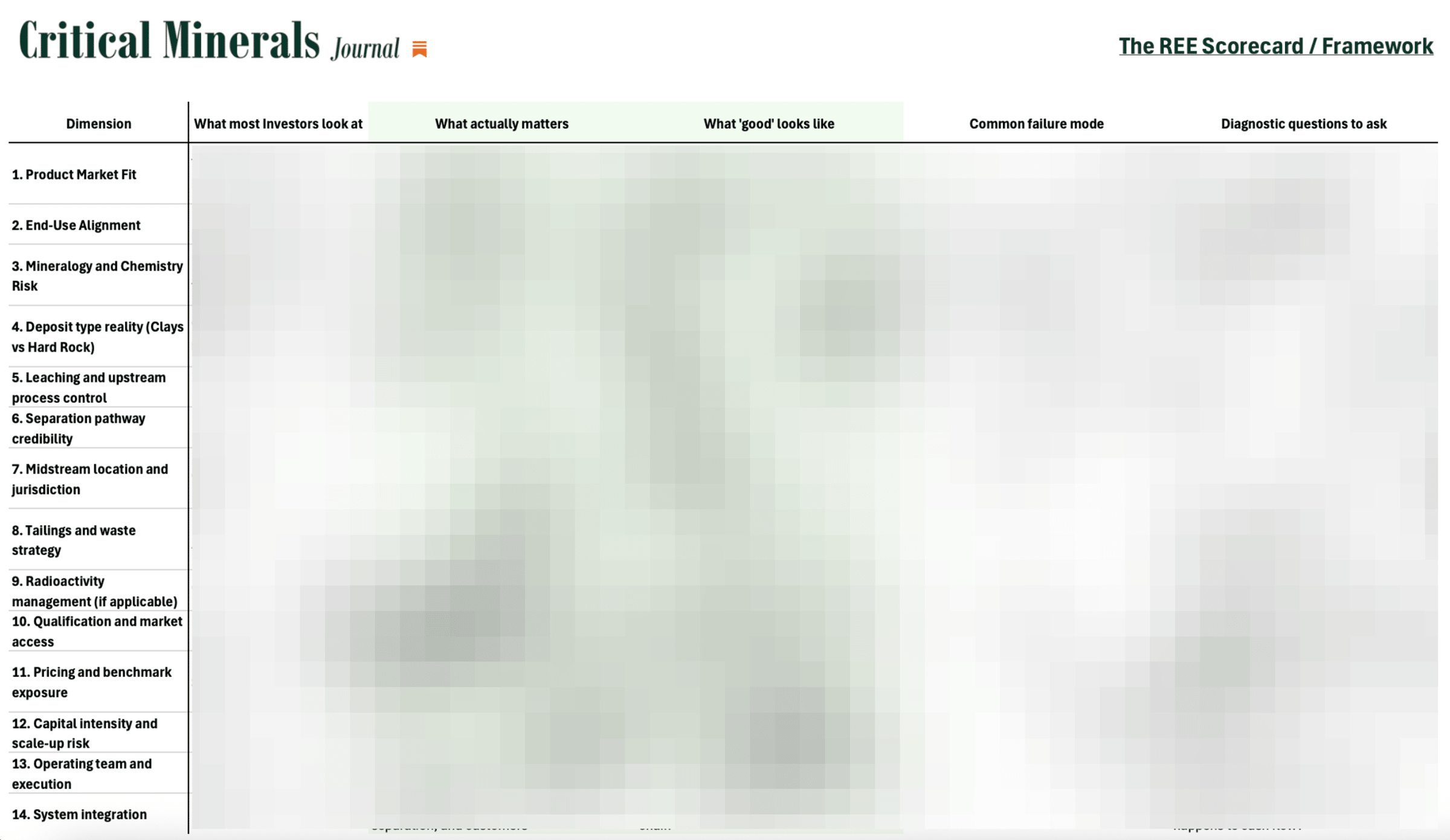
🔒 The rest of this issue is locked
Join Altea to continue reading.
In the rest of the issue, you’ll get:
The REE scorecard for evaluating projects across deposit types and geographies
Why this rare earth cycle is different, and where past investing went wrong
The China vs Europe pricing gap, and what it really tells you
How to turn REE baskets and pricing into real revenue and comparables
A clear view on demand forecasts, and which elements actually matter
The key questions investors should ask before backing any REE project