🎈 Why the world keeps running out of Helium
Helium is a critical resource. But for decades, it’s been treated like a party trick.
Helium underpins some of the world’s most important industries – and I’m not just talking about balloons.
Helium is used in everything from manufacturing semiconductors to operating MRIs. And due to the element’s unique chemical properties, it’s almost impossible to replace with anything else.
But despite how important helium is, it’s historically been treated like an afterthought. In fact, most of the world’s helium supply is produced as a byproduct of natural gas.
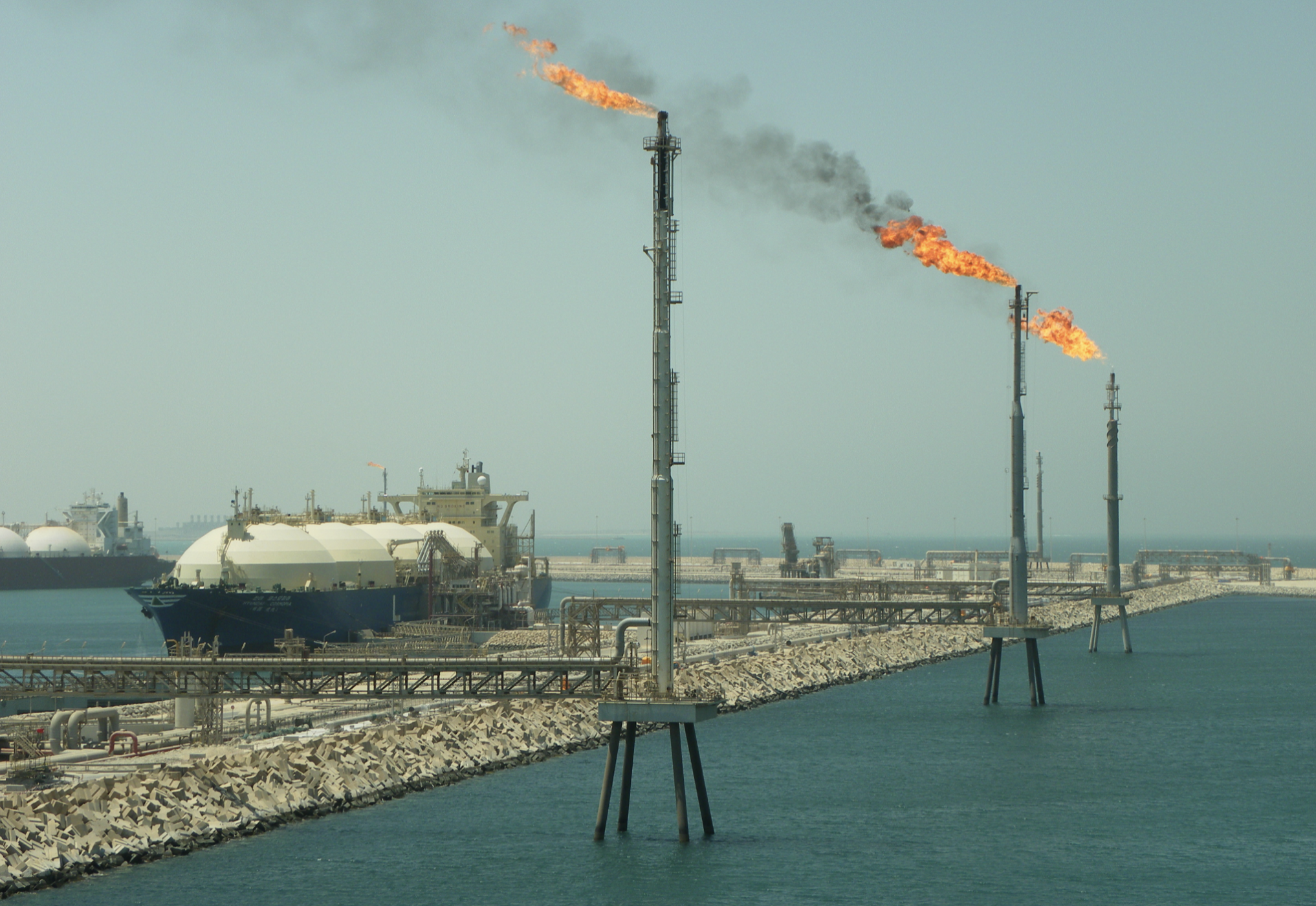
The Iran war has disrupted a third of global helium supply following strikes on Qatar’s gas infrastructure (pictured). But it’s just the latest in a long line of helium supply shocks.
The results of treating helium like an afterthought? A structurally fragile market.
Mismanagement and underinvestment have magnified helium’s natural scarcity to create an industry prone to shortages. Since 2000, the helium market has averaged one major supply disruption every five years.
Today, I’ll be breaking down why an element with such critical demand has such troubled supply. Along the way, we’ll see:
Why the same element that fills party balloons is also essential for modern technology,
How the global helium market came to be dominated by a small set of companies,
How the US government accidentally broke the helium market for decades,
And why rising prices are finally making it profitable to mine helium on purpose, rather than by accident.
Helium’s fragility has as much to do with government policy as it does with geologic conditions.
Let’s go 👇
Brian Flaherty is a financial writer from Atlanta, Georgia. He writes the Front Money newsletter, profiling interesting startup deals for individual investors.
⛏️ Metals I: Invest in a basket of rare earths
Physical exposure to up to seven strategic metals, vaulted in Switzerland.
Most investors only get exposure through mining stocks, which come with operational, political and equity-market risk.
We are testing demand for a more direct route: physical ownership of a basket of strategic metals.
High-level details:
Candidate basket: rhodium, iridium, ruthenium, hafnium, rhenium, and neodymium and praseodymium oxides. Final allocation is set once demand is confirmed.
Industrial demand: autocatalysts take about 85% of rhodium. Iridium is used in hydrogen electrolyzers, rhenium in jet engine superalloys, hafnium in semiconductors and nuclear control rods, and neodymium and praseodymium in permanent magnets for EVs and wind turbines.
Physical custody in our partner's warehouse in Switzerland.
Defined exit path: Our partner has a buyer at exit, under a buyback arrangement.
Target hold of 2.5 to 3 years, with sale triggers if individual metals rise sharply.
The opportunity:
Register interest now. No capital is committed and no payment is taken.
If demand supports it, Alts may form an SPV to acquire the basket as a single position. Minimums and structure would follow.
Indicative costs: 10% on entry, 10% on exit, 1.8% per year storage, and 20% carry on profits only.
The full Deal Memo will be published shortly, covering the basket rationale, custody, costs and exit mechanics.
Deal memo coming soon.
If you're accredited, express interest now:
Disclosure: An SPV will only be formed if sufficient interest is registered. This is not an offer to sell or a solicitation to buy any security. All terms, costs and metals are indicative and subject to change. Physical metals are illiquid, have no public pricing benchmark, and can lose value; entry, exit, storage and carry costs will reduce returns. Alts.co provides media and lead generation services, is not a registered broker-dealer, and receives no fee on capital raised.
The Helium Market: Small But Mighty
Going strictly by the numbers, the helium market is tiny.
The commercial helium market is estimated to be worth $5 billion globally. That’s about the same size as the global hot sauce market.
But despite being a small market, helium has a big impact. Due to helium’s extraordinary chemical properties, it’s a critical input for several trillion-dollar industries:
Because helium remains a liquid down to −452°F, it’s used as a cooling agent when manufacturing semiconductors and operating MRIs.
As the smallest atom in the universe, helium can leak out of microscopic holes. That makes it essential for high-sensitivity leak detection for aircraft and EV batteries.
And since helium doesn’t burn, it’s widely used in spaceflight, where a fire could be catastrophic.
There are other elements with some of these properties. Neon is cold, hydrogen is small, and argon is inert.
But no other element has all of these properties. For the types of sensitive industries we’re talking about, that makes helium irreplaceable.

Helium is also used by deep-sea divers to avoid nitrogen narcosis, which impairs brain function at certain depths. Since helium is so light, it’s easier to breathe under high pressure.
But despite helium’s importance, its supply chain is remarkably fragile. Including the Iran war, the helium market has seen five major disruptions since 2000, with each one causing gas rationing or outright delivery failures.
That fragility starts with helium’s natural scarcity. It takes precise geologic conditions for helium to form, meaning that supply is concentrated in just a few regions of the world.
Helium’s Fragile Supply Chain: A Perfect Storm
To understand helium’s supply chain, we have to start where it begins: deep underground.
Helium is created by radioactive decay in the earth’s crust. Since the element is so light, atoms gradually start drifting through porous rocks toward the surface.
Eventually, some of this helium will be trapped by dense seals of rock salt. This is where our helium supply comes from: gaseous deposits trapped by the right mix of chemistry and geology.

Helium wasn’t even known to exist on Earth until 1895, when it was discovered by a Scottish chemist. By 1922, the first helium airship was constructed – the USS Shenandoah (pictured).
This geology background is more than fun trivia. It explains a huge amount of helium’s troubled supply chain – including why helium is rarely ever mined on its own.
Helium: The world’s most valuable afterthought
The same geologic conditions that form helium deposits also tend to form deposits of another gas: methane, the primary component of natural gas.
And compared to natural gas, the volume of helium in these deposits is tiny. Typical helium-abundant mixes are about 98% methane.
As a result, helium is almost always extracted as a byproduct of natural gas operations. It’s similar to how silver is mostly produced as a byproduct of mining for other metals – a nice bonus, but not the main target.
Helium’s dependence on natural gas worsens the industry’s fragility. If natural gas prices fall, helium supply might fall too, even if the market is in a supply crunch.
Later, we’ll talk about non-methane sources of helium. But in today’s market, the economics of helium remain tightly linked to the natural gas industry.
Helium’s geographic duopoly
Helium-rich gas deposits are relatively rare. Identified helium resources are overwhelmingly concentrated in just four countries: the US, Qatar, Algeria, and Russia.
When it comes to production, the picture is even more stark. The US and Qatar alone make up over 75% of global helium production.
There’s also massive supply concentration within countries. Just one facility in Wyoming (the Shute Creek Gas Plant) accounts for nearly half (!) of America’s entire helium production.
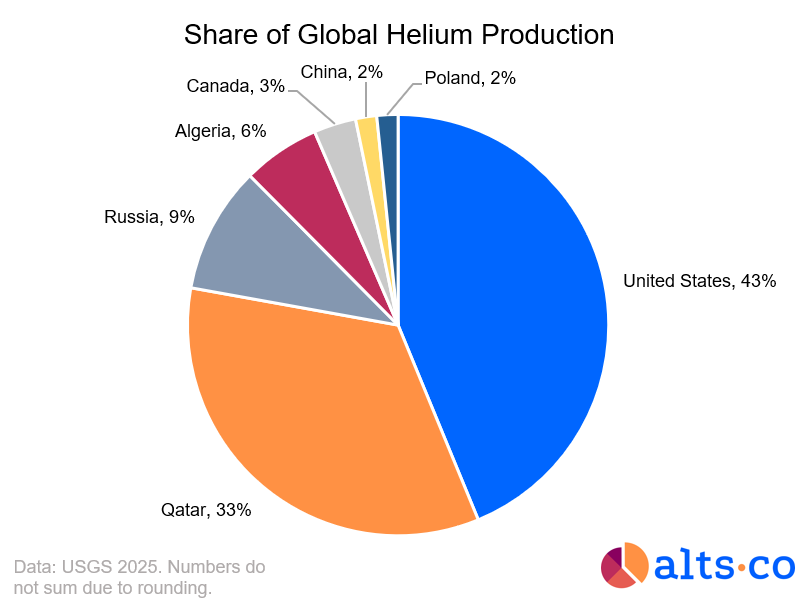
Geopolitics has further undermined supply diversity. Russian helium is currently off-limits in the EU due to sanctions.
There’s one last reason why helium’s supply chain is so fragile: the gas is a completely nonrenewable resource.
Helium is lighter than air. Once helium is in the atmosphere, it starts drifting toward space, where it’s eventually swept away by solar winds.
In other words, every helium atom that leaks out of a pipeline or a party balloon is gone forever. The only helium we’ll ever be able to use is still trapped underground.
How the US Government Broke the Helium Market
Helium supply is fragile. But helium demand is not, with growth driven by technology, medical, and military applications that have no viable substitute.
This tension is what motivated the creation of America’s National Helium Reserve.
Originally created for military purposes, the Reserve ended up dominating the private helium market for years. In doing so, it also exacerbated the very supply challenges it sought to fix.
The rise and fall of the US Helium Reserve
In 1929, the US government acquired a massive Texas gas field to serve as the country’s helium stockpile.
At the time, helium’s strategic significance centered around military airships. In addition to creating the Reserve, the US also banned exports of the gas.
During the Cold War, the Reserve became an important supply of helium for rocket development.
But after the fall of the Soviet Union, helium’s importance seemed to have faded. In 1996, Congress pushed to sell the Reserve to boost the government’s balance sheet.
Unfortunately, this sale was severely mismanaged, with consequences that linger to this day.
America’s helium fire sale
There were two problems with the Helium Privatization Act of 1996:
The Reserve had to be sold on a straight-line basis, with the same amount of helium sold each year regardless of market conditions.
The Reserve also had to be sold at cost-recovery prices designed to recoup the government’s initial investment – not market prices.
Sales began in 2003. From that year on, these requirements led to the helium market being swamped by gas sold at below-market prices.
And the quantities we’re talking about are enormous. During the drawdown years, sales from the Reserve were equivalent to about one-third of global helium demand.
Here’s how Professor Robert Richardson, who won a Nobel Prize in physics and co-chaired an investigation into the Reserve, summarized the situation in 2010:
“As a result of that Act, helium is far too cheap and is not treated as a precious resource. It’s being squandered… They couldn’t sell it fast enough and the world price for helium gas is ridiculously cheap.”
It wasn’t until 2014 that the government began to transition toward selling helium at market prices. By that point, the damage was done.
A decade’s worth of depressed prices had decimated the incentive to extract helium from natural gas. Between 2000 and 2012, global helium production dropped by 19%, even as global demand climbed by 22%.
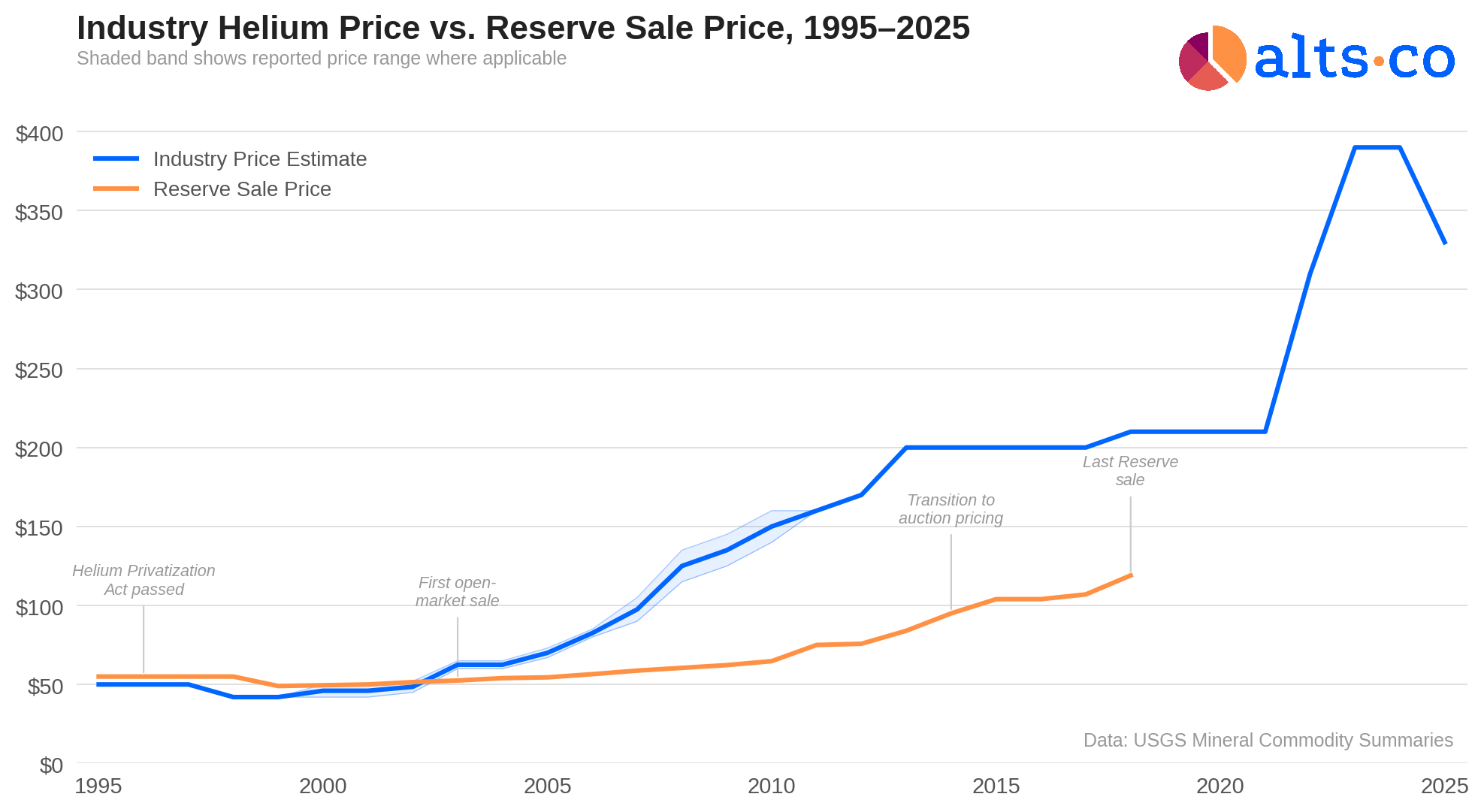
The Reserve’s last open-market sales took place in 2018. The remaining supply was sold off to the Messer Group, a German chemicals giant, in 2024.
America’s national helium stockpile was originally meant to guarantee consistent supply. But the bungled sales process left the supply environment more fragile than ever.
The legacy of the Reserve can still be felt. As private supply contracted, the industry concentrated around a handful of energy giants and gas distributors, creating the market structure we see today.
Helium’s Twin Oligopolies: Production & Distribution
Today, the helium market is dominated by a small set of companies.
Production is controlled by energy giants as a byproduct of their natural gas operations. The biggest producers are ExxonMobil and the state-owned energy companies of Qatar, Russia, and Algeria.
But distribution is the more interesting bottleneck, since getting helium from A to B isn’t exactly simple. Helium is capable of leaking from nearly anything, so you can’t just stick the gas in a shipping container.
Instead, helium needs to be transported as a liquid, requiring specialized tanks that keep it cooled to -452°F or less (-269°C). Even then, the tanks can only hold the gas for about 45 days before it boils off.
A single industrial-grade helium transportation tank can cost up to $1 million. And good luck finding one: there are only about 6,000 such containers in the world.

Distribution is so specialized that only a few companies are capable of doing it. About two-thirds of distribution is controlled by just three companies (Linde, Air Liquide, and Air Products).
On both the production and distribution side, helium is an oligopoly. Hiccups at just one company can have global ramifications – something the Iran war has made painfully clear.
How Iran disrupted the helium market
Early in the war, Iranian missiles targeted the Qatari industrial city of Ras Laffan – where the entirety of Qatar’s helium supply happens to be produced.
The strikes destroyed about 17% of Qatar’s gas infrastructure. As a precaution, Qatar shut down the city in March, taking a third of global helium supply off the market overnight.
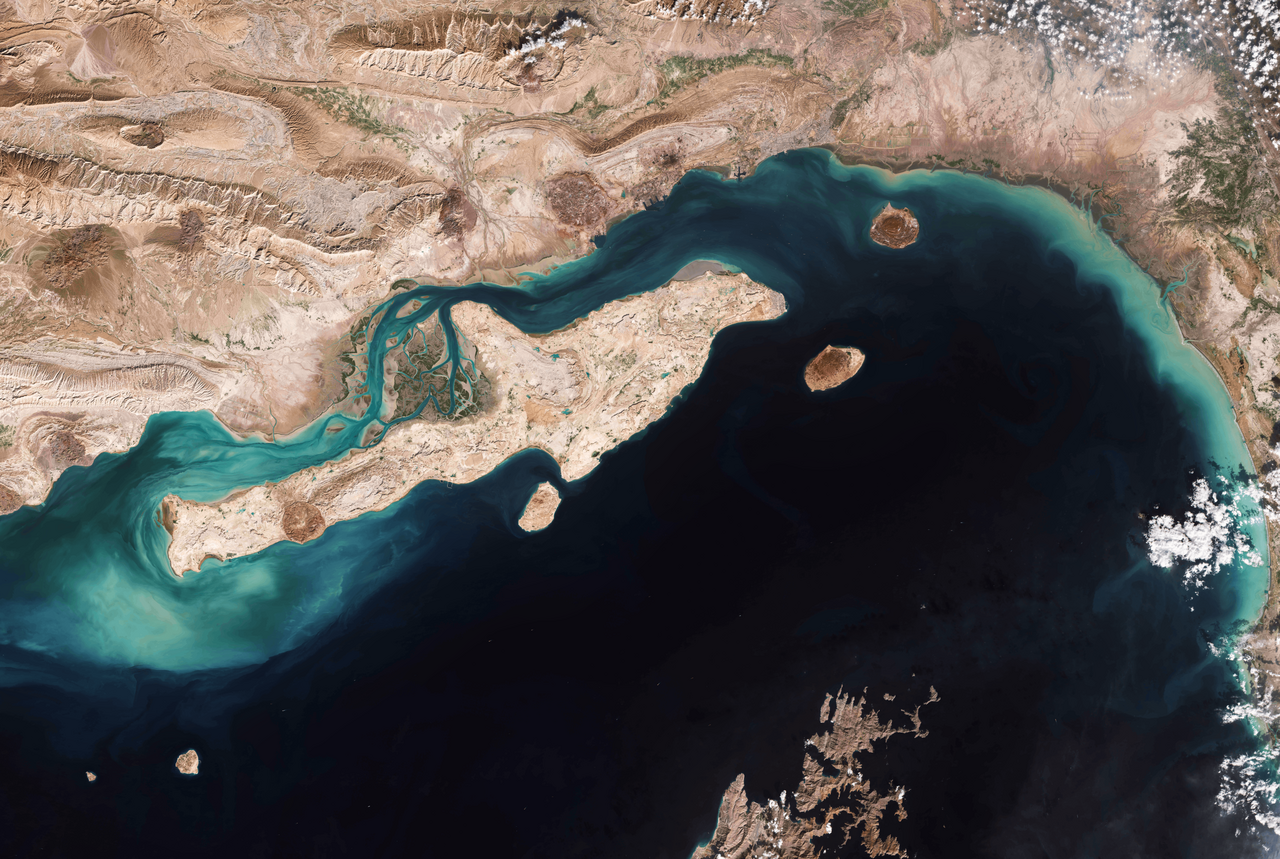
Even if Qatar’s helium production returned tomorrow, suppliers couldn’t necessarily distribute it. The Strait of Hormuz is helium’s primary export route, and it remains closed.
And here’s the thing: the helium market is so opaque that we don’t even know the full ramifications of the Qatari shutdown. Prices are set through private contracts, not an exchange.
We do know that major suppliers have declared force majeure on their contracts, and that prices are reported to have doubled within a week.
As of August, Qatar has just one of its helium facilities running at 25% capacity. But it could be years before Qatari helium supply recovers fully.
This is the cost of such a highly concentrated market: a single disruption in the wrong place can trigger a full-blown crisis.
Pure-Play Producers: Mining Helium on Purpose
Between the end of US Reserve sales and the Qatari supply crunch, helium prices have jumped in recent years.
But there’s a silver lining to rising prices: new forms of helium production are becoming viable, potentially mitigating some of the market’s long-standing fragility.
In addition to methane, helium can also be found alongside two other gases: nitrogen and carbon dioxide. The problem is that both of these gases are cheap. And historically, helium hasn’t been expensive enough to make extraction economical on its own.
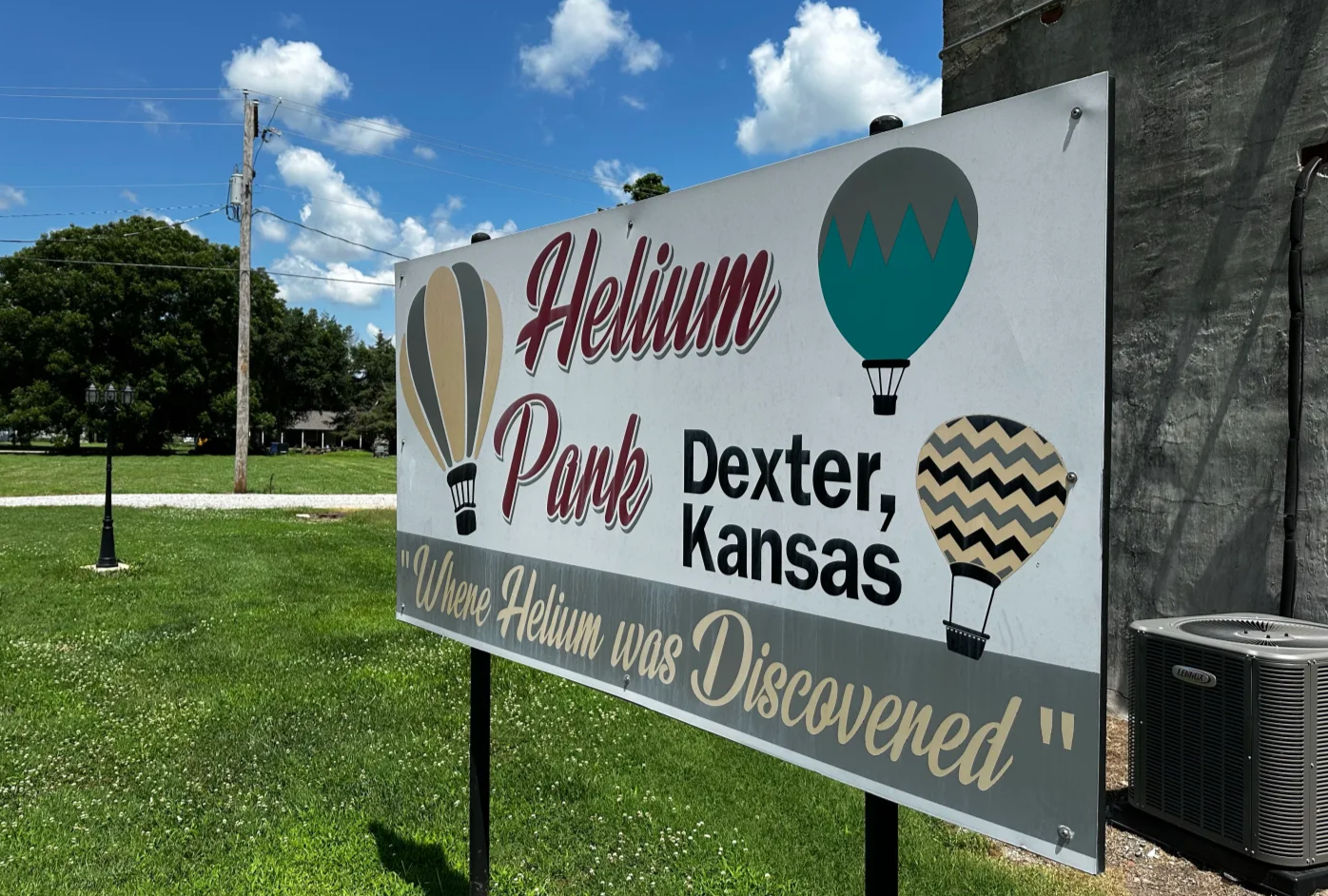
The first helium-rich gas deposit ever discovered – in Dexter, Kansas – was primarily nitrogen. Disappointed not to find methane, residents derided the discovery as worthless “wind gas.”
Higher helium prices are changing the calculus, with several pure-play producers now targeting non-methane deposits directly:
North American Helium (private) is the biggest player in this space, focusing on helium-rich nitrogen deposits in Canada. The company claims to produce ~7% of all helium in North America.
Pulsar Helium (TSXV: PLSR) manages the Topaz site in Minnesota. According to Pulsar, Topaz’s carbon dioxide deposits contain 5-8% helium – far higher than typical methane concentrations.
Helium One Global (AIM: HE1) operates in Tanzania, working in the Rukwa Rift Basin. The site isn’t operational yet, but reportedly contains nitrogen deposits with up to 7% helium.
As you can see, the pure-play market is still a young industry (and hasn’t been without its challenges). But this new wave of suppliers couldn’t come at a more important time.
Driven by demand for AI compute, the semiconductor industry has a rapidly growing need for helium. The element also has applications in a range of next-generation technologies, including quantum computing and nuclear fusion.
Over the next decade, helium is only going to become more important. Having pure-play, price-sensitive producers could be one of the biggest factors in breaking helium’s endless cycle of supply shortages.
Closing Thoughts: The $100 Balloon
After researching this article, I’ll never look at a party balloon the same way again.
Robert Richardson, the physicist I quoted earlier, has argued that helium balloons should cost $100 to reflect the element’s true scarcity. That may be an exaggeration, but I can see his point.
In the US, 15% of helium demand is attributable to MRIs, but 17% is attributable to ‘lifting agents’ – largely balloons. We use more helium for birthday parties than we do for medical imaging.
To be fair, helium supply isn’t an emergency right now. At current consumption rates, we have about two centuries’ worth of supply left on Earth. (And there’s plenty of supply not on Earth.)
But even ample supply can feel scarce if the market is too fragile to deliver it reliably. For decades, helium was treated like a free bonus – a byproduct of natural gas, subsidized by government sales.
I suspect that era is coming to an end. And when helium is finally treated like a critical resource, the industry’s perpetual shortages might end too. 🎈
See you next time,
Brian
Disclosures
This issue was written by Brian Flaherty and edited by Stefan von Imhof
This issue is sponsored by EarthRarest.
Alt Assets, Inc does not have any holdings in any companies mentioned in this issue. We are considering creating an SPV with EarthRarest.