Apartments are on sale. Stocks are not. Here's why this matters.
Two numbers that shouldn't exist at the same time.
The stock market is trading at 28x what companies actually earn. The long-term median is about 18x. It's over 55% more expensive than usual.
Meanwhile, apartment buildings in high-demand places like Phoenix, Dallas and Atlanta are selling for 20-40% less than they were three years ago.
One thing most Americans own (stocks) has never been pricier. One thing far fewer people think about (apartments) has never been cheaper relative to where it was. Actually, the relative recession for some real estate exceeds 2008 in terms of impact!
That gap (and the why behind it) is the story. And for those even remotely interested in real estate, this is one worth watching closely.
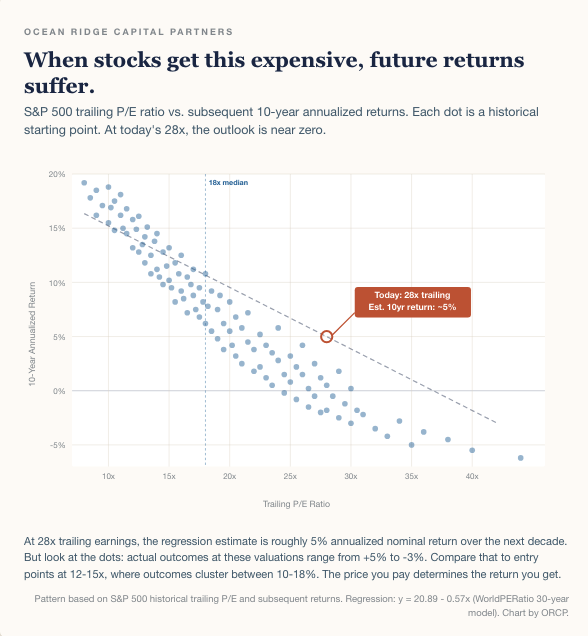
S&P 500 Trailing P/E vs Subsequent 10-Year Returns. At today's valuations, estimated future returns are near zero or negative. Source: Apollo / FactSet historical analysis.
Everyone built at the same time. Then the music stopped.
Between 2020 and 2022, the apartment market went nuts.
Interest rates were basically zero. Rents jumped 14% in a single year nationally. Every developer in America said "let's build" at basically the exact same moment. Investors piled in, especially anywhere there was population growth. Values surged 27% nationally. Sun Belt cities like Dallas, Atlanta and Phoenix saw prices jump 50%+ in two years.
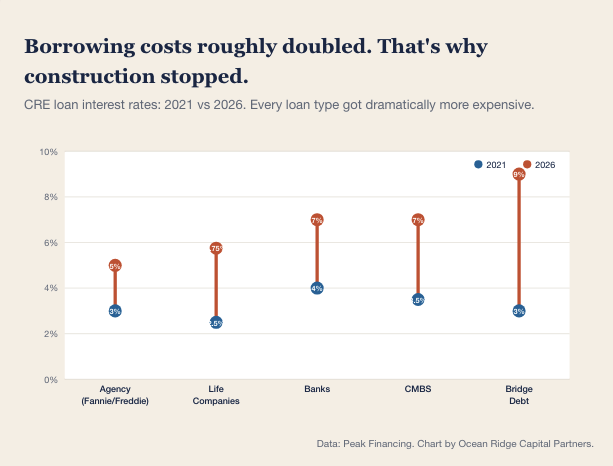
Then the Fed cranked rates up. All those projects that started during the frenzy finished building. All at the same time. Into a market where borrowing money suddenly cost twice as much.
Too many apartments + rising costs + falling values is a toxic mix.
Nationally, apartment prices dropped about 20% from peak. In the hardest-hit Sun Belt markets, 35-40% or more. Investment sales collapsed 74% in early 2023. The steepest drop since the 2009 financial crisis.
And here's what most people missed: the Kansas City Fed found that prices actually fell further than the bad news justified. Investors panicked beyond what the numbers warranted. Prices overshot to the downside by about 5 percentage points.
That kind of overshoot is usually what a bottom looks like.
The builders stopped building. And you can't undo that.
This is the most important part of this entire post. If you read nothing else, read this.
Developers started building 708,000 new apartments in 2022. That was the peak.
By late 2025? Roughly 235,000. The lowest in over a decade.
That's not a dip. That's a 40-70% collapse in new construction.
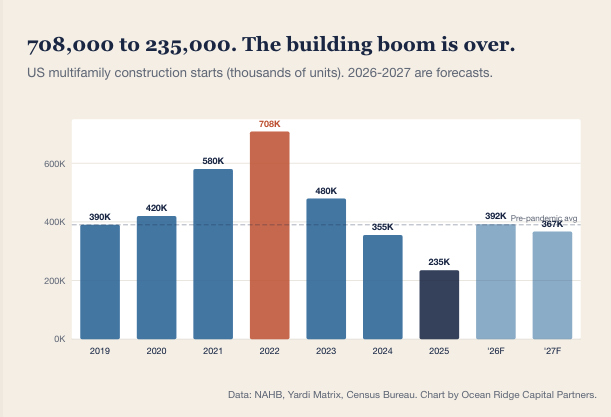
US multifamily construction starts by year. Data: NAHB, Yardi Matrix, Census Bureau.
Why? Building apartments suddenly got really expensive. Loans cost more. Steel and lumber cost more. The developers who lost money in the oversupply wave said "never again" and stopped.
Here's the part that changes everything: it takes about 2-3 years to build an apartment complex. So the apartments being finished right now were started two years ago, when construction was still active.
The apartments that would finish in 2027 and 2028? Many were never started. They don't exist. They're not in the pipeline. They're not coming.
No policy change fixes this. No election outcome speeds it up. No Fed decision can conjure buildings that were never built. The supply drought is locked in.
The timeline in plain English:
Right now (2025-2026): The last wave of apartments from the building boom is hitting the market. This is the pain everyone can see and feel. Vacancy is high. Rents are flat.
Next year and beyond (2027-2028): Deliveries drop dramatically. The apartment shortage starts to bite. Rents start climbing. Vacancy drops. The market flips.
That flip isn't speculation. It's math. The buildings weren't built.
We are 4 million homes short. And falling further behind.
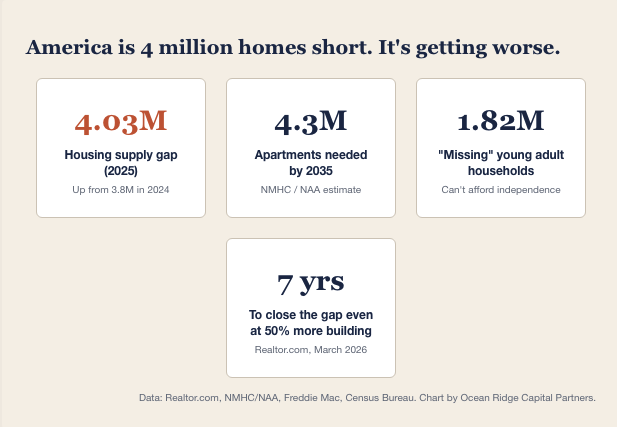
The housing gap in the US hit 4.03 million homes in 2025. Up from 3.8 million the year before. Growing, not shrinking.
Even if we magically increased construction by 50% tomorrow, it would take seven years to close the gap.
We need 4.3 million new apartments by 2035 just to keep pace with demand. We lose 100,000-150,000 apartments every year because old buildings wear out. More than half the apartment stock in America was built before 1980.
And 1.82 million young adults are stuck living with their parents or crammed in with roommates because they can't afford to go independent. Those people need to live somewhere. Eventually they will. And when they do, they're going to rent, because they can't afford to buy.
This isn't a cycle. It's a structural shortage that gets worse every year we don't build enough. And right now, we're building less than we have in a decade.
The economy is actually making this better for apartments (not worse)
This is where most people get confused. The macro environment feels bad. Oil shocks. Tariffs. A frozen Fed. Inflation above target. It reads like a list of reasons to hide under the bed.
But look at what these things actually do to apartments:
Oil and inflation keeping rates high? That means fewer people can afford to buy homes. Buyers need to earn 46% more than renters to afford a typical home purchase right now. Renting is cheaper than buying in all 50 of the largest US cities. Every month rates stay elevated, more people stay renters. More renters = more demand for apartments.
The Fed can't cut rates? That means developers can't afford to break ground on new projects. The supply drought deepens. Fewer new apartments coming means existing apartments become more valuable.
Oil shocks squeezing budgets? Households with tighter budgets are less likely to scrape together a down payment. They keep renting.
The very things that feel like headwinds are actually tailwinds for apartment owners with the right setup. Specifically: fixed-rate debt (so your costs don't move), workforce-level rents (so your tenants can't afford to leave), and existing buildings (so you benefit from the supply drought instead of trying to build through it).
One more thing worth flagging: Two of the biggest private credit funds in America just restricted withdrawals. Investors who were told they'd get "bond-like income with easy liquidity" are finding neither part was true.
When the investments your advisor sold you start locking the doors, it raises a fair question: what do I actually own? An apartment building with tenants paying rent and a real building you can touch is a very different thing from a leveraged loan to a software company with no hard asset behind it.
That distinction matters more now than it has in years.
Alright, so what could go wrong?
I'm not going to pretend this is a no-brainer. Here's what to watch.
Demand cooled off in the second half of 2025. After a monster first quarter (best apartment absorption in 30+ years), things slowed. Immigration policy changes and weaker job growth are real headwinds. This week's jobs report showed 92,000 jobs lost with unemployment rising to 4.4%.
Vacancy is at a record high. National apartment vacancy hit 9.3% at the end of 2025. Some Sun Belt cities are still swimming in empty units with vacancy in the mid-teens.
The "bottom" isn't the same everywhere. Cities like Chicago, Columbus, Kansas City and Philadelphia that didn't overbuild are clearly past the worst. Chicago is posting 3.6% rent growth. These markets never had the problem.
Sun Belt metros that went crazy with construction? More uncertain. Still working through excess supply.
I'd put the odds at 70-75% that the broad national bottom is in. Higher in supply-constrained markets. Lower in the most overbuilt ones.
The recovery might be slower than optimists want. One private equity economist put it bluntly: the supply-demand picture "will be disappointing for the next few years." Don't expect a rocket ship.
This isn't "close your eyes and buy everything." It's "the conditions that caused the crash are reversing, and there's a window opening for people who can tell the difference between a real opportunity and a trap."
Summary: stocks are priced for a perfect world. Apartments already took the hit.
Your stock portfolio needs everything to go right. At 28x earnings, there's almost no room for surprise. One earnings miss. One recession scare. One prolonged oil shock. And values compress fast.
Well, oil shocks are happening right now. Tariffs are raising costs right now. The Fed is stuck right now.
Apartments, on the other hand, already got punched. Values are down 20-40% depending on market. The oversupply is peaking. The building drought is locked in. Demand is structural. And even if we stay “higher for longer” there is a systemic demand for housing that is increasingly underserved.
If you own mostly stocks, the question isn't whether apartments are perfect. It's whether having something in your portfolio that already took the hit and benefits from inflation, housing shortages and rate-locked renters makes your overall position stronger.
What we did with this exact thesis (a recent exit)
We just exited a Cleveland apartment portfolio of 20 properties. 130% total returns for our investors. 22% annualized since we bought the assets in mid-2020.
Cleveland isn't sexy. It didn't go viral on TikTok (at least, not for the right reasons). It didn't become the next Austin.
We bought there because the supply story was right. Steady demand. Limited new construction. No overbuilding. We locked in fixed-rate debt before rates exploded. We improved the properties and ran them well.
Boring formula. Big result.
The cities posting the best rent growth right now share those same traits. Chicago leads at 3.6%, then New York at 3.3%, the Twin Cities at 2.7%, Kansas City at 2.5%. All supply-constrained. None overbuilt.
The lesson always repeats: supply is the only thing that matters in apartments. Get that right and the rest follows.
What's coming in the next 18-36 months
Look - I don’t have a crystal ball. But money is flowing back in slowly but steadily. The government agencies that back most apartment loans raised their limits to $88 billion each for 2026. Banks and insurance companies are lending again. Deal activity turned positive for the first time since 2022. 72% of apartment investors plan to expand this year.
Rents are starting to move. Growth went from basically zero in 2025 to a projected 2% in 2026 and 3.4-3.8% by 2028 when the supply drought really bites.
Distressed deals are surfacing. Banks have been modifying problem loans to avoid recognizing losses. That game is ending. When it does, more properties hit the market.
But not every distressed deal is a good deal. Distress means the current owner is hurting. It doesn't mean the building is worth buying. The people who win in this window will be the most disciplined. Not the most aggressive.
The best apartment deals of the next decade are probably being found right now. This window doesn't stay open forever. As the data improves and more capital flows in, prices tighten. You want to be positioned before consensus catches up. Not after.
I'm buying actively in this window. If you're interested in investing or learning more about the space, I'd welcome the conversation. Happy to share notes or go deeper on anything here DM me.
And if you want to take our 2026 Investor Quiz to figure out what kind of investor you are, I hope you find it useful: https://oceanridgecap.com/quiz