🎬 Introducing our Film Bridge Lending Portal
A plain-English breakdown of a highly misunderstood corner of private credit. (And an announcement we've been building towards for a year.)
If you've been following along with our journey, you've probably noticed that film bridge lending has been showing up more and more in what we do.
We created Film I, our first film fund, in December 2024.
7 months later, we opened a second tranche
5 months after that, we followed with Launch JV, a joint venture with Cinelaunch.
And now, today, we're launching a Investor Portal that lets accredited, qualified investors participate directly in individual film bridge loans. (More on this in a bit!)
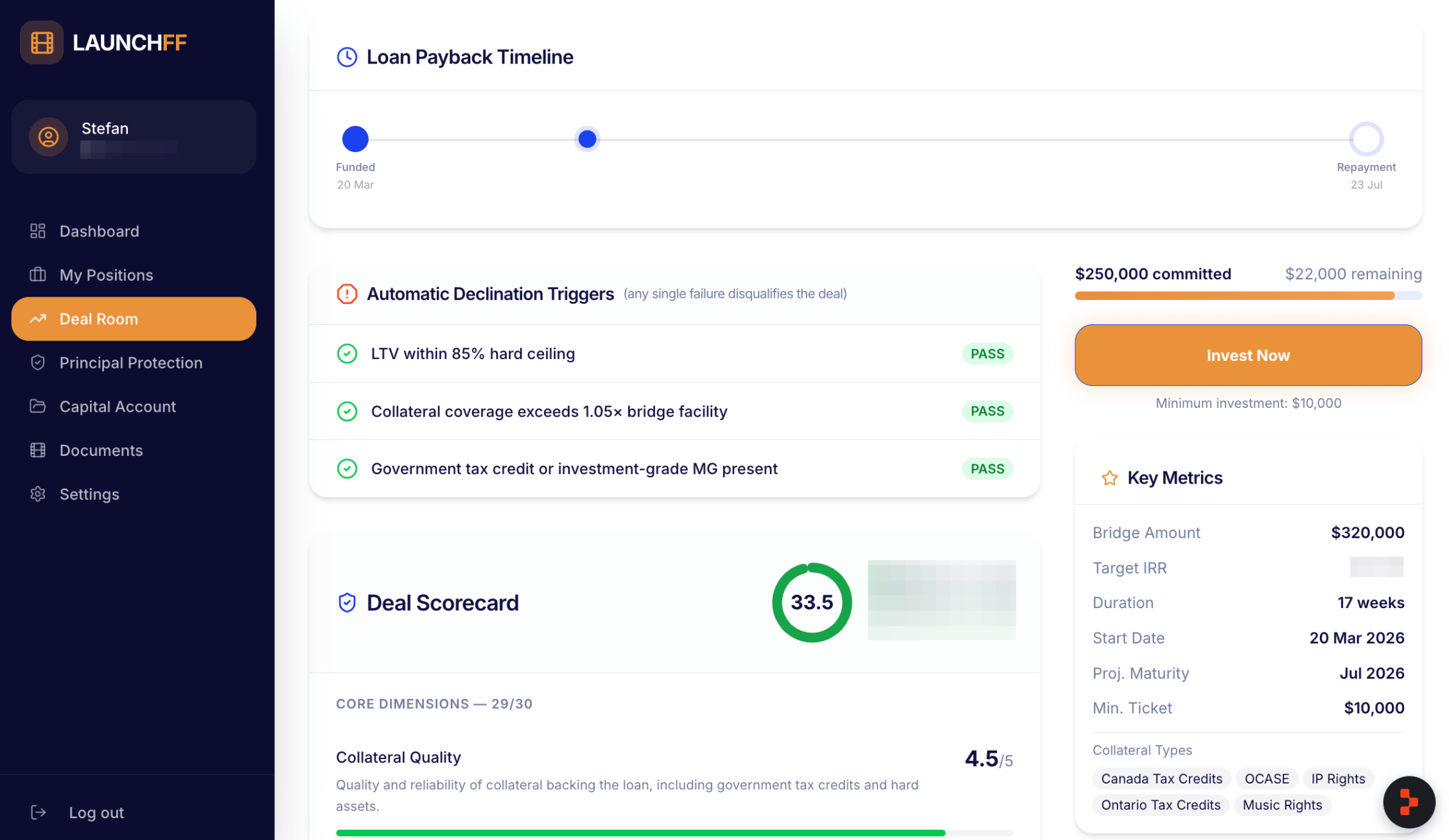
Film bridge loans are one of the most misunderstood areas of alternative finance. Explore opportunities at film.alts.co
But based on the questions we keep getting, a lot of people are still fuzzy on what this actually is. You've seen the words 'film' and 'lending' sitting next to each other, and your brain has filled in the gaps. Box office bets. Hollywood glamour. Vanity projects.
This is none of that.
Today, I want to take a step back and explain this exciting world we've been operating in. How we got here, how it all works, and how accredited, qualified investors can participate.
Once you understand this world, you'll see why this has become the most meaningful, exciting part of our business.
Let’s go. 👇

How we got here
We didn't set out to become film lenders. This evolved deliberately, over a few years.
It started with Film I, our first fund in the space, built in partnership with Chris Daniels from Cinelaunch. Then came Launch JV, which let us go deeper and originate more deals.
The goal has been straightforward: dip our toes into the mechanics of film bridge loans, do some deals, and build producer relationships.
So far, it has been a resounding success.
Today, between Film I and Launch JV, we have $12.4m out on loan, across 31 films, with zero defaults.

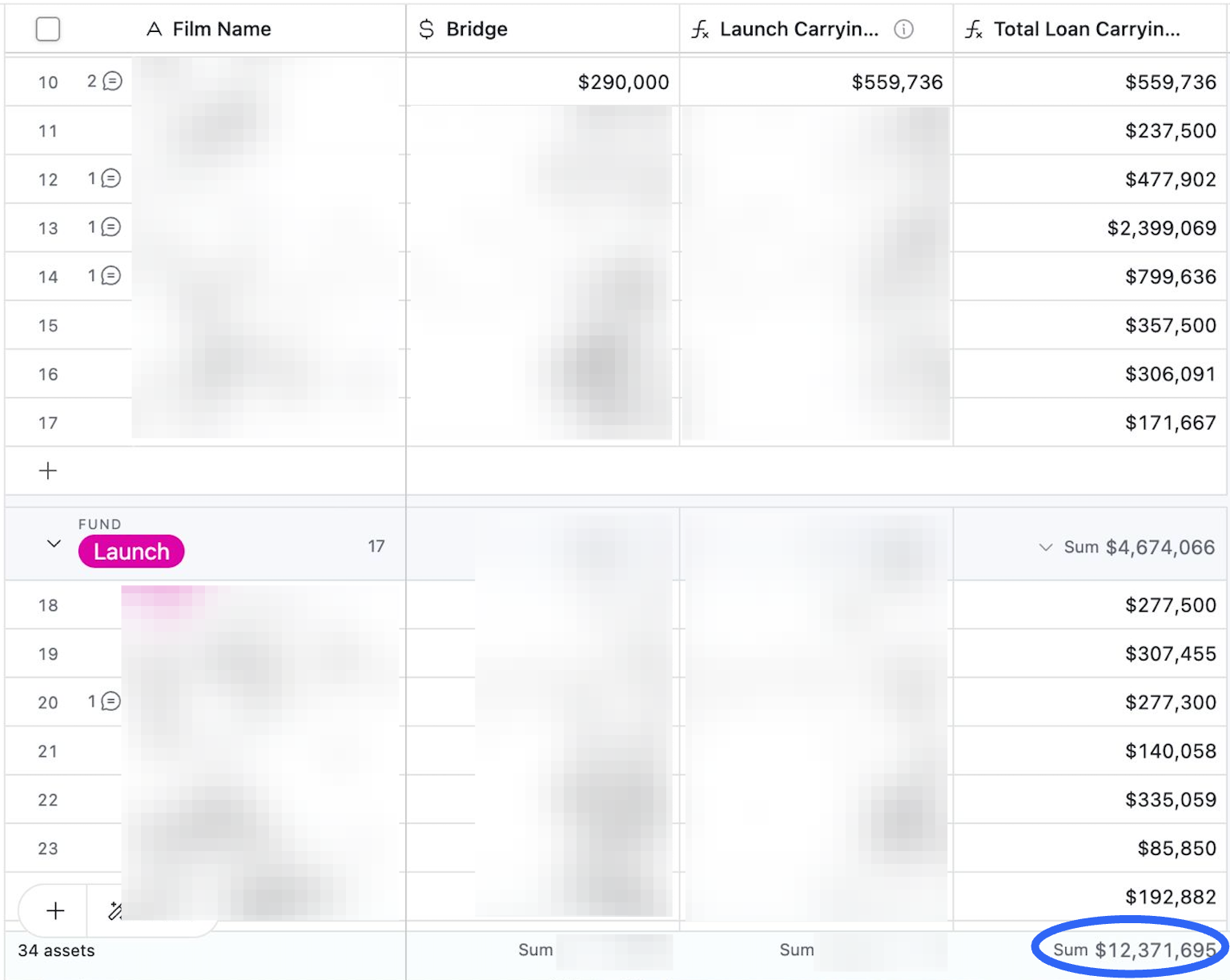
So — the deals are flowing, and our track record is building.
But we keep running into the same problem.
These closed-end funds are great, but how do we open this up to more people? How do we let the Altea community participate without committing to a blind pool upfront?
That question is what led us here. We'll come back to it in a moment.
First, let's explore how film bridge loans work.
This is not film equity investing
Say 'Hollywood' in an investment context and people immediately picture speculation. Chaos. Unpredictability.
And honestly, if they're thinking about film equity, they're not wrong.
Most film investments retail investors encounter are equity plays. You are buying a piece of the film. If it makes money, you make money. If it doesn't make money, you lose.
Remember, 80-90% of films lose money! This means deploying capital into film equity is usually more akin to entertainment speculation than serious investing.
As Wyatt puts it:
"Film equity investing is the entertainment equivalent of buying a vineyard."
What we do sits in a completely different part of the capital structure. It's called gap financing, and it operates more like private credit than anything you'd associate with Hollywood.

Yes, there's a "glitz and glamour" aspect to this world. But film bridge financing is essentially a form of receivables financing. The film industry just happens to be where it lives, which is both why it gets confused with equity investing, and why the pricing stays elevated.
Because institutional capital hears the word 'film' and walks away, the returns reflect a market that's been structurally undercapitalized for years.
For smart investors like you who understand this distinction, that's where the opportunity lies.
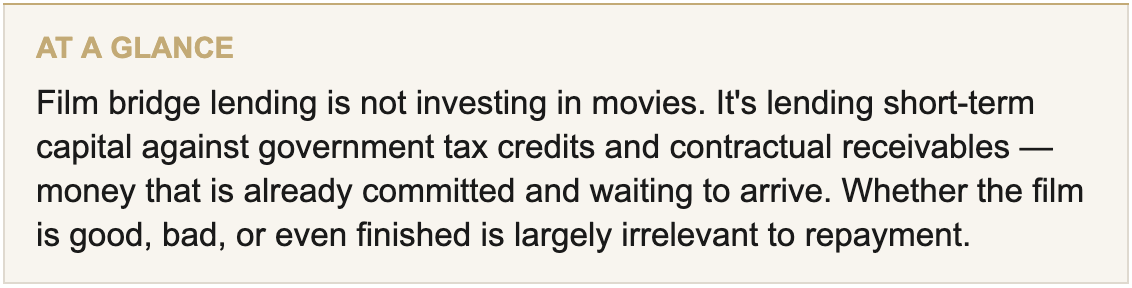
Every film has the same structural problem
Most people don't realize this about filmmaking: the money almost never arrives when you need it.
Think about how a typical independent production is financed. It's not one check from a studio. It's a patchwork of sources, including tax credits, distribution agreements, and senior lender facilities.
Each of these sources has its own timeline, conditions, and reasons for moving slowly.
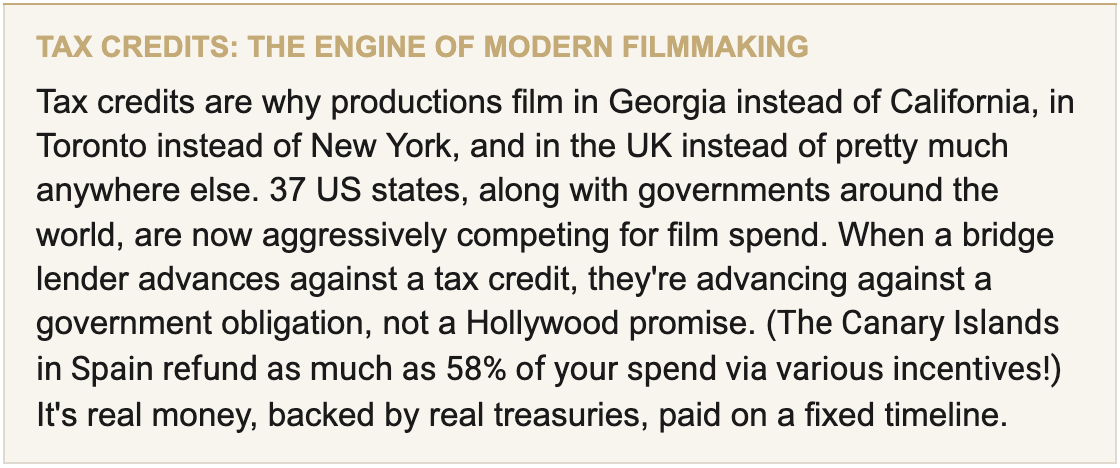
Take a recent production we funded in Georgia:
They had a state tax credit worth 30% of their local spend. This is a huge incoming payment to the producers, backed by the State of Georgia.
But that credit doesn't get issued until the money has been spent, a CPA audits the expenses, and a formal application is submitted. That process takes weeks. (Interestingly, a film never actually has to finish production to qualify.)
The same film had a distribution agreement guaranteeing a minimum payment on delivery. But the check only clears once the film is completed.
Finally, they had a specialist bank committed to providing most of the production financing. But the bank needed to finalize insurance, complete legal opinions, and satisfy its internal credit committee. More weeks. Possibly months.
So here you have a film with real, contractually committed money coming from three sources. None of it has arrived yet. And the location permits start in three weeks.
This is not a theoretical scenario. This happens all the time. On paper, these films are fully financed. But in practice, they’re stuck.
How our bridge lending works
These confirmed tax credit certificates, signed distribution agreements, and committed bank facilities are considered receivables — meaning it’s money that's contractually owed, but hasn't arrived yet. Each represents a documented obligation from a creditworthy counterparty.
So as a lender, we advance capital against these receivables. These are short-term loans, typically 8 to 20 weeks long.
When the longer-term money arrives, it repays our bridge. The producer stays on schedule. The lender earns a premium for providing speed and certainty during a compressed window.
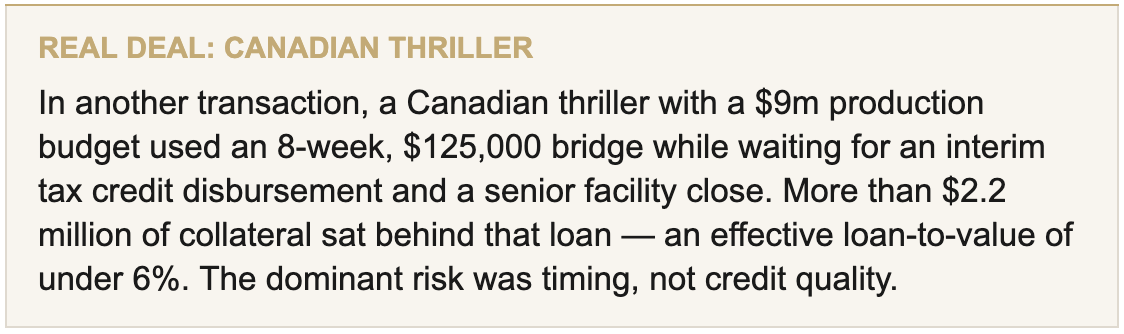
This isn't exotic finance. The same basic structure underpins trade finance, invoice factoring, and receivables-backed lending across dozens of industries. Film bridge lending simply applies it to a very specific type of contractual receivable.
As bridge lenders, we are not financing movies directly. We’re financing a timing mismatch.
The money is already coming. Someone just needs to show up first. That someone is us.
What actually secures these loans?
These loans aren't secured by "vibes and a prayer" (great name for a band!) They're secured by multiple, overlapping layers of hard collateral, always backed by government treasuries.
1) Government tax credits
37 US states now offer production incentives, alongside mature federal programs in dozens of countries, including UK, Canada, and Australia.
These credits are triggered by qualifying spend, not box office performance. Once the production has spent the qualifying dollars, the credit is owed. The state audits it, certifies it, and pays it on a statutory timeline.
This means a film can bomb critically and commercially and the tax credit still gets paid, because the credit is owed for what was spent, not what was earned.
Think about what this means for a lender. When repayment comes from a government treasury obligation, you're essentially holding the credit risk of a state or national government — the same underlying credit quality as a government bond.
The difference is that the duration is 8 to 20 weeks instead of 10 years, and the pricing reflects a market that hasn't figured that out yet.
Government-backed credit quality at non-government pricing is a very rare combination.

2) Distributor guarantees
In a distribution guarantee, a film distributor (A24, Lionsgate, Netflix, etc) pays a fixed sum upon delivery of the finished film meeting agreed specifications. Once delivered on spec, the distributor owes the money regardless of how many tickets it sells.
This guarantee is a floor, not a projection.
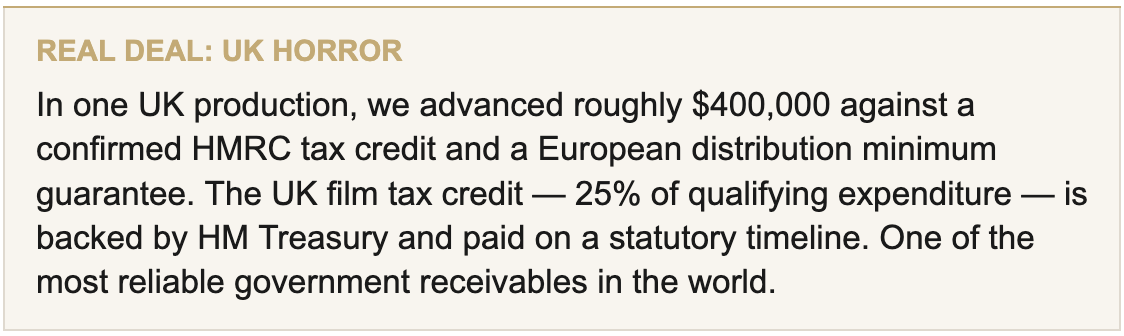
In one deal we've done, the distributor's commitment was backed by a bank-issued letter of credit, which effectively converted the film receivable into a banking instrument.
At that point, the lender's exposure looks a lot more like bank paper than entertainment speculation.
3) Additional security layers
Stacked on top of the bankable collateral, we also have:
First-priority lien filings under the Uniform Commercial Code (UCC-1 in the US, PPSA in Canada, debentures in the UK). We never take second position.
Copyright security interests registered with the US Copyright Office
Assignment agreements that redirect payment flows directly to lender-controlled escrow accounts
Irrevocable powers of attorney
Completion bonds issued by rated insurers.
When the money arrives, it lands in an account the lender controls. The repayment is structurally enforced.
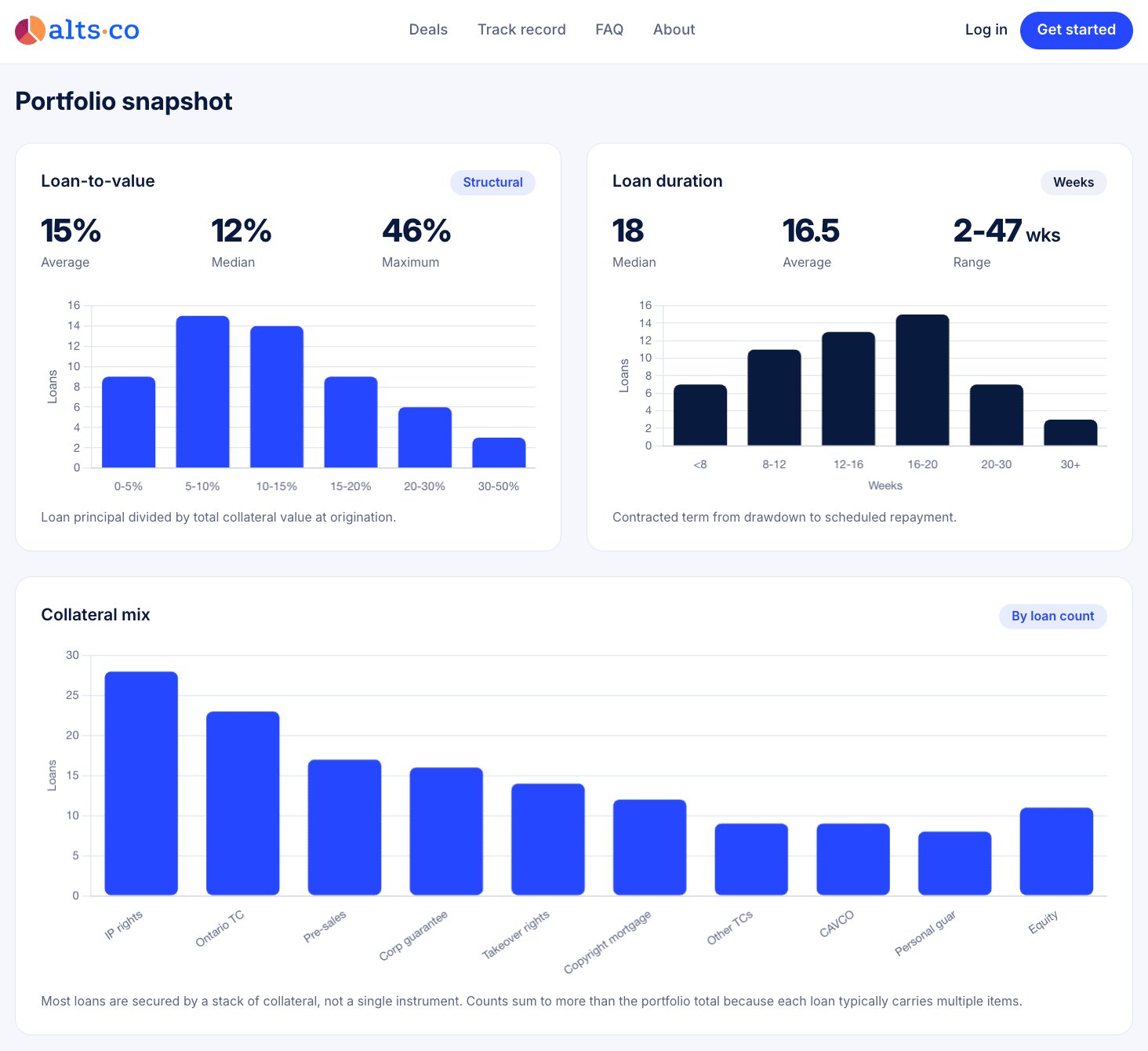
Each deal we do also goes through a structured collateral scoring process before a dollar is committed. Think of it like a scorecard that grades each collateral element and flags automatic declination triggers.
If a deal doesn't clear our minimum threshold, it doesn't get done.
Why don’t banks just do this?
If this all sounds relatively straightforward, the obvious question is: why haven't banks captured it?
Well, banks largely exited film finance after 2008, and Basel III made it worse. The capital treatment for film assets is punitive, so banks have every regulatory incentive to stay out.
So I see three reasons:
Ticket size is too small. Individual bridge loans typically run $50k - $500k. For a large bank, the administrative cost per dollar lent at this scale is prohibitive. The profit is a rounding error. For them, the economics aren’t meaningful enough to work.
Duration is too short. 8 to 20 weeks is too short for institutional lending programs. Bank credit processes are designed for multi-year facilities. A loan that repays before the annual review cycle doesn't fit their business model.
Collateral complexity. Evaluating a Georgia tax credit, or assessing the enforceability of a pre-sale agreement with a German distributor, requires specialist knowledge that a generalist loan officer doesn't have.
On a personal level, I think the banks just don't understand this stuff.
Remember, film finance has a reputation problem, and most institutional credit teams have never bothered to look past it. The collateral structures aren't that different from trade finance or receivables lending — things banks do every day. But 'film' triggers a hard pass before anyone reads the term sheet.
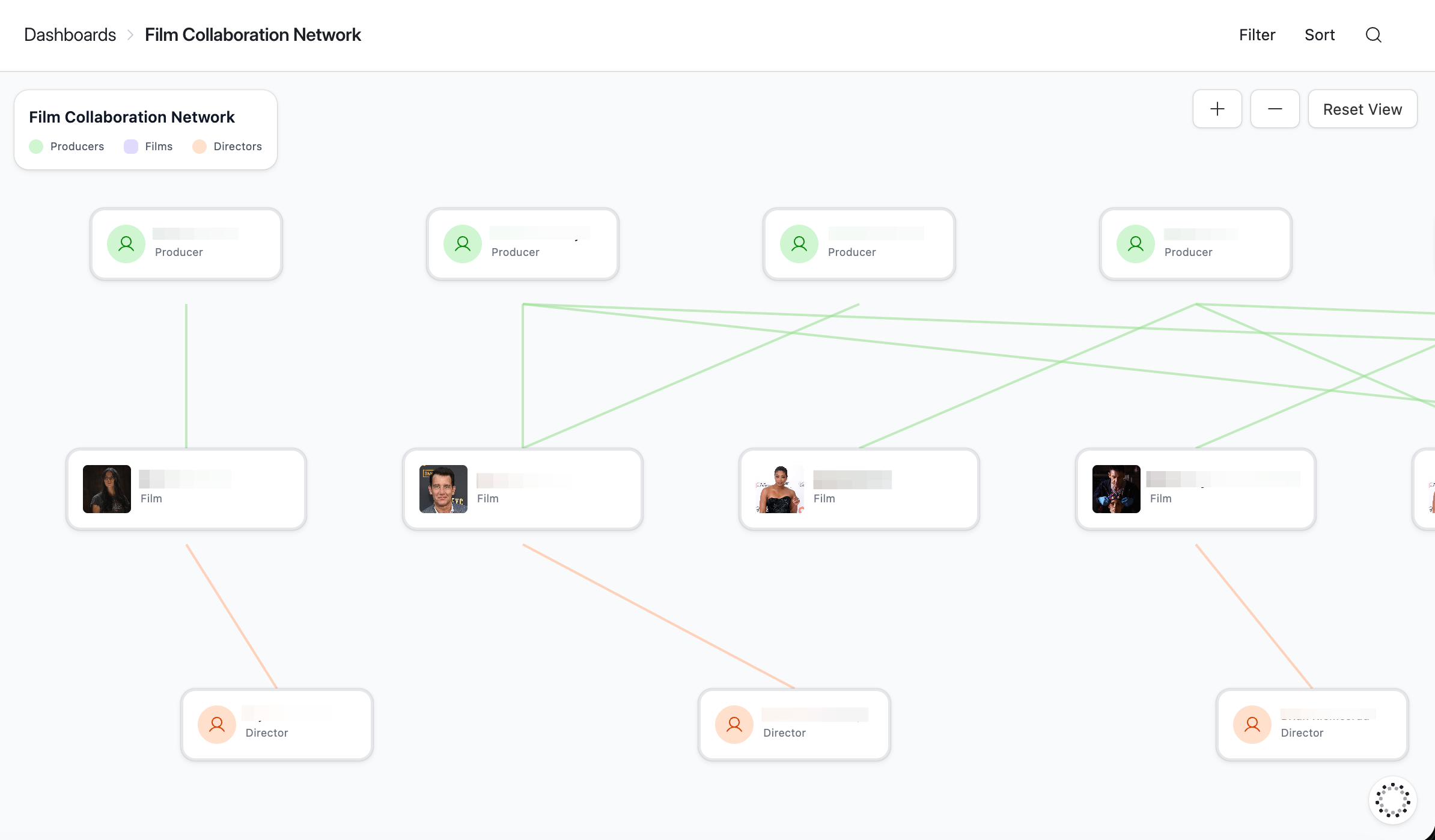
This is a personal world, a complex web of relationship building. When they do enter this space, banks typically do senior lending, where they advance eg 80% of a loan against a tax credit. But the facility is bigger or longer.
The complexity is real, but it's learnable. You've just spent ten minutes learning it. Most bank credit committees never will. The word 'film' keeps institutional capital away.
The result is a persistent, structural investment opportunity. Not because the risk is high. Because the specialist expertise to underwrite it properly is scarce.
We operate in this gap.
🫵 You can now invest alongside us!
So. Back to what we've built.
Film I and the Launch JV are closed to new investors. But we now have two new ways for the Altea community to participate directly: co-invests and takeouts.
Co-invests
A co-invest is exactly what it sounds like.
When we originate a new bridge loan, we offer Altea members the opportunity to invest alongside us from day one, in that specific deal, on identical terms.
You see the loan summary, the collateral stack, the loan-to-value ratio, and the expected duration before you commit a dollar. No blind pool. No upfront commitment to deals you haven't seen.
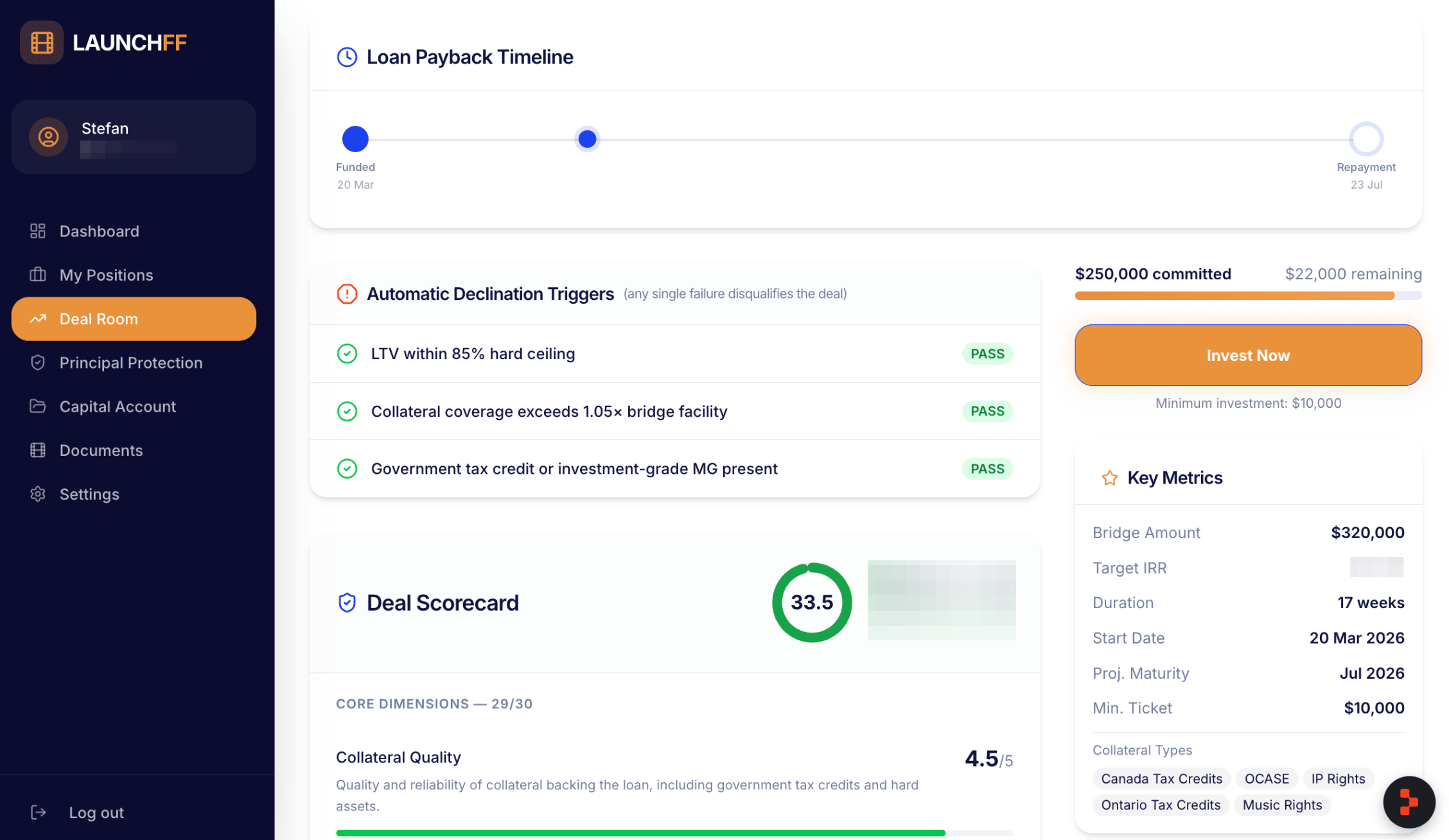
We share in both the upside and the downside proportionally. If the deal does well, everyone does well. If it doesn't, we're in the same boat.
Our first co-invest was a $235,000 bridge loan. We syndicated $186,935 of it (80%) to members who wanted direct exposure. That's the model.
The structure is pari passu: we put our own capital into every deal at the same level as co-investors.
Takeouts
Takeouts are the other side of the coin.
Instead of joining a loan at origination, you're buying into a position that already exists — one that's been seasoned, is already secured, and is partway through its timeline to repayment.
In one recent case, we were carrying roughly $312,000 of exposure on a loan that had already been partially syndicated. We sold $252,000 of that position to members, reducing our net exposure to $69,000 and returning cash to the balance sheet for new deals.
Members who took the takeout stepped into a loan that was already closed, already secured, and already ticking toward repayment.
Takeouts tend to have higher origination friction and less predictable duration than co-invests. You're stepping into a loan mid-life, so the remaining timeline depends on where that specific production is in its process, which varies more than it does at origination.
Remember, these are illiquid private credit notes. You're in until the loan repays. If that takes longer than projected, the collateral protections remain in force the entire time, and penalty interest accrues in your favour for every additional week.
That said, the collateral stack is already in place. Liens are filed, receivables are assigned, and the security structure is established before you step in. You're not taking on more credit risk, you're taking on less timeline certainty.
New investor portal
Both co-invests and takeouts flow through our shiny new investor portal.
We have new loans you can invest in right now.
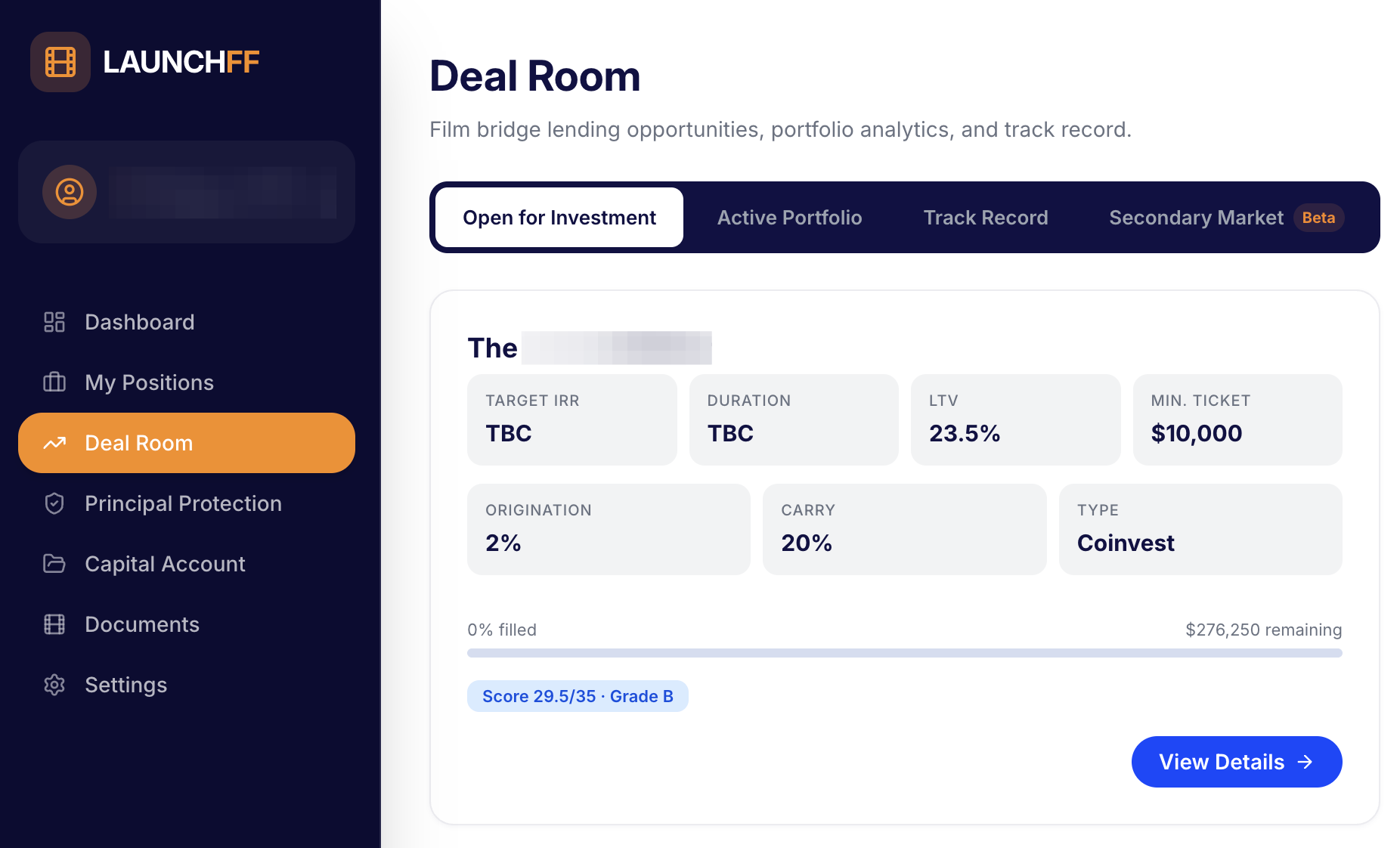
Qualified investors can see the active deal pipeline, review collateral summaries and the full scoring report for each opportunity, and opt in deal by deal. Six loans have already been syndicated to investors. Minimum ticket size is $10,000 per deal. Typical hold period is 8 to 20 weeks. Capital is returned upon loan repayment.
Our platform comes with rigorous, standardized underwriting that gives you a genuinely powerful amount of information on each deal.
Reporting is in real-time via dashboard, not a quarterly letter.
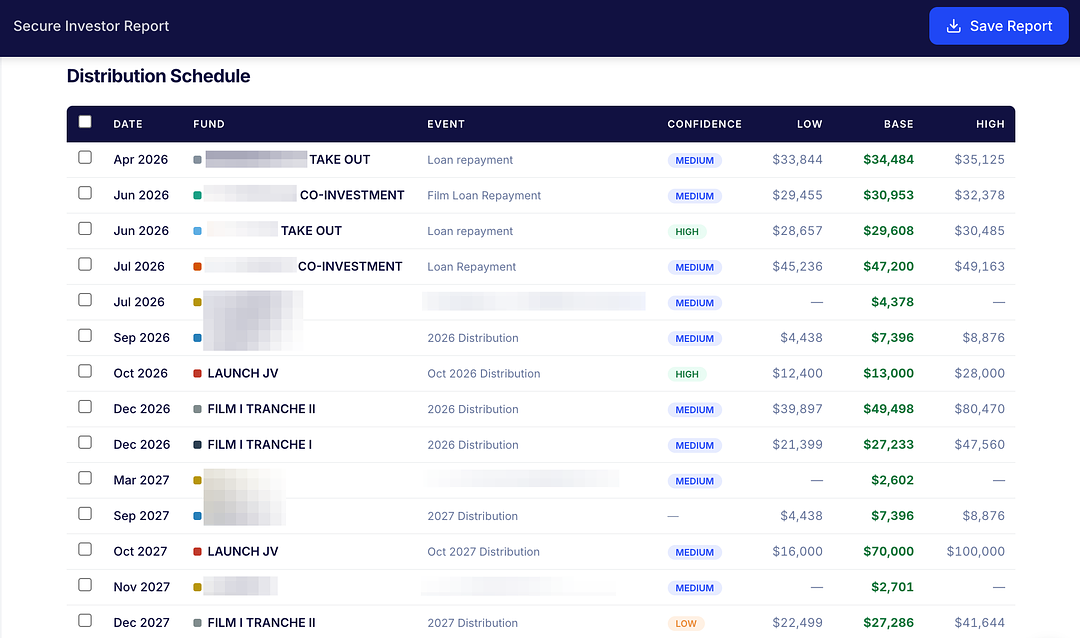
START NOW: 3 steps
First things first: Access to these loans is strictly limited to verified accredited investors.
You'll need to sign an NDA, verify your identity, and prove your accreditation status before seeing deal-specific information. This keeps the pipeline protected for everyone in the program.
Step 1: Qualification form
This is a short application to determine if you’re a potential fit.
Step 2: Take our free course
To make sure you’re prepared for this world, we’ve built a free five-module course on film bridge lending. What it is, how the collateral works, the common misconceptions, where it fits in a portfolio, and how to evaluate an opportunity.
This course is designed to get you up to speed quickly. If you’ve made it this far in the issue, you’re halfway done.
There's quiz at the end. Passing the quiz will give you the confidence to invest in our deals (and +50 points in our Rewards Program.)
Step 3: Sign NDA
If approved, you'll receive an NDA to sign. From there you can log in to the portal, access to the deal pipeline, full collateral scorecards, and co-invest invitations as deals come through.
Closing thoughts
This specific film bridge financing market — a market which very few investors know exist (and frankly, a market which we helped bring to life!) — is what our company is all about.
Very few firms out there are doing anything close to this. We've spent the past 16 months building the relationships, track record, the relationships, and the infrastructure to do it right.
Now we're inviting our community in.
If you want to go deeper before doing anything — and I'd recommend it — take the course. Fifteen minutes, built specifically to take you from zero to genuinely understanding this world. By the end, you'll be asking better questions than most people who've been in finance for years.
If you're already convinced, or want to move faster, express interest through this form. We'll take it from there.
---
That’s a wrap! 🎬
See you next time, Stefan
Disclosures
This issue was written and edited by Stefan von Imhof, with a massive amount of help from Wyatt Cavalier, the big brain behind Launch Film Finance.
This issue has no sponsors or affiliate links.
As always, nothing in this issue is investment advice. These are my observations about an asset class I've been operating in, not a recommendation to invest. These opportunities are available to verified accredited investors only. Please consult your own advisors before making any investment decisions.