Recap of our Investor Trip to Japan
We just wrapped up our third investor trip to Japan with ten Altea members and a terrific lineup of guest speakers.
This was our most ambitious trip yet. We arrived eager to experience bullet trains, bowing, noodle slurping, and the world's best convenience stores.
We returned with lifelong friendships, new deals to diligence (including an exciting SPV we’re cooking up with our friends at Senjin Capital), and an appreciation for the spotless streets and impossibly polite Japanese people.
Over five days in Tokyo and Nagano, we met activist investors who buy companies for less than the cash sitting in their bank accounts, heard from an expat who has spent 40 years in Japan and now acquires and renovates entire villages, and learned from the most famous bonsai master in the world.
Shoes were removed (repeatedly), bonsai were appreciated, a sumo wrestler was challenged (thanks, Matt), and a few brain cells were lost to cask-strength (68%!) whisky.
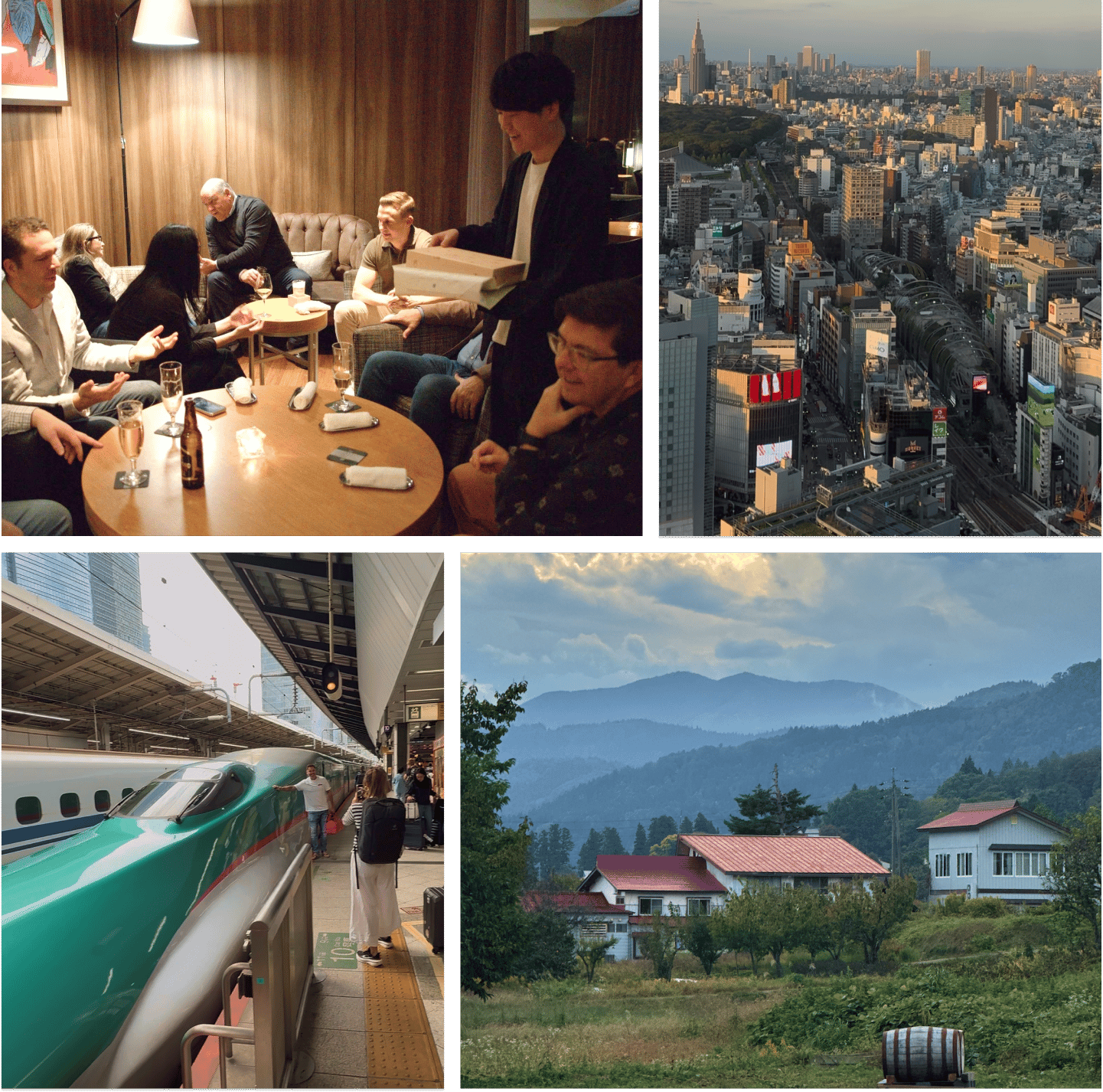
Clockwise from top left: Hayato-san surprises us at welcome drinks with cookies from a 300-year-old bakery | The Cerulean Tower rises above Shibuya, with Shinjuku in the distance | Bottom row: aboard the Shinkansen bullet train, from Tokyo to the mountains of Nagano.
So, what did we learn? Where are the real opportunities? What are the big takeaways?
Read on, I’ll tell you all about it 👇
Rich companies, cheap stocks
Japan's massive equity discount
Imagine a stock trading for less than the cash in its bank account.
That's the pitch from James Halse and Toby Umezaki, co-founders of Senjin Capital, who kicked things off for us Monday morning.
You may recall Senjin from our issue a few months ago, where we explained why Japanese boards went from dodging questions about their lucrative assets to asking activists what they should do with it.
Last week, James and Toby went a level deeper: what they actually buy, why Japanese small caps are so cheap, and how they get a return.
In the clip below, Toby explains the type of companies they look for. Their first investment was a manufacturer of metal fittings for electric poles: a rock-solid business whose sales only dipped about 1% during Covid.
This company's cash, securities and Tokyo real estate add up to more than its entire market cap, and that is exactly the type of value stack Senjin looks for — a prime candidate for constructive activist investing.
A typical stock picker is forecasting future earnings and basically guessing what multiple the market will pay for them. Senjin approaches the companies in good faith and creates the result themselves.
"We're not just there to make a quick buck, we're bonafide investors looking to help them improve...It becomes much more of an execution challenge, than trying to outthink every other investor who's looking at the same stock." — James Halse
James explains their process:
Why the cash piles up
Why would a company sit on a mountain of cash?
Because historically, shareholders were never the point.
"It’s much less important to have cash in the bank than it is to have status... What matters to the Japanese management teams is preserving the company for the future, serving their customers, ensuring that all of their employees continue to be employed forever."
— James Halse
Lifetime employment worked brilliantly during Japan's growth era. Then came the bubble, followed by competition from Taiwan, Korea and later China.
Since nobody could be let go, companies never restructured. They kept their fingers in hundreds of subscale businesses instead of focusing on the core.
Then James dropped a stat that stopped the room: about 90% of Japanese public companies don't have a CFO! Finance typically sits inside a "corporate planning" department and is treated as a clerical function. Concepts like the time value of money rarely come up.
In fact, one of Japan's most profitable blue chips, running 50% operating margins, famously boasted it could keep paying its staff for 25 years with zero revenue.
James was careful to say this isn't incompetence. Picture living on an isolated island for 50 years, he said, where everyone around you has worked at the same company their whole career. Nobody arrives from Goldman Sachs or McKinsey. If you work at a car company, you make great cars. You don't try to financially engineer your earnings per share.
The less charitable version? Some of these companies run like a "nursery for adults."
How Senjin earns a return
Senjin hunts in Japan's micro-caps: roughly 2,500 listed companies worth less than $300 million.
There are no big institutions to rally at this end of the market, so Senjin builds stakes of 10-20% and goes to work. Politely, privately and patiently.
When it works, there are three ways out, typically within 18 to 24 months:
Higher dividend payouts. Japanese stocks tend to trade on their dividend yield, so if a company moves from a 30% payout ratio to 90%, the share price can roughly triple.
A private equity takeout. Japan-focused PE funds raised $15 billion last year, and buyers routinely pay 50% to 60% premiums.
A buyback of Senjin's own stake. Companies like this option: it gets rid of the activist, shrinks the cash pile, and raises the share of friendly holders on the register.

Senjin’s first investment makes the metal fasteners on Japan’s electric poles. At a $50 million market cap, the company held about $45–50 million in cash and securities, plus a central Tokyo factory worth another $25–30 million. Senjin now owns just under 20%, and the company is paying out more than 100% of its earnings.
Introducing Japan I
Senjin's fund normally carries a $250,000 minimum. We're putting together Japan I, an SPV with James and Toby that gives accredited investors access at a much lower entry point.
If you're accredited and want to be first in line, express interest.
Express Interest in Japan I →
Bonsai Day 🌳
Shunkaen: An oasis in Edogawa
Bonsai Day was probably my favorite day of the trip.
Our friend Hayato-san organized an afternoon tour and tea ceremony at Shunkaen Bonsai Museum, a serene, private Shangri-La tucked into a quiet residential corner an hour east of Shibuya.
As capitalists, it’s easy to get swept up in the rush of dealmaking and miss the forest for the trees. But sometimes the trees are worth slowing down for.
Shunkaen is world-famous, and easily one of the finest bonsai collections on earth. If you’ve ever seen a photo of a spectacular bonsai, there's a good chance it was taken here.
Some of the trees are over 600 years old, and the oldest is estimated at over a thousand. They were growing before Europe knew the Americas existed. They’ve watched the samurai rise and fall, and Tokyo burn and rebuild twice. A few are worth over a million dollars. In truth, they’re priceless.
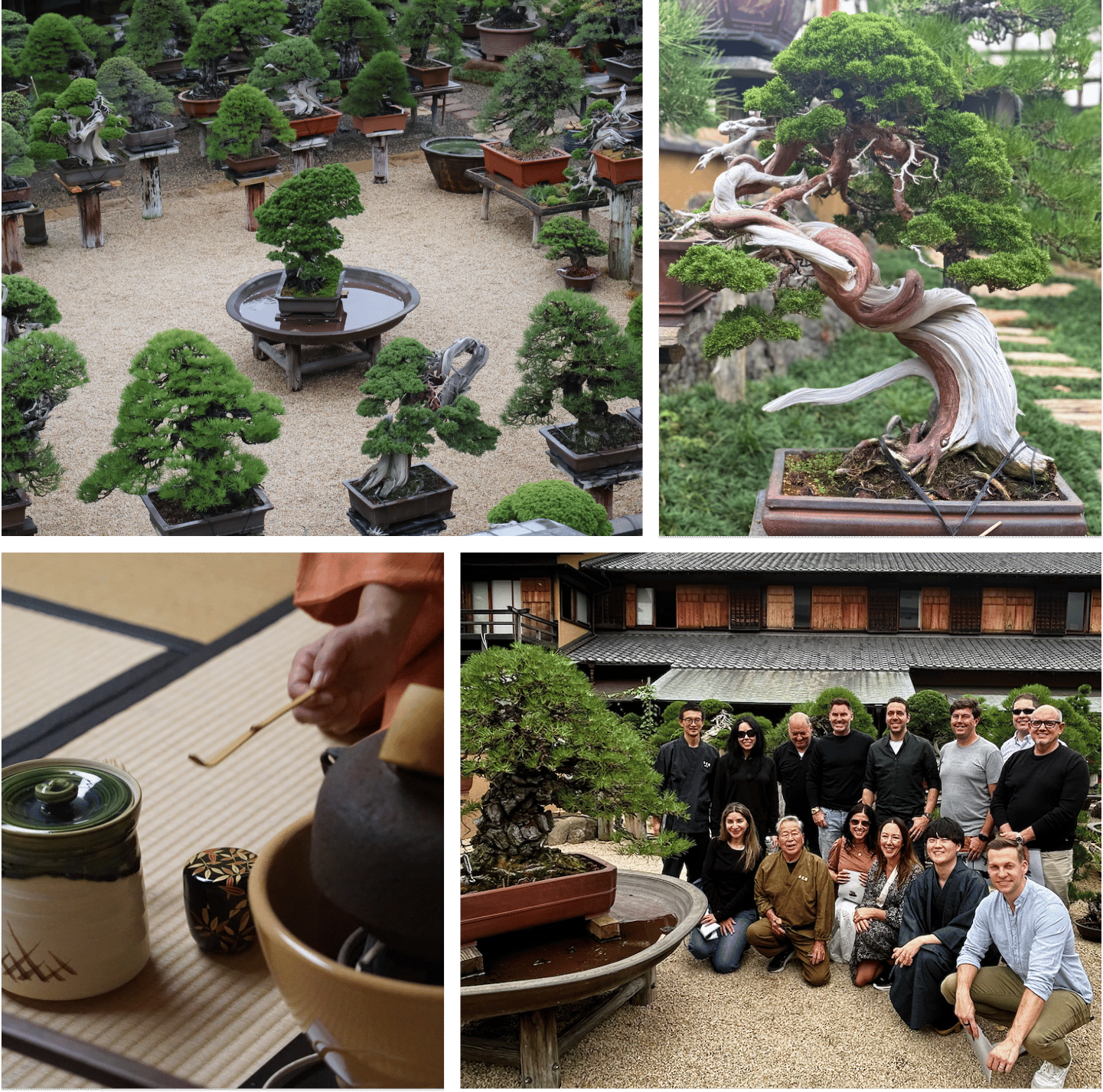
Clockwise from top left: Shunkaen’s courtyard greets you with a 1,000-year-old pine at its center | One of my favorite trees: a shimpaku juniper, its living bark spiraling around deadwood | Our group with Master Kunio Kobayashi (front, in brown) | A tea ceremony closed out the afternoon.
The world's most famous bonsai master
Master Kunio Kobayashi opened Shunkaen in 2002. Today it’s home to more than 1,000 trees and welcomes about 50k visitors a year, most from overseas.
He’s arguably the most decorated bonsai artist alive. He has won the Prime Minister’s Award four times, and trees under his hand have taken the Kokufu Prize 16 times.
We got a private tour with Master Kobayashi himself, translated by Jin-San — the museum’s director who spent six years as Kobayashi’s live-in apprentice and became director in 2018.
Shunkaen draws a remarkable crowd, and his trees command serious money. Jeff Bezos, Cameron Diaz and Leonardo DiCaprio have all visited, and Jack Ma bought a tree here for ¥10 million.
Japanese politicians and business leaders keep their own trees in the garden’s care. An 800-year-old juniper he exhibited in Kyoto in 2023 was valued at $1m.
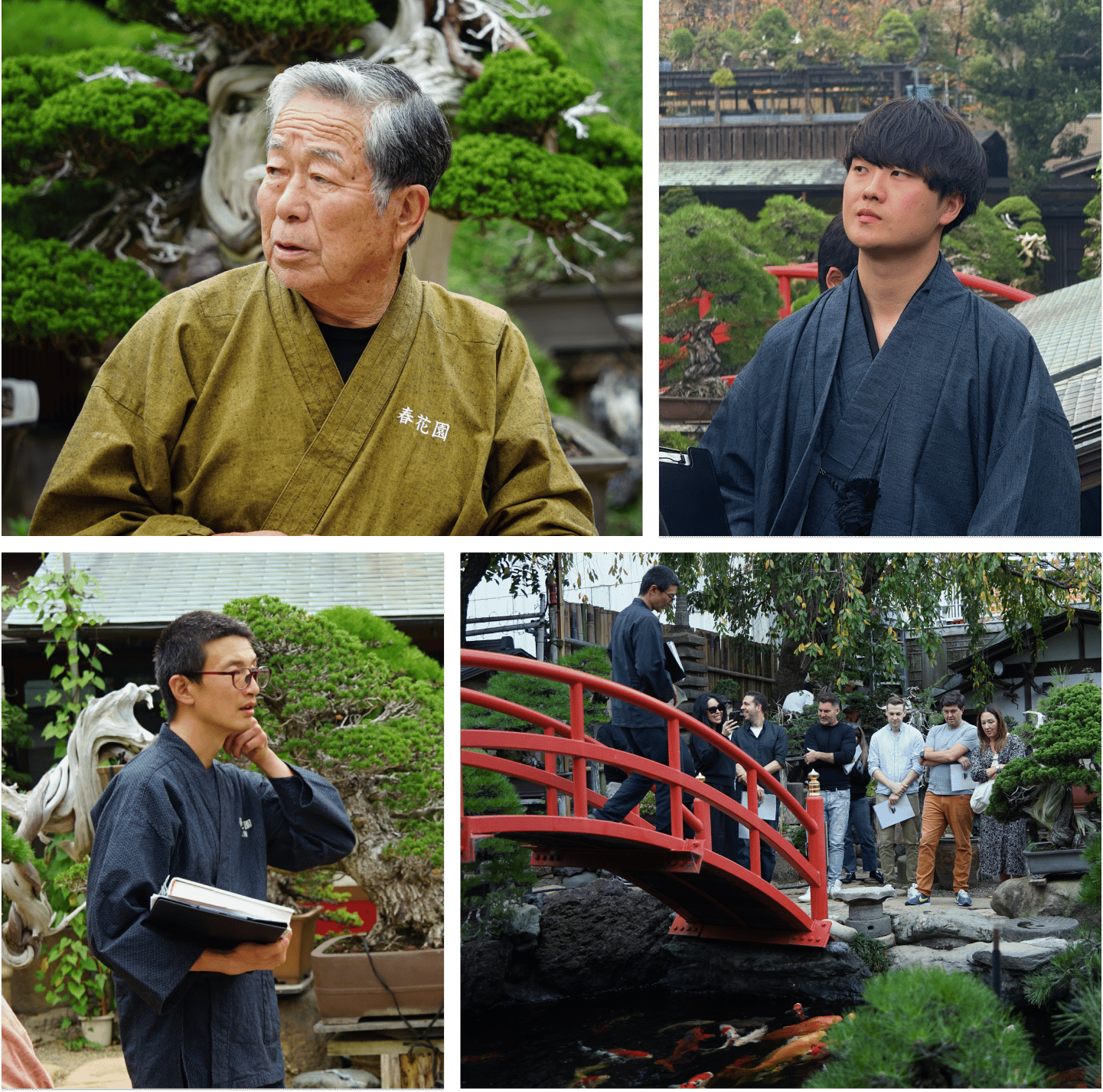
Clockwise from top left: Master Kunio Kobayashi, who taught himself bonsai after age 28 and went on to win the Prime Minister’s Award four times | Hayato-san, who studies keido (the art of bonsai display) under Master Kobayashi | Crossing the red bridge over Shunkaen’s koi pond, another Japanese art form where a single champion fish can sell for over a million dollars | Jin-san, the museum’s director and Kobayashi’s former live-in apprentice. Bonsai Day wouldn’t have been possible without their help. 🙏
Life and death in the same pot
What struck me most was the wood.
An old prized juniper has bleached, silvery dead wood twisting around thin veins of living bark. Artists keep this dead wood on purpose, and even carve it.
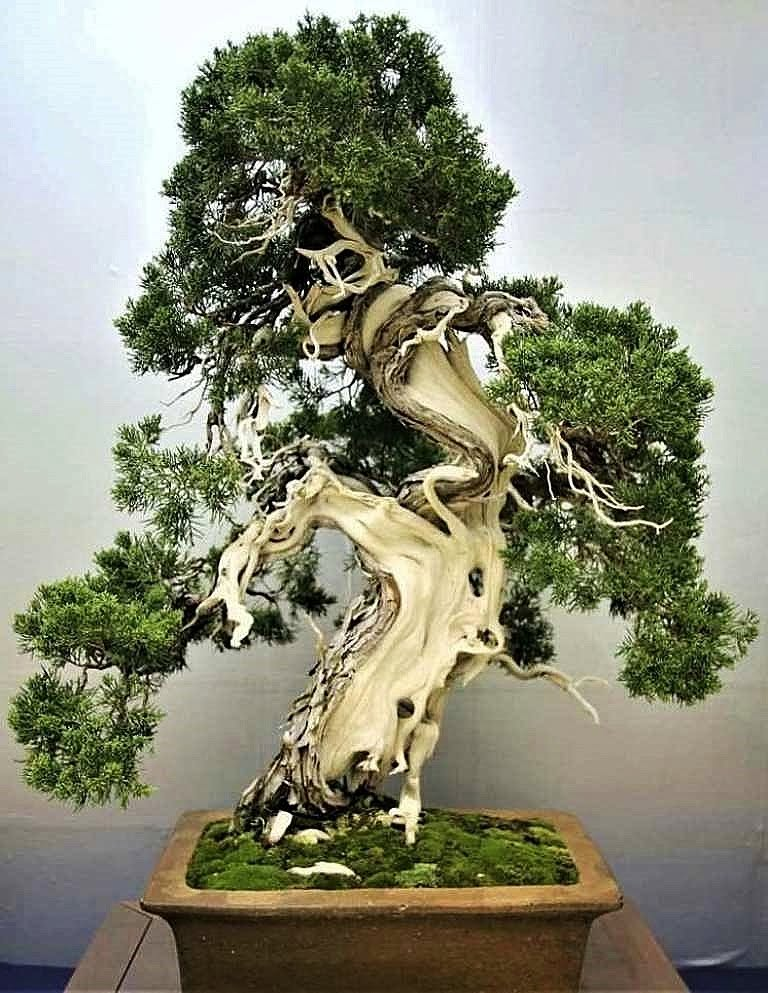
Seifu, my favorite tree at Shunkaen. Notice the marbling: the bleached white wood is the part of the tree that has died, while thin ribbons of living bark keep the rest of it alive. It's a record of everything the tree has survived.
Seeing Chinese penjing 20 years ago changed Master Kobayashi’s style, and in 2015, he restyled this juniper with those ideas.
We learned that a bonsai artist’s work is mostly about taking things away: pruning, thinning and leaving negative space so the tree can breathe. As someone who spends a lot of time thinking about adding features, that lesson hit home.
The Japanese have a name for this way of seeing: wabi-sabi, the beauty of things that are imperfect, impermanent and incomplete.
How Azukari bonsai investing works
Demand from overseas is rising fast. Legitimate ways to buy are not.
As Hayato wrote about in Bonsai as an Alternative Asset, the best trees are not allowed to leave Japan. Exporting one means stripping its soil and regrowing it for years under inspection, which can kill a tree that has lived in the same pot for decades.
Hayato’s answer is simple: The tree stays in Japan, in the hands of the artist who knows it. Only the ownership travels.
How it works:
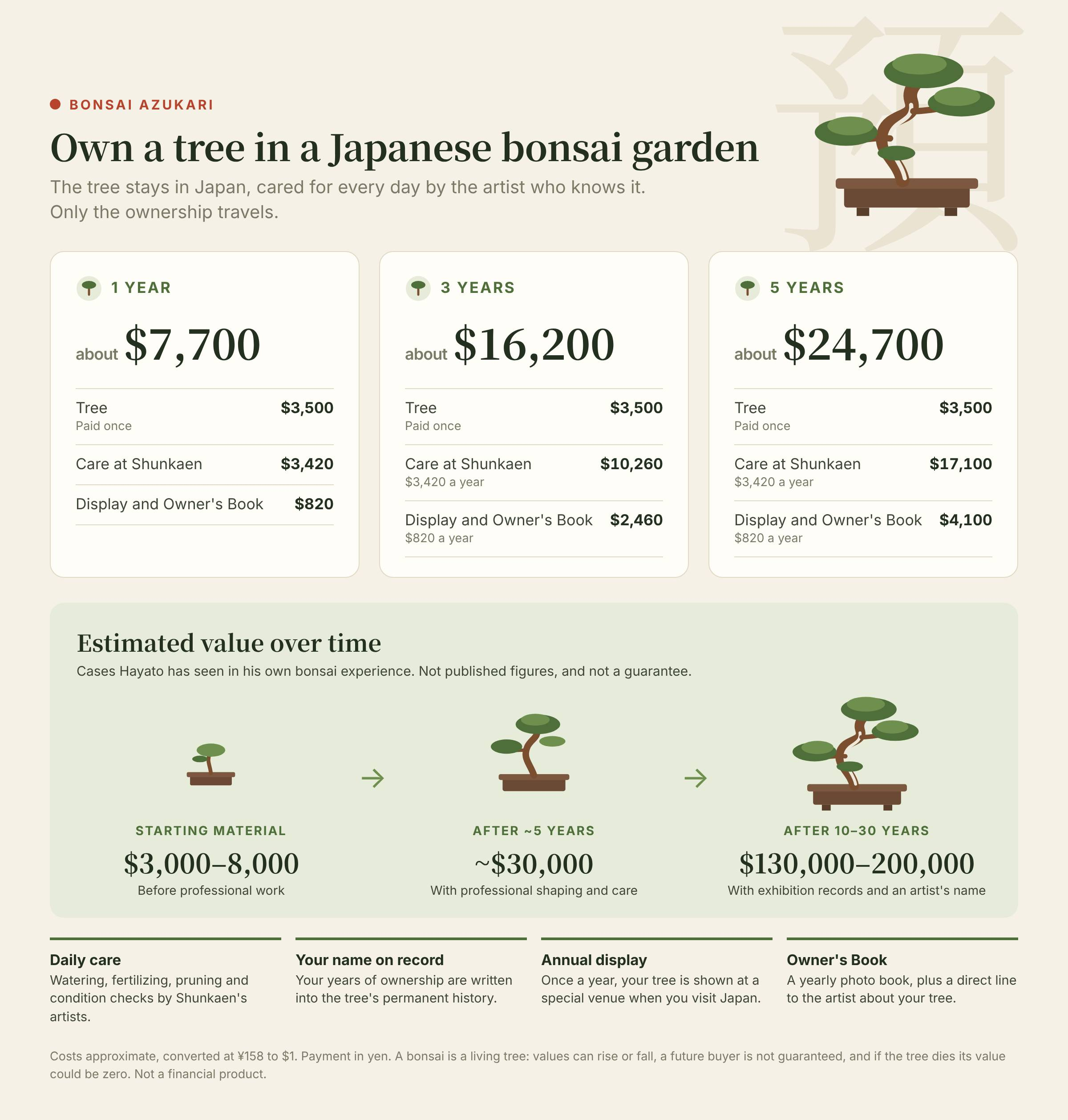
There are three ways to exit:
A closed auction for trade professionals (available now)
Azukari’s own online auction (next year)
Public offers from buyers in Japan (next year)
How much can a bonsai tree appreciate?
Hayato has seen $3k-$8k material reach around $30k after about five years of professional work. He has also seen trees reach $130k - $200k after 10-30 years, once they carry exhibition records and an artist’s name.
At the very top of the market, a Japanese white pine sold for about $1.3 million at a 2011 convention.
What are the risks?
Hayato is upfront about them. Neither appreciation nor a future buyer is guaranteed. There’s no refund during the term and no insurance. And if the tree dies, its value could go to zero.
Interested in owning a tree at Shunkaen? Have questions?
Express interest below and Hayato will be in touch.
Express Interest in Bonsai →
The man who buys empty villages 🏯
If James and Toby buy companies nobody else is looking at, Terrie Lloyd buys the houses nobody else wants.
Terrie landed in Japan in 1983 with a backpack and a head full of ideas. He has since started 18 companies — including JapanTravel.com, which helped organize this very trip — and sold 8 of them.
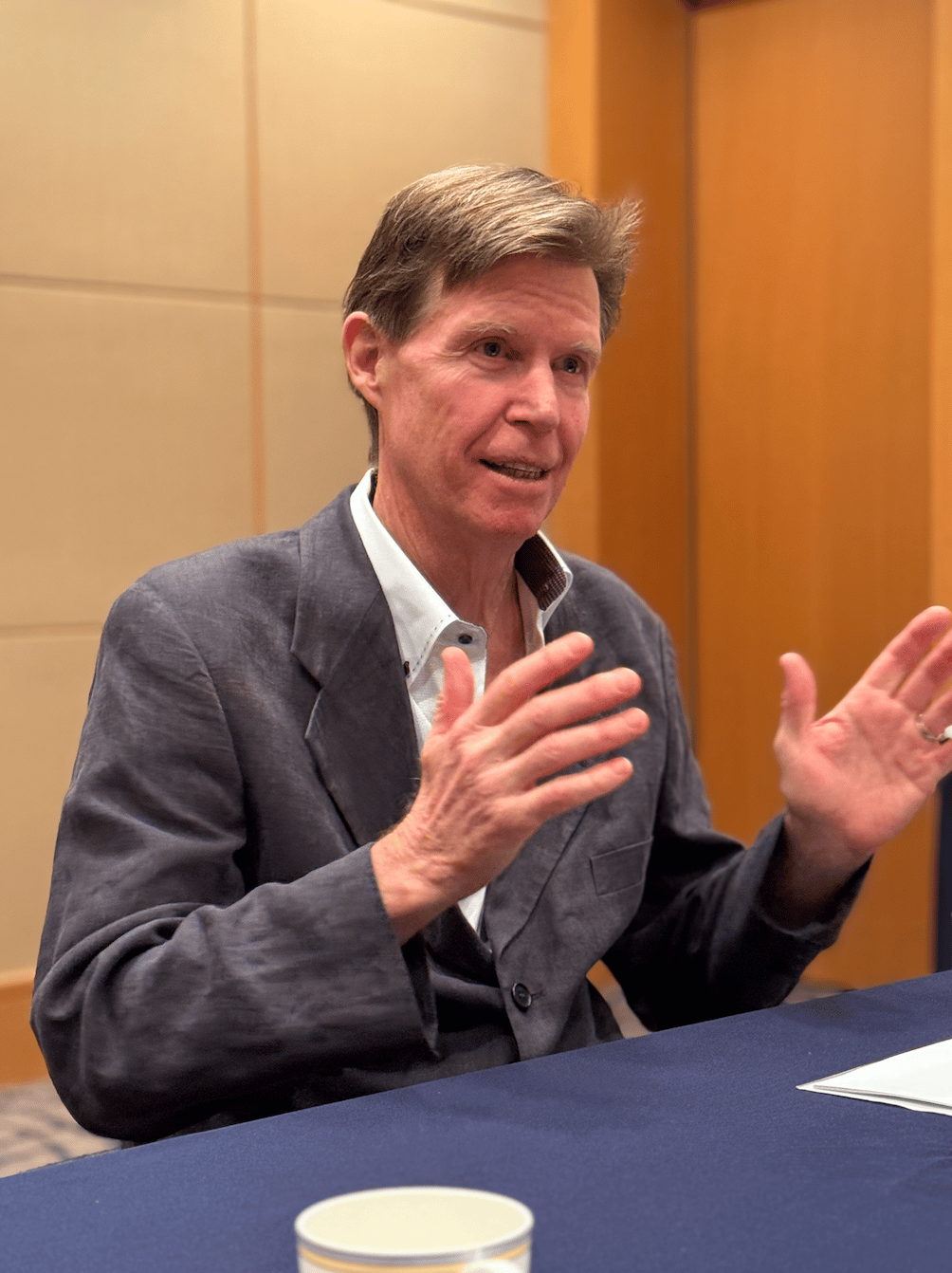
Tourism has since gone from a minor sector to one of Japan's biggest, and visitor spending per head has roughly tripled along the way. Terrie Lloyd has not only witnessed the boom, he’s helped build it.
Why Japan has so many empty houses
As we explored recently, Japan has around 9 million vacant homes. Terrie believes about a third of those are realistically on the market. The rest are "mostly pretty horrible, you wouldn't want to live there."
So why don't people knock them down? Taxes.
See, land with a house on it is assessed at one-sixth the rate of empty land, so owners let houses rot rather than clear them.
A 2023 law lets cities remove that tax break from neglected homes, and Terrie expects broader reform within five to ten years, which could release a lot of new land.
In the meantime, has seen what happens when foreigners spot value first. Japan has long been a top skiing destination for Australia. In Niseko, Aussie entrepreneurs bought land at around $3.17 per tsubo (3.3 square meters). Today it trades above $6,300!
Singaporeans are now the largest source of real estate capital. Aussie investors have since moved on to ski towns like Nozawa Onsen and Myoko — not too far from where we visited in Nagano.
Owning the whole pipeline
Terrie's real play is entire villages.
It starts with a single house and a lot of patience. One waterfront plot took him four years: a year waiting for a spirit blessing ceremony, a farmland conversion, and two boathouses stuffed with three generations of fishing nets.
But once the neighbors see you're responsible and friendly, the next house comes easier. Then the next.
"Nothing is difficult in this country as long as you're willing to do the paperwork."
— Terrie Lloyd
His first project sits in Amazaki, a village on the island of Omishima. The house opened in June and is already the top-performing Airbnb on the island. It breaks even at about 20% occupancy, and at 50% Terrie projects a 17% to 20% annual return. A second house around the corner is under renovation now.
A normal person would have trouble doubling occupancy. But Terrie has an unfair advantage: Through Japan Travel, he can see exactly where tourists are going and where there aren't enough beds for them.
For example:
360,000 cyclists ride past Omishima each year, yet the island has only around 60 rooms
Pilgrims flock to the Kumano Kodo trail and the mountaintop temples of Koyasan with the same problem
Terrie counts about half a dozen destinations like this across Japan.
So he buys and renovates traditional houses in exactly those places. Then Japan Travel sends guests their way, from cyclists and hikers to wealthy Japanese families and corporate retreats.
This is the brilliance of Terrie's strategy. And if this type of end-to-end control sounds familiar, that's because it's a very Japanese way to do business. We wrote about zipper giant YKK, which smelts its own brass, builds its own machines and even makes its own shipping boxes to eliminate every failure point.
Terrie is running the same playbook on rural tourism: he sees the demand, builds the supply and delivers the customers.
Akiya 2.0
The plan is to scale up to clusters of about 30 akiya per location, enough to host a corporate retreat, and eventually 100 houses across 10 clusters.
Terrie is especially focused on the Seto Inland Sea, "Japan's Mediterranean," where foreign hotel brands are starting to arrive.
He thinks the window to buy there is three to five years:
We’re planning something together with Terrie for early 2027.
There are two ways in. You can buy and renovate your own akiya with help from Terrie’s team, or invest alongside him in Akiya 2.0’s village projects, with options for both accredited and non-accredited investors.
Curious about either one? Express interest.
Express Interest in Akiya Homes →
A short sumo break 🤼
After a morning of balance sheets, it was time to watch some enormous men push each other around.
We took a bus across town to Sumida, home of the Tokyo Skytree, as well as Tokyo's sumo tradition.
Our destination was Dosukoi Tanaka, a restaurant built around a real sumo ring and run with former wrestlers. The big tournaments only happen six times a year, so a private show like this is the best way to see sumo up close the rest of the time.
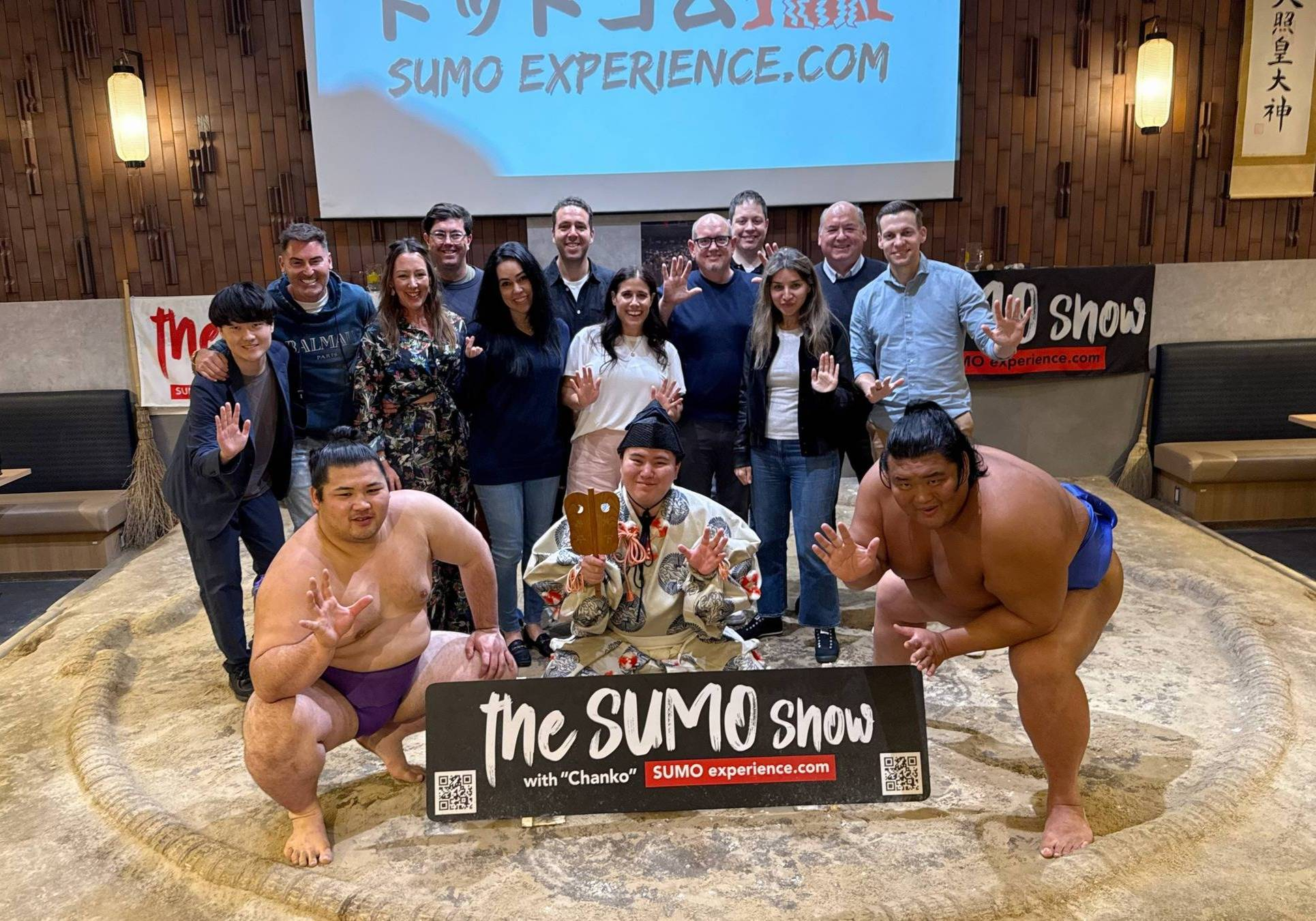
There are two things nobody tells you about sumo. The first is how flexible the wrestlers are, and the second is how short the matches are.
A typical bout is over in ~7 seconds. Everything else is ritual, so the show filled the gaps with history, techniques and highlight reels.
It turns out a big story in sumo right now is how foreigners are starting to win — especially those from Mongolia and eastern Europe.
Nearly a quarter of top-division wrestlers are now foreign-born.
At this month’s Sumo World Championships, Ukraine shared the gold medals with Japan.
The sport’s hottest star is Aonishiki, a 22-year-old Ukrainian who fled the war in 2022 and has already won three top-division titles.
Inspired by this new era of foreign champions, we decided to put our own contender into the ring with a wrestler: Matt, the strongest of the bunch.
As you can probably guess, he didn’t stand a chance. Absolutely ridiculous.
In his words, it was "like pushing up against a brick wall." 🤣
Startup pitch competition 🚀
We covered our startup pitch event in last week's issue. The group voted Floatmeal the winner for its fast-growing alternative protein.
Let me know if you'd like to invest in, partner with or simply connect with any of the six founders.
Farm-to-bottle whisky in the Japanese Alps 🏔️
On Wednesday we caught the 8:41am bullet train to Nagano. (Not 8:40, not 8:42. I'm talking 8:41 to the second. The Shinkansen waits for no one.)
Shinkansen’s average delay is 24 seconds, with no passenger fatalities since 1964. Nearly all Japanese trains are privately run.
Up in the mountains, we hiked through a cedar forest to Jigokudani, home of the famous snow monkeys that soak in hot springs all winter. In October they're usually shy, but we lucked out and spotted one.
But our final stop was Kiyokawa Mountain Farm Distillery up in Iiyama, one of four distilleries that make up our Whisky I SPV.
Most Japanese whisky starts with imported barley, but Kiyokawa grows its own. Founder David Troiano says Kiyokawa is Japan's only farm-to-bottle distillery. Growing his own costs ten times more than importing. He does it anyway.
Slow, Italian, and cold
This is specialty, small-batch whisky. They could produce more, but they don't.
Each step trades efficiency for flavor:
Fermentation runs six to ten days, vs the industry's usual three or four.
The wash stops at about 7% alcohol. Pushing it to 10% would be cheaper per liter, but you lose flavor.
The giant copper stills and wooden fermenters are imported from Italy.
The spirit then ages in Japanese barrels and in ex-Marsala, oloroso and PX casks (just like Miguel at House of Rare).
David travels to Sicily every year to pick the Marsala casks himself. Iiyama's hot summers and deep winters do the rest.
Nothing goes to waste. Spent grain goes back to local rice farmers, and an energy recovery system saves about an hour and a half of run time every day. (Up in the mountains, David told us, that's a lot.)
Turning the farm's rice paddies into barley fields required approval from the local agricultural committee, who wanted him to plant rice.
But his patience paid off. He's in no rush. Kiyokawa bottles already sell for around $500 in Taiwan.
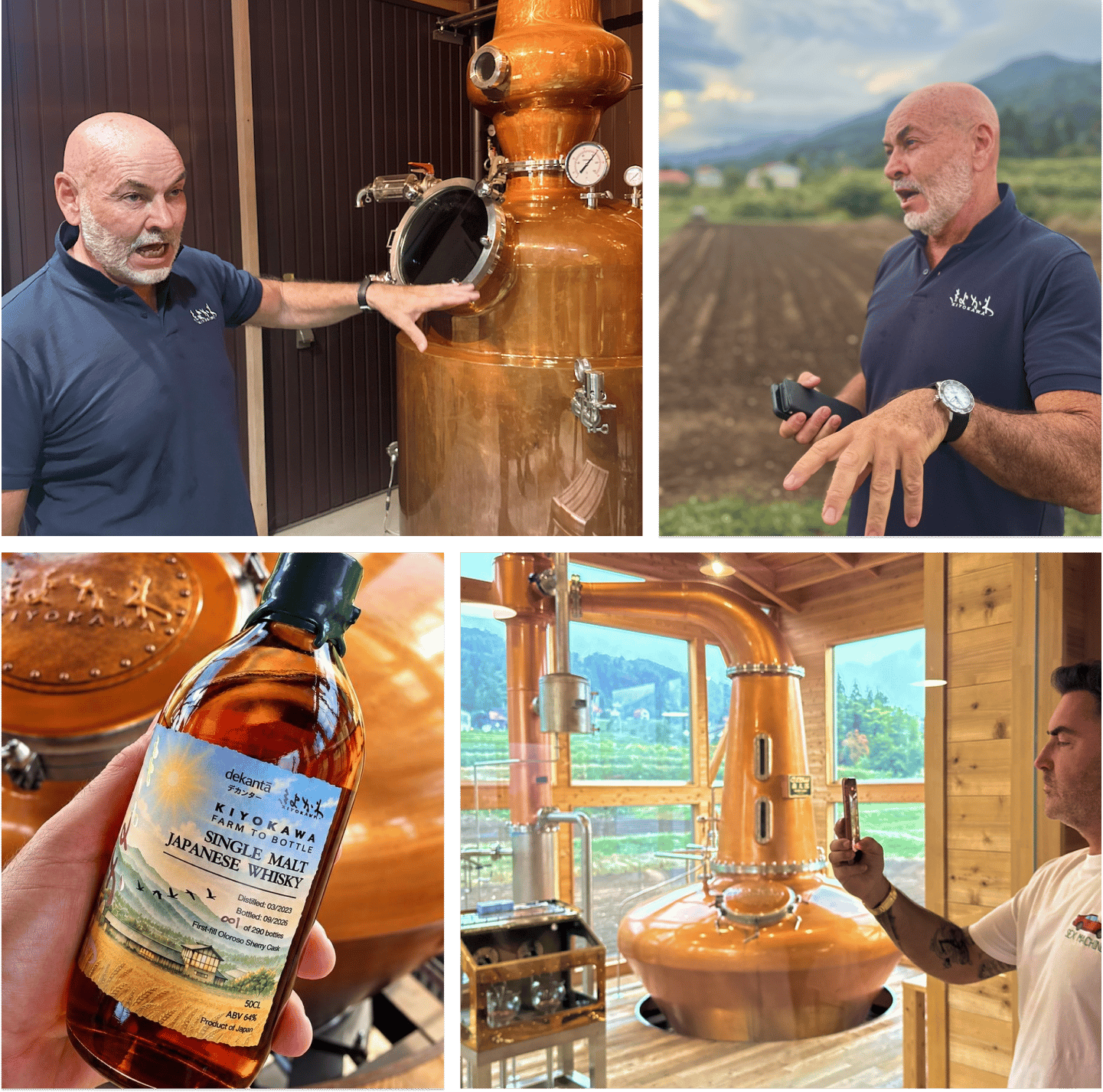
Clockwise from top left: David Troiano walks us through Kiyokawa’s Italian-made copper still | Out in the barley fields David grows himself | The still house, with the mountains of Iiyama behind it | Wyatt owns bottle No. 1 of 290: the very first release from Whisky I, a single malt aged in a first-fill oloroso sherry cask and bottled at 64%
Our friend Ronan Cullen of dekantā, the world's largest online platform for Japanese whisky, hosted our cask tasting to celebrate a milestone: the very first bottled release from Whisky I, the cask SPV we built with dekantā.
Whisky I holds 11 casks from Kiyokawa, Hanyu, Ontake and Karuizawa. Older casks close to maturity get bottled first, while younger ones keep aging, with releases spread over five years.
We raised a glass to bottle number one as we listened to the relaxing sounds of the koto, a traditional instrument that's slowly disappearing from Japanese life.
The first bottle is launching publicly in the coming days, and Altea members get preferred pricing.
We’re also working on Whisky II, our next Japanese whisky deal for accredited investors. ETA early 2027. Stay tuned.
Adventure capitalism at its best ⛩️
Trips like this are a huge part of why we built Altea.
We don't source random deals from strangers and hope for the best. We travel far and wide, sit across the table from real operators, and see everything our own eyes.
There’s no substitute for being in the room. Trips like this one are where good ideas turn into real deals, and where the real diligence happens.
A huge thanks to everyone who joined:
…and to the people who made this special trip happen:
@Hayato Takahashi , our guide, translator and friend, who planned Bonsai Day down to the last scroll (and brought souvenir sweets from a 300-year-old company on night one).
Yasufumi Jin (Jin-san), director of Shunkaen, whose translation, planning and support made Bonsai Day possible.
@Christine Mayol and the team at Japan Travel, who handled every bus, train and booking behind the scenes.
@Jamie Halse and @Toby Umezaki of Senjin Capital, and @Terrie Lloyd of Akiya 2.0, for a phenomenal Monday morning.
Master Kunio Kobayashi and the team at Shunkaen, for the unforgettable tour and tea ceremony.
David Troiano and the Kiyokawa team, and @Ronan Cullen of dekantā, for the cask tasting.
The six founders who pitched us over breakfast, including @Moana Kitamura and @Katsutake Jimmy Ishii
@Sota Nakajima and Go Izumida, for the beautiful photography.
---
That's it for today.
Until next time, Stefan
Disclosures
This issue was written and edited by Stefan von Imhof
Alt Assets, Inc has no current holdings in any companies mentioned in this issue. We are planning Japan I: An SPV investing in Senjin Capital's fund
We are exploring creating an SPV with Terrie Lloyd and Akiya 2.0 in early 2027.
I am personally thinking of buying a bonsai tree through Azukari.
This issue contains no affiliate links. We don't get a dime if you buy a bonsai tree, a sumo suit, or a ticket to Japan.